Swiss campaign attacks motorway fee hike and ‘cheap’ tourist vignette

Campaigners have quickly amassed support to defeat the proposed 150% hike in the cost of Switzerland’s annual motorway charge. They are also against the cheaper short stay tourist vignette.

.

 2013 Swiss motorway vignette, available to buy at the border for 40CHF (£28) or €33. Valid from December of the year previous to end of January the year after. Annoyingly has special adhesive on reverse which means it cannot be taken off and reused. That’s the Austrian vignette underneath; we have almost a whole windscreen full now..

A close-up of the 2013 Swiss motorway vignette, available to buy at the border for 40CHF (£28) or €33 (you can pay in Euros). Valid from December of the year previous to end of January the year after. Annoyingly has special adhesive on reverse which means it cannot be taken off and reused.

With 32 days remaining, campaigners against the 150% hike in the cost of Switzerland’s motorway vignette have already far surpassed the 50,000 signatures they need to force a national referendum on the issue.

The Swiss system of direct democracy allows citizens the final say on any legislation if they can marshall enough support via petition within three months.

By the end of May over 70,000 signatures had been collected. The petition closes on 13 July 2013.

Both houses of the Swiss parliament approved the hike to 100CHF per year (£70) in March after long running opposition from the lower house was overcome. The annual vignette currently costs 40CHF.

Campaigners are also against the proposed 40CHF two month vignette for tourists on the basis that Swiss citizens using motorways rarely will have to pay the full amount while tourists paying the reduced fee will almost certainly use the national network.

If the referendum is granted, as looks certain, the initiative against the fee hike will have to win a majority of citizens voting, and a majority of the cantons (or districts) voting too, the so-called double majority.

See our previous report here. Read the news report on thelocal.ch here.

Meanwhile, the right wing ‘Autopartei’ (aka Freedom Party of Switzerland) is attempting a comeback on a platform of higher speed limits, ringfenced motoring taxes and an expanded motorway network. The party previously achieved some electoral success in the 1990s. However, infighting later saw members transfer en-bloc to the more moderate Swiss People’s Party which adopted much of AP’s manifesto on immigration, law and order, regulation, the EU, etc.

.

Daily Brief 11 June 2013

Last update 21:45

.

in brief: an RAC report says UK motorists think motorway tolls and congestion charges are inevitable – new Apple iOS for cars revealed – street protests in Istanbul and Sarajevo – UK EU law review – French transport strikes – Foreign Office ‘Driving Abroad’ widget

.

TRAVEL/WEATHER:

Meteoalarm weather alerts – red flood warning west Czech Republic. Amber warning for rain/storm in south Germany, extreme west and east of Austria, south Serbia, north and west Bulgaria and Greece.

The flooding in central/east Europe continues. For the latest see @KGeorgievaEU: as at 15:00GMT – Hungary Gravity #floods now shifting downstream from Budapest.  Мonitoring focusing on Domborim & Paksasf. Peak expected in Baja & Mohacs. #CzechRepublic Situation stabilized unless rains. Water levels expctd to or decreasing in all regions, incl Middle-Bohemia & Prague. #Austria Cleanup efforts still on in #floods areas w/ focus on Lower Austria Danube. Now also landslides risk due 2 expected heavy rainfalls.

Weather – rain showers in Central Europe/Alps and central Italy. Fine otherwise, especially Spain & Portugal. Cool in the north/ Scandinavia.

45 min delay 23:00 Calais-Dover DFDS for operational reasons. No ferry/train operators currently reporting any delays.

Port of Dover tweeted this afternoon, ‘Here in Dover sea conditions in the Channel are slight with a South Easterly breeze, force 3 and the visibility is moderate’.

@CF_travel_news, Condor Ferries’ twitter account, reports, ‘The current forecast indicates slight sea conditions, which will moderate towards the end of the week.’

.

NOTES:

Istanbul – police have re-occupied the disputed Taksim Square in the city, scene of rioting over the past weeks. See the latest from the BBC. The latest FCO advice is for ‘all British nationals to avoid demonstrations’.

France – three day strikes by airport and rail workers are expected to lead to a ‘week of travel chaos’.

.

NEWS/PHOTOS:

.

Driving in Europe – the Foreign Office has launched a new widget for quickly reviewing driving and travel advice around the world, obviously including Europe. Click here or see fcowidget.com

.

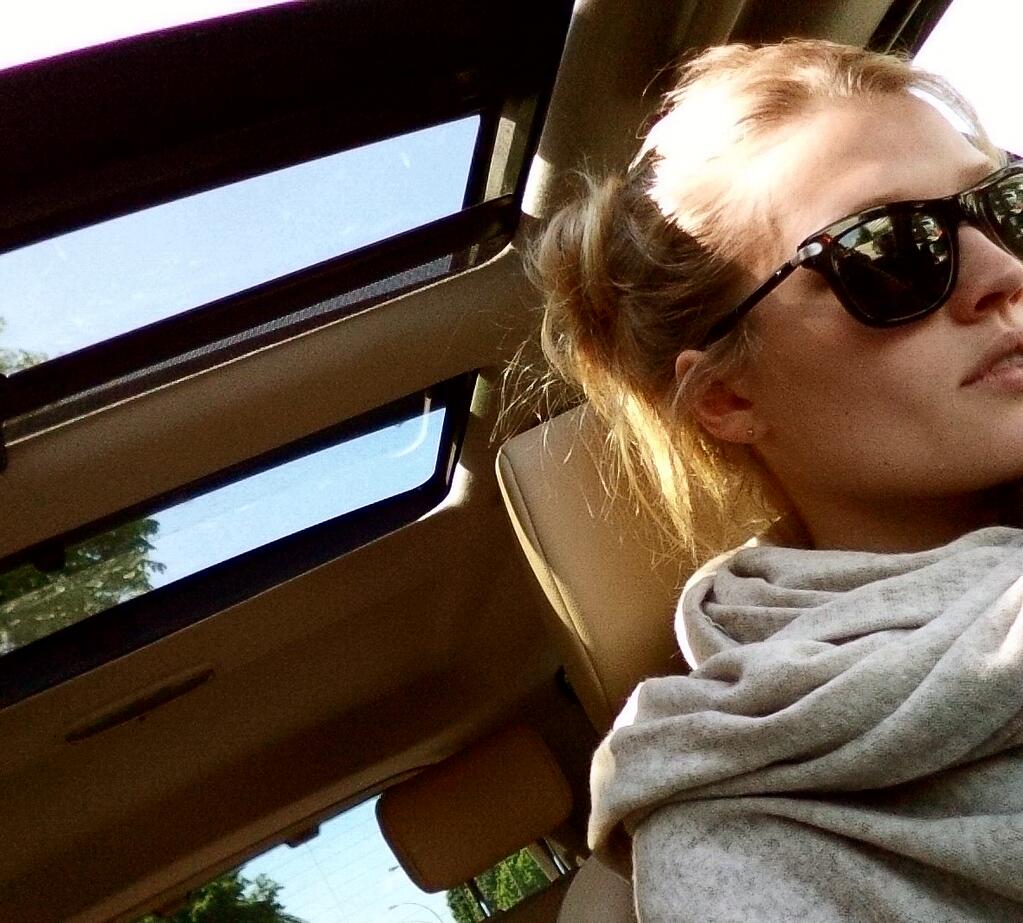
German supermodel - and new girlfriend of film star Leonardo di Caprio - Toni Garrn managed a few hours in sunny Hamburg and her, sadly otherwise under-utilised, Land Rover Freelander 2 last week. © Toni Garrn/ Twitter @RealToniGarrn.

German supermodel – and new girlfriend of film star Leonardo di Caprio – Toni Garrn managed a few hours in sunny Hamburg and her, sadly otherwise under-utilised, Land Rover Freelander 2 last week. © Toni Garrn/ Twitter @RealToniGarrn.

.

UK – The Daily Telegraph reports an RAC survey which says over half of UK motorists think congestion charging and motorway tolls are inevitable. 29% backed motorway tolls. A third back congestion charges in cities. Download the 2013 RAC Report on Motoring here.

The Department for Transport is calling for evidence in its ‘Balance of Competences’ review of EU. If you have experience of the impact of regulation/legislation emanating from Brussels in the transport field – good or bad – then click here to fill in the consultation.

.

Technology – US tech giant Apple revealed a new operating system to enable its devices to be used in cars at its World Wide Developers’ Conference yesterday. A long list of manufacturers have been signed up to start using the system next year.

.

France – police investigating the Lake Annecy murders are now reportedly trying to trace mysterious phone calls made to Romania on the theory that whoever masterminded the attack was trying to arrange a ‘budget assassin’.

.

Sarajevo protests

Sarajevo - taxi drivers have joined protestors in an enduring, well attended but so far peaceful demonstration against the govt’s inability to issue identity documents to babies. The protest started last Wednesday. The situation is emblematic of the political deadlock inside the country, organised strictly along ethnic lines. Photo: © Twitter/ @andymcguffie, EU spokesman for Bosnia and Herzegovina.

Sarajevo – taxi drivers have joined protestors in an enduring, well attended but so far peaceful demonstration against the govt’s inability to issue identity documents to babies. The protest started last Wednesday. The situation is emblematic of the political deadlock inside the country, organised strictly along ethnic lines. Photo: © Twitter/ @andymcguffie, EU spokesman for Bosnia and Herzegovina.

.

Spain – a stowaway has been found clinging to the engine on a cross-Gibraltar Strait ferry, inches away from the propellers reports Olive Press.

.

Brussels parking fine: denouement

As French authorities look for a company to collect speeding fines from foreign motorists we heartily recommend Euro Parking Collection PLC.

.

1424a

There is nobody to blame except for ourselves. Not just for unwittingly falling foul of Brussels’ parking regulations but for writing about it on this website.

A few days after our article last month How will UKIP councils tackle unpaid foreign traffic fines? – which mentioned how we were ticketed in the Belgian capital but didn’t know how to pay the fine – a letter from Euro Parking Collection dropped through DriveEurope’s front door.

Euro Parking Collection (EPC), based in London, are contracted on behalf of many individual European local authorities to collect traffic infringement fines on their behalf.

EPC’s clients include municipalities in Hungary, Norway, Spain, Denmark, Ireland, Sweden, the Netherlands – Belgium of course – and our own much loved Transport for London.

Despite a deeply ingrained corporate culture of respect, fairness and responsibility, DriveEurope couldn’t help but feel aggrieved that EPC – which prides itself on its ‘international coverage assisting local authorities in 10 European countries and employing a multilingual, multinational staff’ – apparently only managed to track us down thanks to the efficiency of Google Alerts.

Not sure how officials at the ‘Administration Communale d’Etterbeek’ in Brussels feel about that*, or that it took EPC a few days short of five months to find us.

Whatever, we have now paid the £31.12 due. No doubt the company shareholders are delighted to have their margins slashed and admin costs swollen by the registered letter we received assuring us that the matter was now closed.

As the French authorities cast around for a suitable company to facilitate the speeding fines they are now authorised to collect from foreign motorists we wholeheartedly point them in the direction of Euro Parking Collection. (The articles we have seen on the subject say UK motorists will not be liable for speed camera detected offences in France as our govt is not a signatory to the relevant treaty – parking is a civil offence, speeding criminal – but don’t bet on it. We will keep you posted).

* probably not much: the Brussels’ authorities are themselves happy to rely on Google Translate for the English version of the city’s incomprehensible parking regulations. Also, drivers should note that Brussels’ parking zones are only marked on their boundaries, and that ticket machines and parking information is not available on every street.

Daily Brief 10 June 2013

Daily newslog. Last update 14:30

.

In brief: DFDS flash sale Dover-Dunkirk – A1 Bologna-Florence widening scheme – roadside blood tests Finland – French police expand mobile speed camera car scheme – tolls set for Danube 2 bridge

.

TRAVEL/WEATHER:

Weather alerts – the highest level flood warning for the west Czech Republic is still in place with severe warnings for southern Germany and west Austria. For the latest on the flooding affecting central/east Europe see the EU’s Crisis Response page: ‘the situation is improving slowly but remains critical’. Thousands of people were evacuated from Magdeburg in eastern Germany yesterday; flooding is also affecting parts of central SwitzerlandWarsaw, PolandCroatia and Serbia.

Weather – heavy rain showers in central Italy also affecting Switzerland, Austria and Hungary. Cloudy but fine otherwise.

Crossing the Channelthe 16:30 MyFerryLink sailing from Calais has been delayed by an hour due to a technical problem. No operators currently reporting any delays.

@Port_of_Dover reported at 15:30: ‘Here in Dover sea conditions in the Channel are slight with a North Easterly breeze, force 3 and the visibility is good.’

@CF_travel_news, Condor Ferries’ twitter account, reports, ‘The current forecast indicates slight sea conditions, which will moderate towards the end of the week.’

.

NOTES:

@Burger_Ferry reports that, ‘Mont Blanctunnel between #France and #Italy closes today from 22.00-06.00hrs due to maintenance work.’

.

NEWS & PHOTOS:

.

DFDS – a flash sale today and tomorrow by the Dover-Dunkirk operator sees drivers save 20% on all sailings until 18 December: a car and up to four passengers could pay as little as £28 each way. Valid for cars and motorbikes, Dover-Dunkirk only.

.

EU – the Commission’s proposal to beef up the roadside inspection regime of commercial vehicles has been watered down after today’s meeting of the Transport Council: LCVs under 3.5t will not be included; it’s a directive not a regulation; no annual quotas/targets; cargo securing checks not compulsory; and seven years to introduce risk-based inspections. See the meeting’s minutes here. Simplified pet movement rules have also been approved.

.

Finland – needlephobics look away now. Twenty of Finland’s 7,500 police officers are qualified to take blood from drivers suspected of drink/drugs offences. Under very specific circumstances, and only where the officer concerned has previously worked as a healthcare professional, drivers suspected to be under the influence can be asked to provide a blood sample by the roadside according to the TISPOL newsletter (see page 9). ‘I hope this piece of information is useful to other colleagues in Europe when considering how to intensify police efforts in the fight against drink driving on the roads of Europe,’ says the Finnish TISPOL rep. Question: how can they ensure hygiene?

.

Major upgrade to A1 Bologna-Florence by 2014

35zz

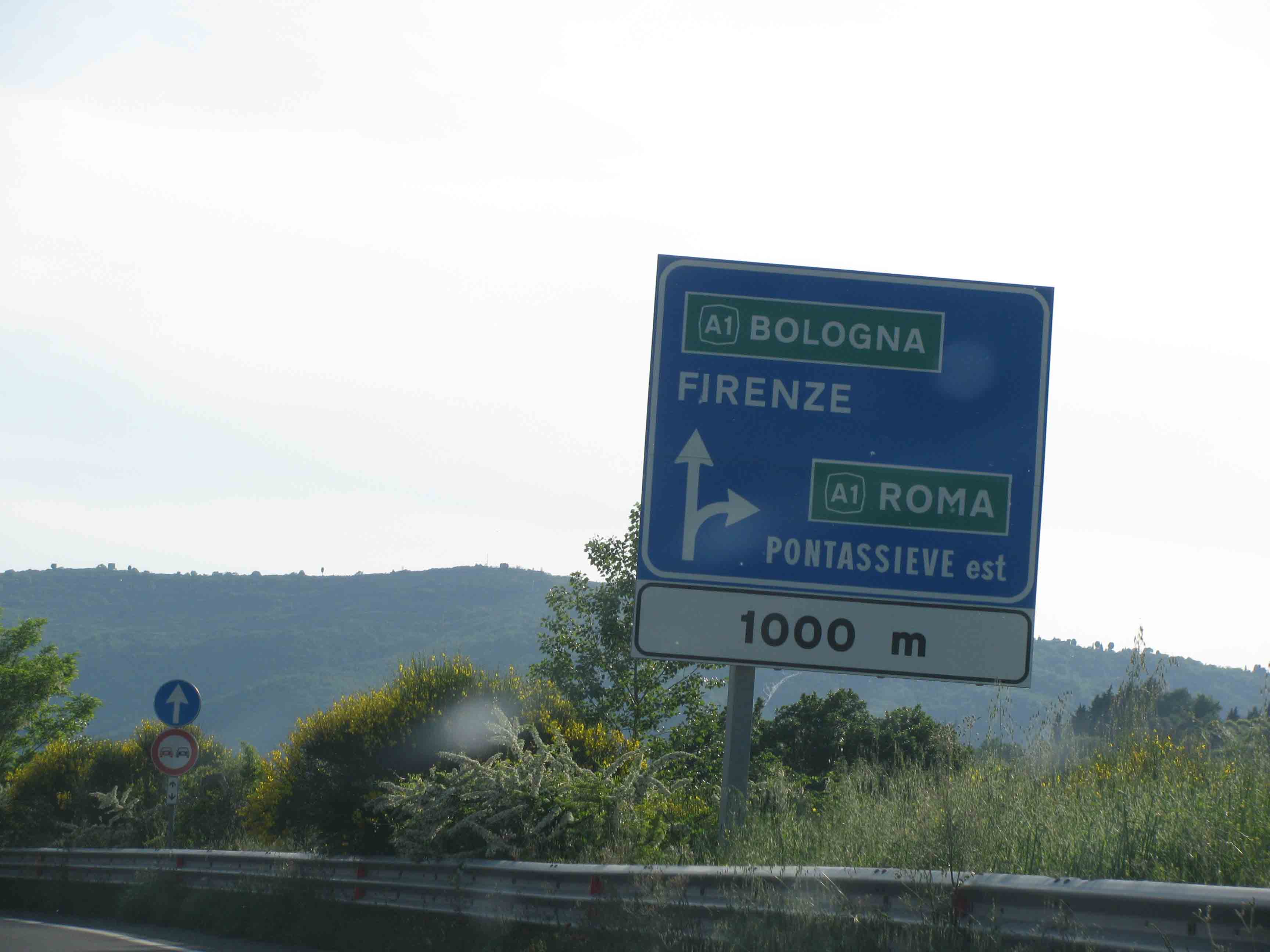
Italy – news on Friday that a new motorway was to open between Bologna and Florence in 2014 raised eyebrows because it’s not clear where it would go. The existing A1 ‘spinal motorway’ already runs direct for the 70 miles between the two, with the legendary Futa and Raticosa mountain passes running parallel to the east. The reports following the ‘Republic of Ideas’ event in Florence were it seems lost in translation. In fact an extra lane is planned for the A1 on this stretch and will indeed open in 2014. It does though represent a new phase in Italian motorway development titled ‘wider but not longer’. Giovanni Castellucci, CEO of concessionaire Autostrade per l’Italia (the largest in the country, and one of the biggest in Europe), was also keen to point out his company’s tolls were also the cheapest in Europe.

.

France – In two months of operation new mobile police speed camera cars have caught 10,000 speeding motorists according to official figures. The new scheme is said to have already contributed to a fall of 27% in road deaths in March 2013 compared to the year previously, and 15.4% in April 2013. In addition to the 26 units already deployed, another 20 will be operational this month. By 2016, 300 units will be in action at a rate of 100 new ones per year. Keep up-to-date with coverage of the camera cars here. Tip: when driving on French motorways, if you see an unmarked Renault Megane driving precisely at the limit with two burly heffers in the front seat, slow down.

Paris Grand Palais, awe-inspiringly huge exhibition space, is remade as a temporary drive-in movie theatre this week though film go-ers will not be able to bring their own cars. The vast space alongside the Champs Elysee will house Fiat 500 convertibles for seats as well as a host of other Americana to help buffs get in the mood. Click for more.

.

Bulgaria/Romania – tolls for the Danube 2 bridge, set to open on Friday, have been set at €6 each way for cars. Vehicles between 3.5-7.5t will be charged €12. Up to 12t the fee is €18. Triaxle trucks and buses over 23 seats pay €25 while four axle lorries pay the maximum €37.

.

Navigation – Google has reportedly offered $1.3bn for the crowd sourced navigation/traffic app Waze, topping a $1bn offer from Facebook. The Israel-based company apparently has 47m subscribers worldwide, all updating maps and traffic conditions in real time.

.

Touring with the family – Marking the 200th anniversary of the publication of the stories of the Brothers Grimm, Daily Telegraph writer Judith Woods takes her family on a magical journey along Germany’s Fairy Tale Route.

.

Cruise Control changed our lives. But how fast can you go?

Discovering Cruise Control on the 1,300 mile drive back from Romania settles a long running argument about distance driving. But how fast can you go before putting yourself at risk of a speeding fine?

Click for the route.

The usual mash up between an old map, out of date satnav and not really paying full attention sees us drive most of the xx miles between Timisoara and Arad by back roads when they’ve just opened a new motorway.

The usual mash up between an old map, out of date satnav and not paying attention sees us drive most of the 45 miles between Timisoara and Arad, Romania, by back roads when they’ve just opened a motorway.

No booze the night before, no carbs for breakfast (or coffee, it makes you wee), open the windows, gag the kids, stereo on full blast, and keep a pin handy to jab yourself in the eye when you feel sleepy.

The list of advice on tackling a long distance journey is long and literally torturous. But nobody describes the sheer sense of achievement to be had from successfully transporting yourself across a continent.

We were headed for the Nadlac border point, the ‘gateway to Western Europe’, but a hand written sign to Budapest sees us divert to the sleepy Turnu crossing instead. Advantage: no queues. Disadvantage: nowhere to buy the vignette you need for driving on Hungary’s motorways. Result: a gentle drive through the countryside. Did you know 49.5% of Hungary is arable farming land, one of the highest proportions in the world?

We were headed for the Nadlac/Battonya border point, the ‘gateway to Western Europe’, but a hand written sign to Budapest sees us divert to the sleepy Turnu crossing instead. Advantage: no queues. Disadvantage: nowhere to buy the vignette you need for driving on Hungary’s motorways. Result: a drive through the countryside. Did you know 49.5% of Hungary is arable farming land, one of the highest proportions in the world?

Flying a plane is not commonly thought to be boring, even from halfway across the world. So why is tackling much shorter distances in a modern vehicle – likely loaded with features to make the journey comfortable, safe and fast – considered the seventh circle of hell?

A diversion through an interesting sounding town or city is a much better break than a stop in a depressing and expensive motorway service station. This is Szeged in the far south, on the Tisza river, Hungary’s third biggest city, pop 170k. Twinned with Cambridge, Szeged is home to the country’s top university, established in 1581.

A diversion through an interesting sounding town or city is a much better break than a stop in a depressing and expensive motorway service station. This is Szeged in the far south of Hungary, on the Tisza river, the third biggest city, pop 170k. Twinned with Cambridge, Szeged is home to the country’s top university, established in 1581.

In our case it was because of a sharp difference in opinion on how to tackle mega drives. One view came direct from the Sebastian Vettel school – as fast as possible in all situations – relying on lightning reflexes to keep out of trouble and hefty doses of aggression to bully other cars out of the way.

A fearsome 600 mile drive from Bratislava to deepest western Germany in 2012, torrential rain all the way, showed that the sheer determination intrinsic to this approach makes it highly effective.

Stopping to buy vignettes has effectively replaced border controls to the point there’s no net benefit these days to the Schengen Area on transcontinental journeys. But since in Hunagry, Austria, Slovenia, Switzerland, etc, etc they are available at garages you can double up with a fuel stop to save some time. Once achieved though the smooth and straight Hungarian motorways are uniformly excellent though and brisk too with a 130kmh limit. It’s xxkm to Budapest then xx km west to the Austrian border with only soon to be complete road works on the connecting section to slow us down.

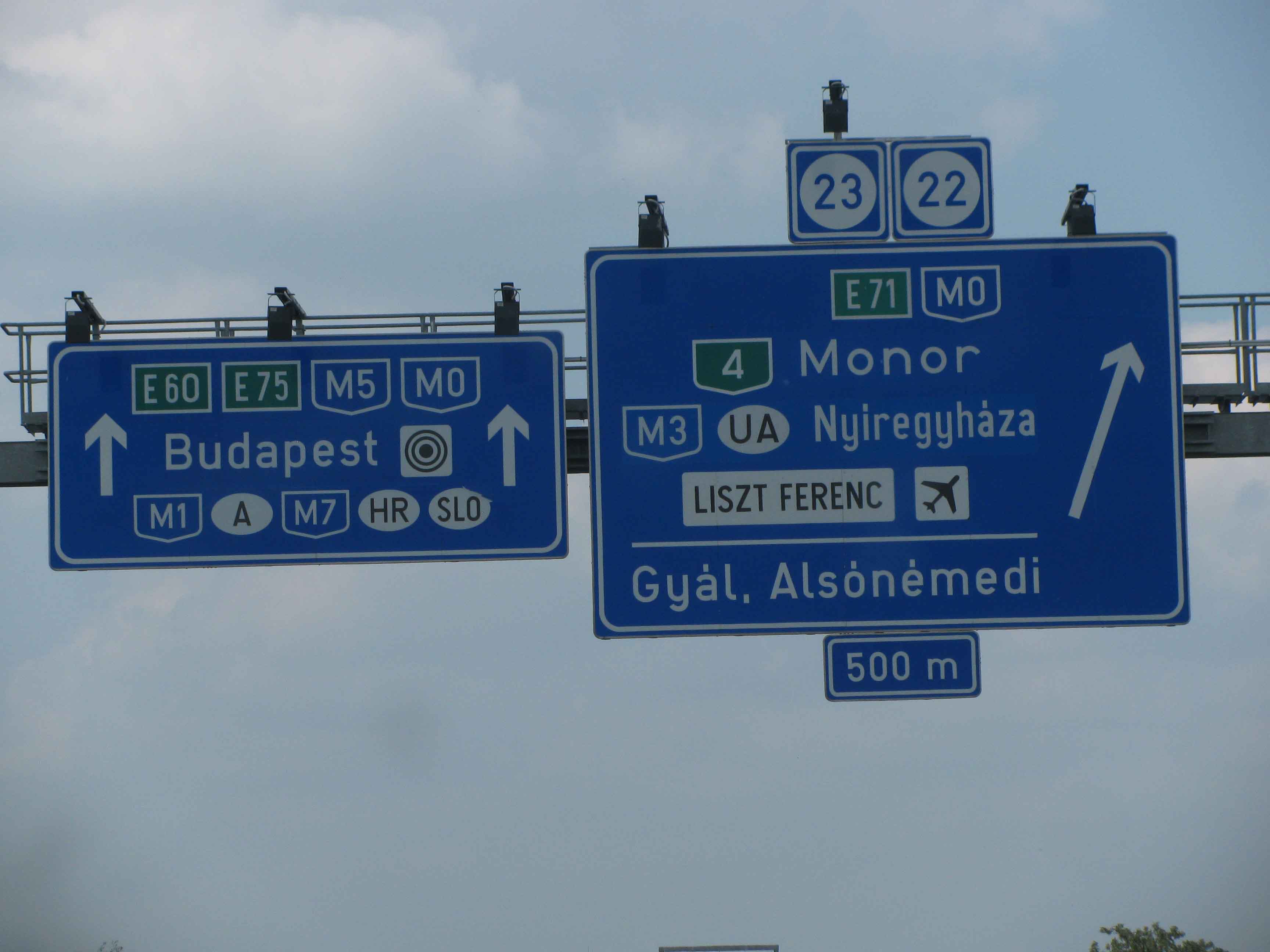
Stopping to buy vignettes has effectively replaced border controls to the point there’s no net benefit these days to the Schengen Area on transcontinental journeys. Since they are available at garages double up with a fuel stop to save time. Once achieved though the smooth and often straight Hungarian motorways are uniformly excellent, with a 130kmh limit. It’s 173 km north to Budapest then 177 km west to the Austrian border with only soon-to-be-complete roadworks on the connecting section to slow us down.

Meanwhile, what we call the Alain Prost approach – the F1 driver who famously never drove faster than he had to – neatly divides the distance to be covered by the time available. This target speed is then rigidly adhered to, calling on all forms of anticipation to avoid harsh acceleration or braking, the enemies of fuel economy.

The 627.5 mile drive between Maastricht and Vienna in 2011 with enough energy left to enjoy the beer afterwards saw a gentle nod of assent from across the table.

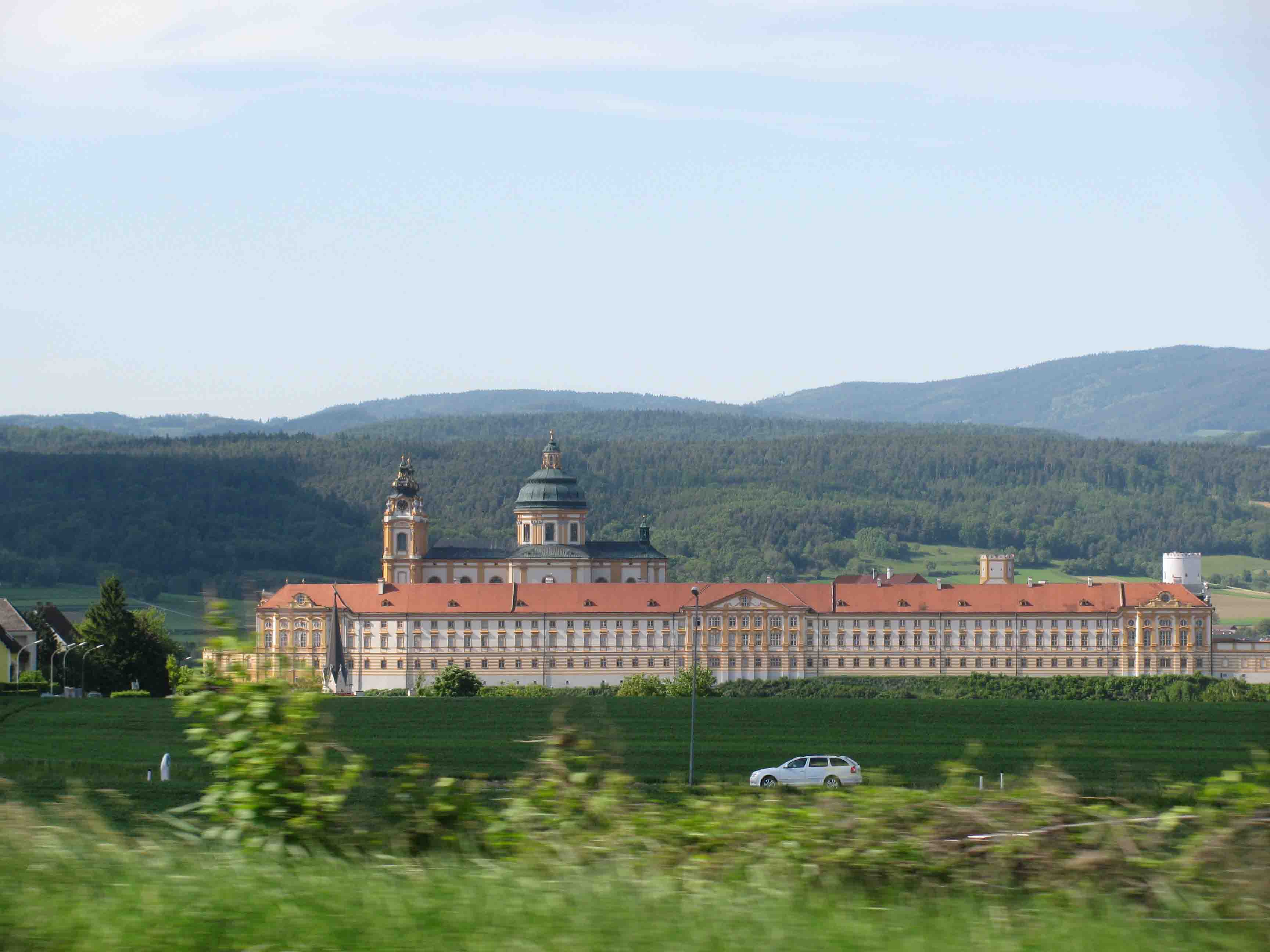
Melk Abbey as seen from the A1 West Autobahn in Austria halfway between Vienna and Salzburg. Built in the early 18th century, with five internal courtyards, the Benedictine monastery overlooks the Danube. Definitely worth a look next time.

Melk Abbey as seen from the A1 West Autobahn in Austria, halfway between Vienna and Salzburg. Built in the early 18th century, with five internal courtyards, the Benedictine monastery overlooks the Danube on the other side. Definitely worth a look next time.

After years of wrangling, ultimately it looked like the Steady Eddie approach would win the day. But boy it was boring. On long trips, being seen to be brisk is important.

The theory might be right, the costs lower and the stress less but maintaining a terminal velocity of eighty odd miles an hour even on derestricted autobahn is beyond ludicrous.

Overnight stop after 448 miles, Lovely Linz. It‘s all in the mix, of old and striking modern architecture in Autria‘s third largest city, straddling the Danube, but also in the way cars, trams and pedestrians are happy to share Hauptplatz in the city centre. Thanks to a ring-round by the Tourist Info we bag virtually the last available hotel room, at the okay Spitz ‘design’ Hotel and, thanks to cruise control, while away a long evening in this spectacular square.

Overnight stop after 448 miles, Lovely Linz. It‘s all in the mix, of old and striking modern architecture in Autria‘s third largest city, straddling the Danube, but also in the way cars, trams and pedestrians are happy to share Hauptplatz in the city centre. Thanks to a ring-round by the Tourist Info we bag virtually the last available hotel room, at the okay Spitz ‘design’ Hotel and, thanks to cruise control, while away a long evening in this wonderful square.

Just in time – only 103 years after its invention – cruise control rides to the rescue. Previously disregarded as one of the host of gimmicky extras loaded on our car, trying it for the first time on this trip from Romania now sees it join xenon headlights and digital speedos on the list of essential extras for driving in Europe*.

No more heel ache from keeping the throttle in a set position. No more approximation. No more steadily and inevitably declining average speed as the day wears on. No more constantly checking the speedo to see if the mandated average speed has been exceeded.. And keen progress through road works, for instance, while other drivers hover below the limit.

Finally, no more achieving only what you set out to do. In these early days at least we’ve gone further, faster than ever before.

Autobahn: the lure of derestricted autobahn entices many but while it’s not strictly true that they are steadily being outlawed a combination of road works, heavy traffic and dual carriageway in many places will slow you down. If it rains it’s max 130kmh.

Autobahn: the lure of derestricted autobahn entices many. While it’s not strictly true that they are steadily being outlawed a combination of road works, heavy traffic and dual carriageway in many places will slow you down. If it rains it’s max 130kmh.

Indicated speed versus actual speed. The argument now rages around the optimal cruising velocity. How fast can you afford to go before putting yourself at risk of a speeding fine?

By UNECE Regulation 39 all speedometers must overestimate. The margin varies by manufacturer but must not exceed 10% plus 4kmh (so a maximum 92kph in a 80kph zone). That’s a significant difference on a long trip.

Then there’s how much over the speed limit law enforcement will allow before they pull you over. Put all that together and an indicated 145kph in a 130kph zone is pushing it, but not too far.

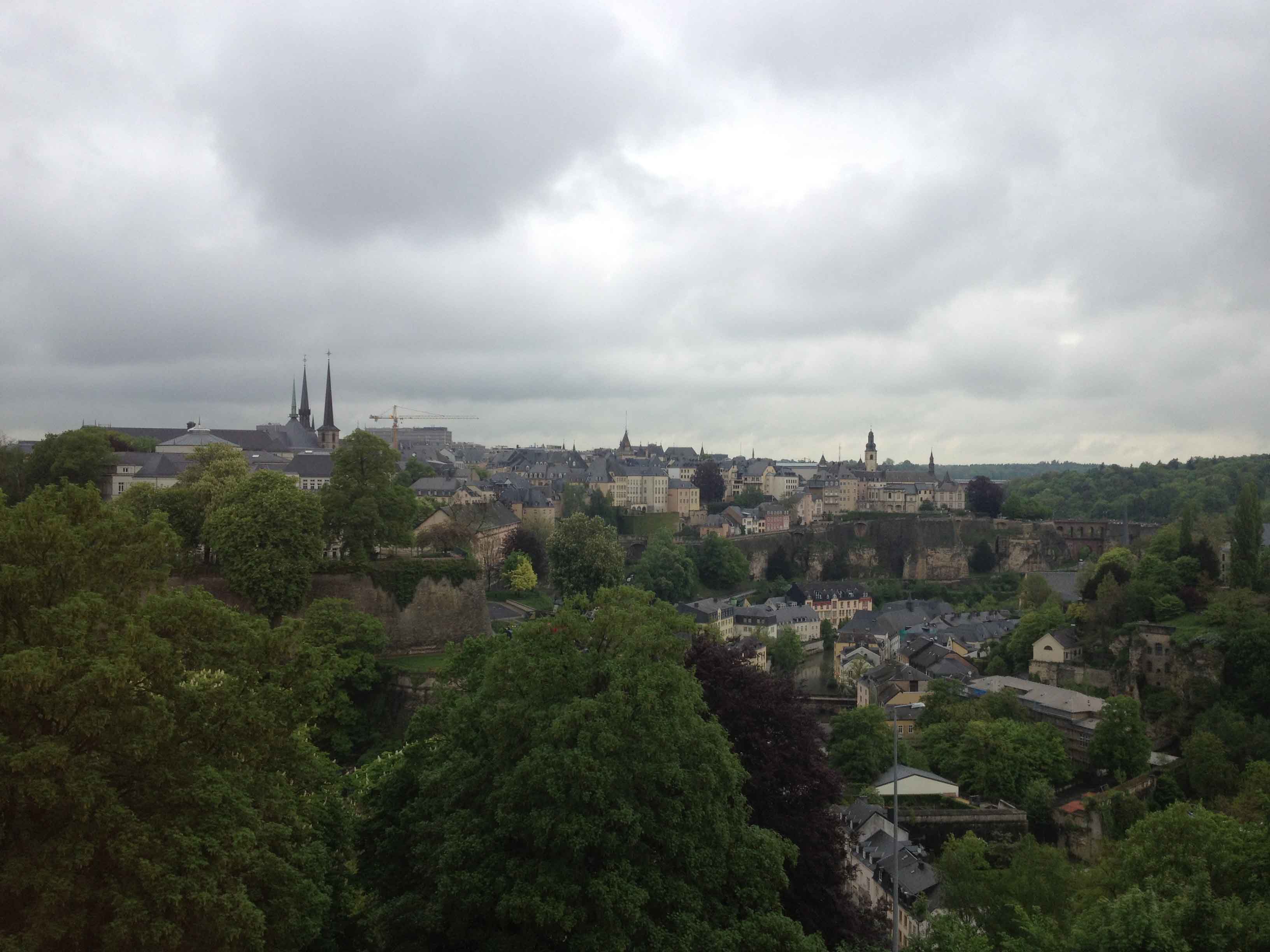
Decadent Luxembourg: having something to look forward to is a great way to perk you up particularly in that middle part of the day when energy flags and motivation slips. Even so we completely overdo it at the Sofitel in Luxembourg. After eight hours and 488 miles by 18:30 we’re in the roof top bar sipping custom designed cocktails, all thoughts of sightseeing abandoned. But hey, what is there to see we can’t make out from up here?

Decadent Luxembourg: having something to look forward to is a great way to perk you up, particularly in that middle part of the day when energy flags and motivation slips. Even so we completely overdo it at the Sofitel in Luxembourg. After eight hours and 488 miles by 18:30 we’re in the roof top bar sipping custom designed cocktails, all thoughts of sightseeing abandoned. But hey, what is there to see we can’t make out from up here?

New fangled smartphone speedometer apps theoretically put all this beyond doubt, but there are a number of issues. First and foremost for these apps to work you need the roaming function switched on. Not a problem in the UK but prohibitively expensive on the Continent.

We’ve used four different ones now – out of the 400 available on iTunes – and to put it politely they’ve all been unreliable. The GPS system they use is not 100% accurate in Europe plus all GPS devices are affected by ‘atmospheric conditions’, i.e. the weather.

We’ll have to wait for the European satnav system Galileo before we can fully put this one to bed. And who knows when that will happen?

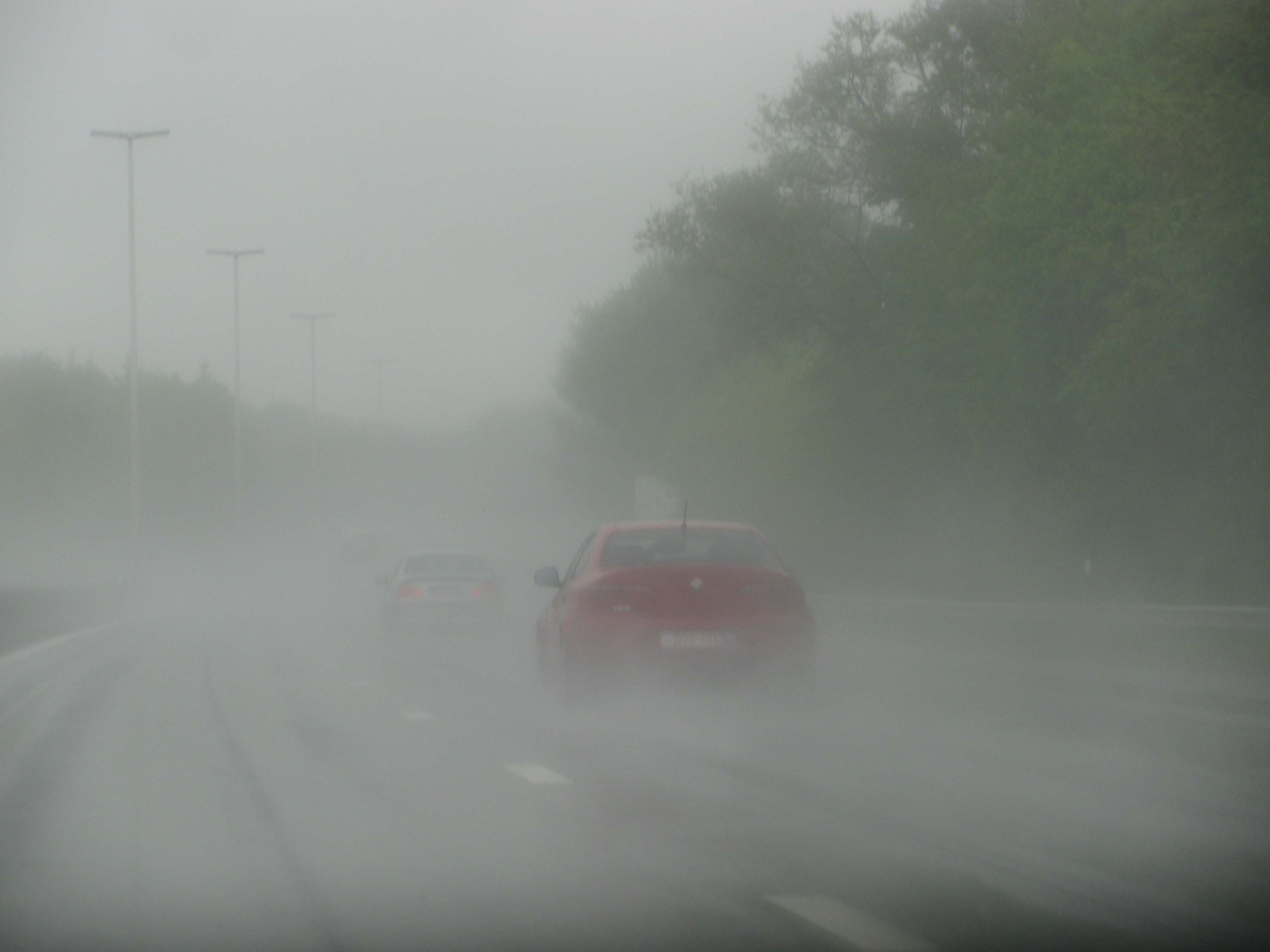
There’s no escaping the torrential rain that has literally ravaged central Europe since early April and continues to do so at the time of writing.

There’s no escaping the torrential rain that has literally ravaged central Europe since early April, and continues to do so.

What do you think? Are we too fast, or too slow? How do you tackle long distance journeys? Have you found a reliable speedometer app? Leave your comments below.

Bittersweet. Bitter because it cost us €105 to cross from Dunkirk to Calais. Sweet because we’ve survived the trip and the atmosphere on-board is always relaxed as we all sail back to our little island.

Bittersweet. Bitter because it cost €105 to cross from Dunkirk to Calais, compared to about £40 in advance. Sweet because we’ve survived the trip, and the atmosphere on-board is always relaxed as we all sail back to our little island.

.

* Xenon headlights can be switched automatically for driving on the other side of the road, so no fiddly headlight stickers, while digital speedos will also read in kmh.

.

Next: all the data from our May 2013 ‘Istanbul or Bust’ trip: how long, how far, driving time – and how much it all cost…

.

Driving through Romania

A string of shameful errors means we miss just about everything we’ve come to see. What we do see however leaves a lasting impression.

Giurgiu – Bucharest – Transfagarasan – Timisoara, 447 miles, 14 hours.

.
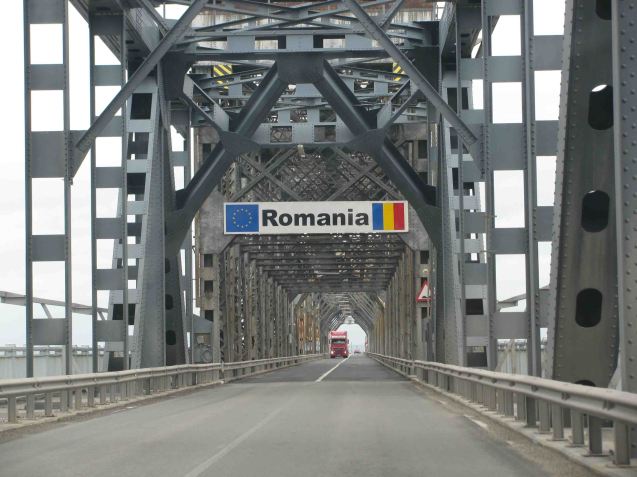
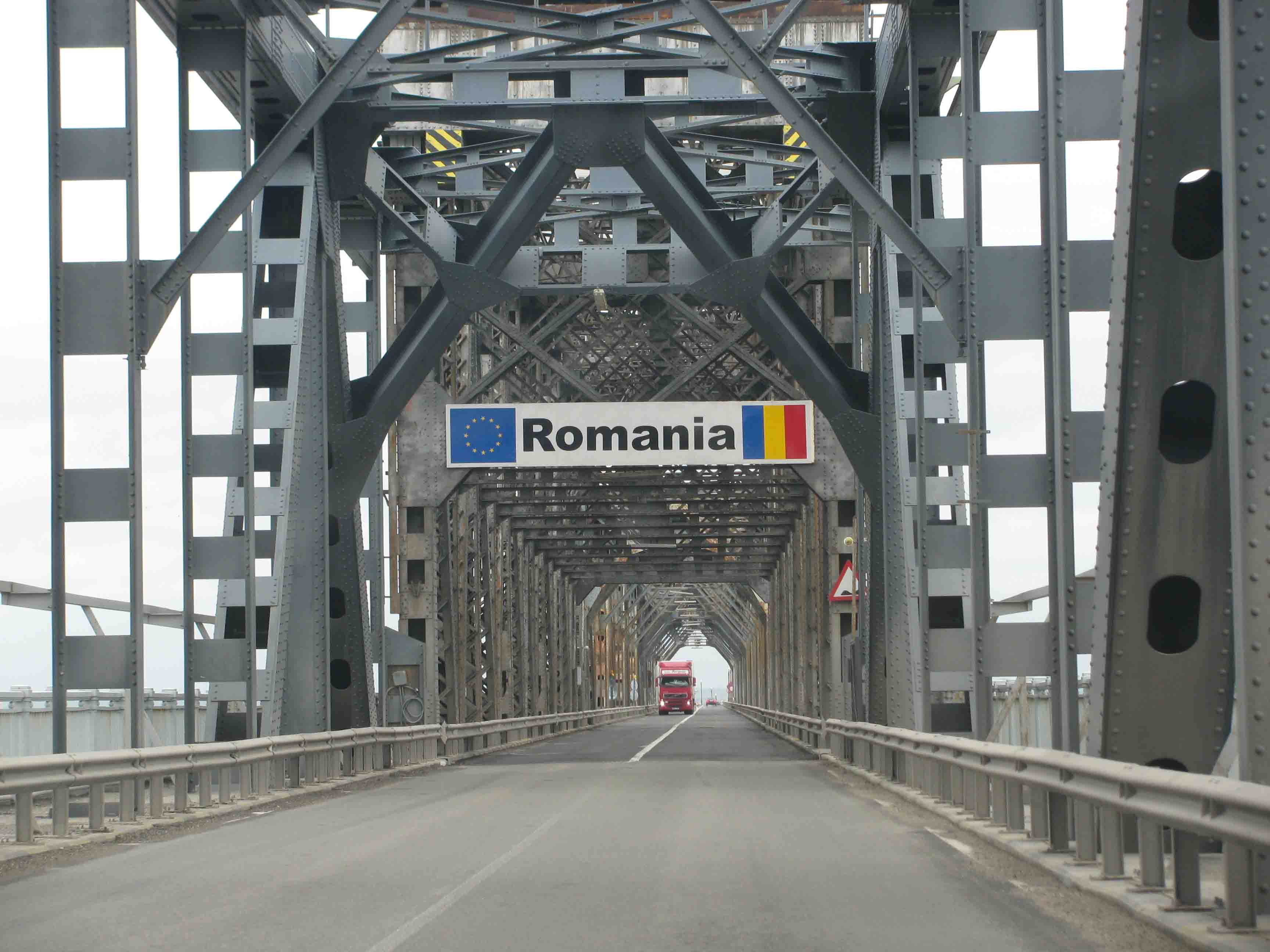
The Giurgiu-Ruse Bridge over the Danube between Bulgaria and Romania.

The Giurgiu-Ruse Bridge over the Danube between Bulgaria and Romania.

.

The woman in the booth has never heard of the United Kingdom, or Great Britain. She needs to know where we’re from so she can fill in the vignette we need to drive on Romanian roads.

England? That she understands. (BTW, GB in Romanian is ‘Marea Britanie’. The vignette is €4 for a week).

Lack of motorways is going to be a major factor today. Romania lags behind even Bulgaria in fast-road building, not least because of the Carpathian Mountains which perform a spectacular left hand turn through the centre of the country.

However, Romania is the home of Jeremy Clarkson’s ‘world’s best road’ Transfagarasan. That’s where we’re headed after a drive through Bucharest. Exactly where we’re going after that we haven’t decided yet.

.
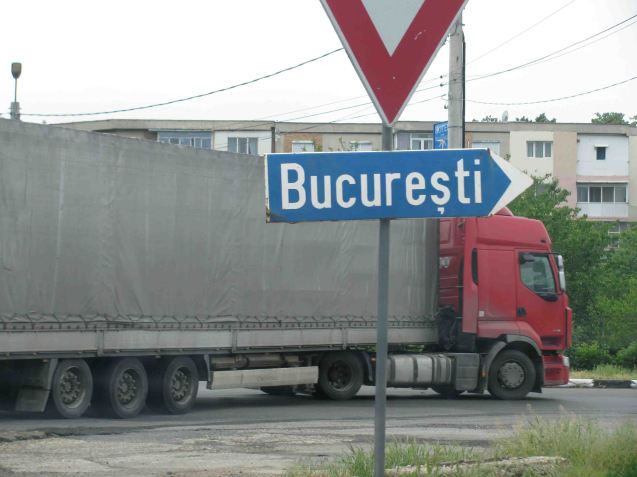
Rigidly keeping to the initial 50kph (31mph) speed limit sees us overtaken by a truck.

Keeping rigidly to the initial 50kph (31mph) speed limit sees us overtaken by a truck.

At todays rate of exchange - £1 is just over five Romanian New Leu (RON) - a litre of diesel will set you back xxp, even cheaper than Greece and Bulgaria.

At today’s exchange rate – £1 is 5.13 Romanian New Leu (RON) – a litre of diesel costs £1.10.
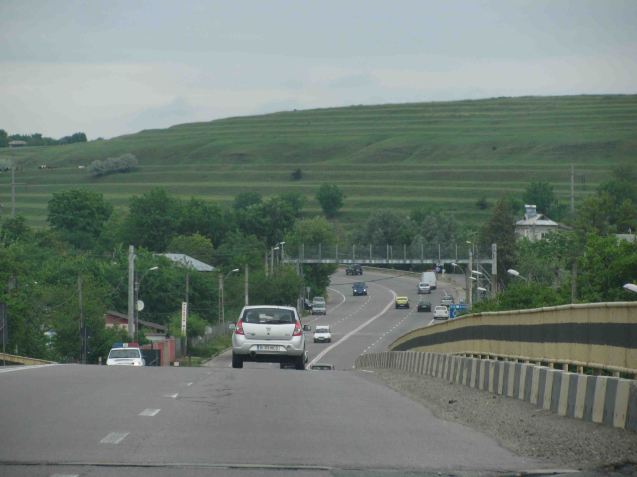
The landscape is rolling at best. We pass through a town called '1 Decembrie', named to commemorate the day in 1918 - the Grand Union - when Transylvania joined Romania and the whole country declared itself independent of the fast disintegrating Austro-Hungarian empire.

The landscape is rolling at best, but with spectacular mountains to look forward to further north.

.

We’ve never heard of a place named after a date before. There’s a town on the 45 mile drive to Bucharest called ’1 Decembrie’, commemorating the day in 1918 when Transylvania broke away from the Austro-Hungarian empire to complete modern day Romania.

.

First sight of Bucharest.

First sight Bucharest.

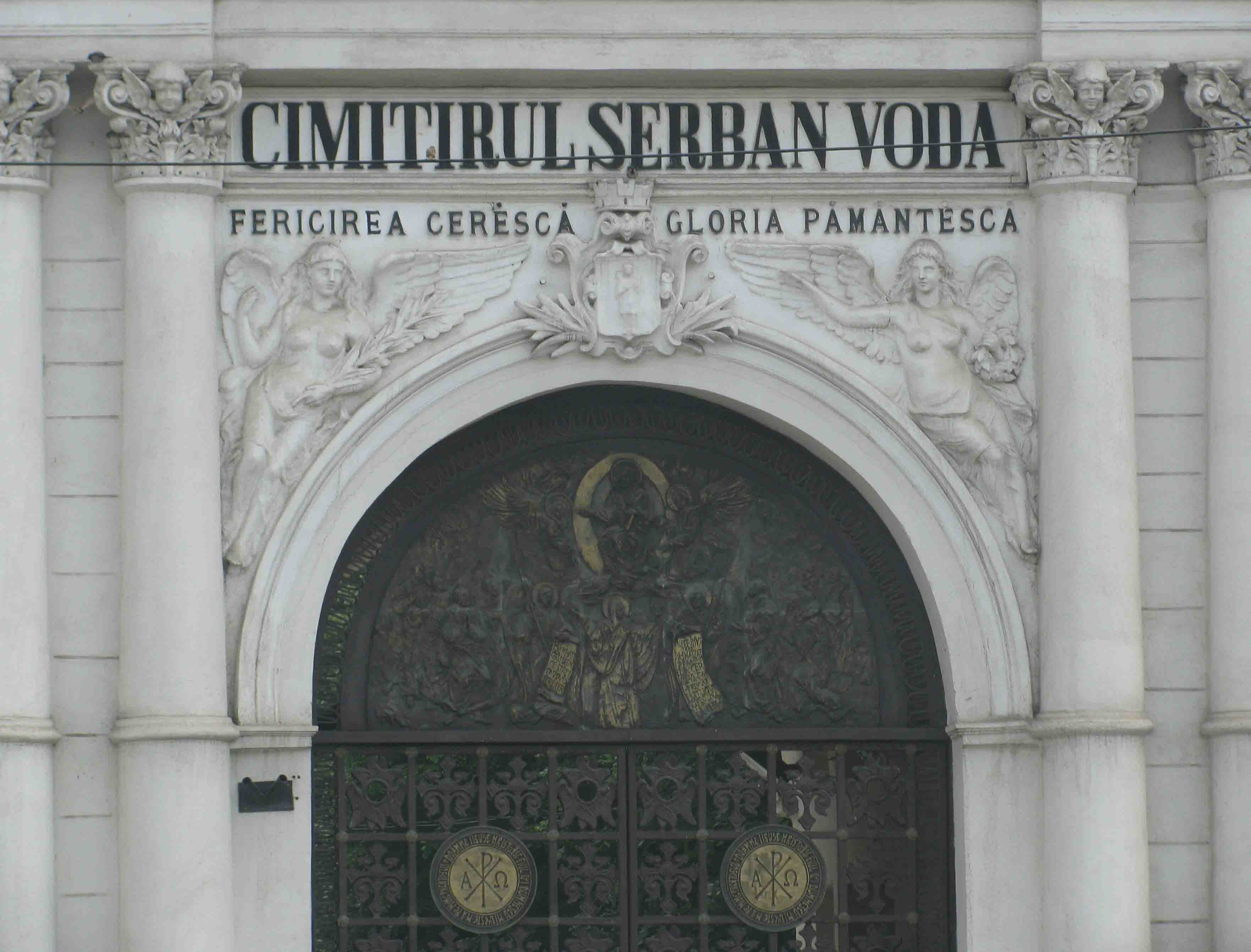
The Bellu Cemetery, Calea Serban Voda (E70/85).

Bellu Cemetery, Calea Serban Voda (E70/85).

.

E70/85, now Calea Serban Voda, makes its final curl into the city centre around Tineretului Park and Bellu Cemetery, the largest and most famous in Romania. The inscription reads ‘Earthly Happiness, Heavenly Glory’.

Many notables are buried here including Ion Diaconescu, the Romanian Nelson Mandela. He spent 17 years in prison from 1947, the first days of the Communist regime, then became a leading political figure after the 1989 revolution. Also, Henri Coanda the pioneering aerodynamicist. Needless to say the former dictator Nicolae Ceausescu is not buried here.

.
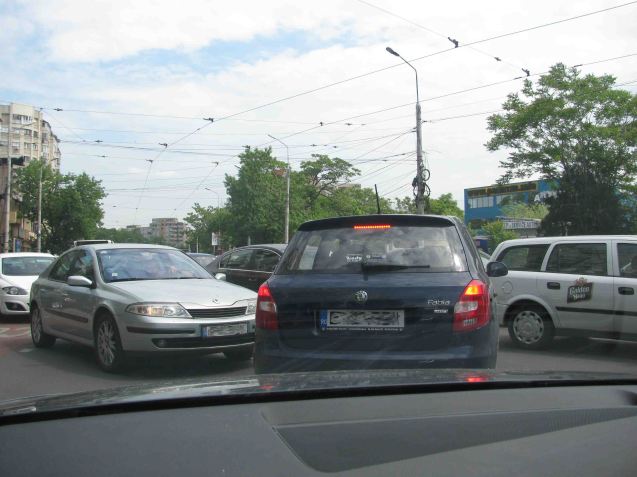
Awkward turn

Mmmmn

.

There’s an awkward moment as we turn off Serban Voda onto Boulevard Dimitrie Cantemir, the main north-south road through the city centre. Faced with three lanes of stationary traffic we just don’t know what to do. The guy behind seems keen so we let him past, sticking to his tail as he forces his way through. The opposing drivers look bored and shuffle out of the way.

This is our only bad experience of the notorious Bucharest traffic. With nearly 1.5m cars for its 1.7m inhabitants, and a population density almost on a par with Thessaloniki, traffic and parking are major issues. This Tuesday lunchtime it’s busy but not gridlocked.

.

Spoken Romanian sounds like any other east European ‘Russian-style’ language. Written down though its Latin roots are obvious. The Spanish and Romanians have a degree of mutual understanding.
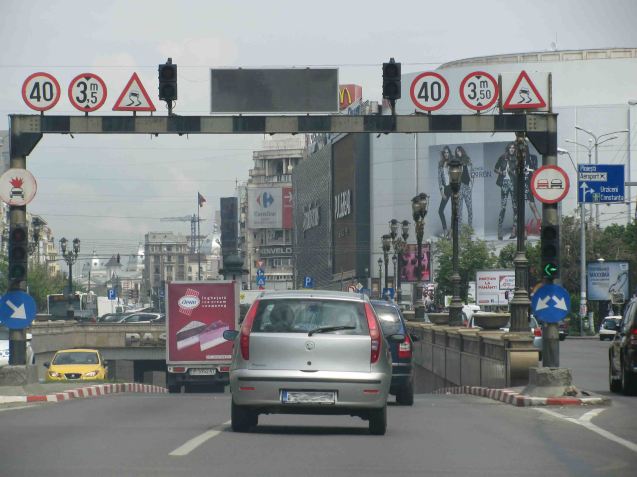
Spoken Romanian sounds like any other east European ‘Russian-style’ language. Written down though its Latin roots are obvious. The Spanish and Romanians have a degree of mutual understanding.

A fateful moment

Pasajul Unirii tunnel, centre of Bucharest

.

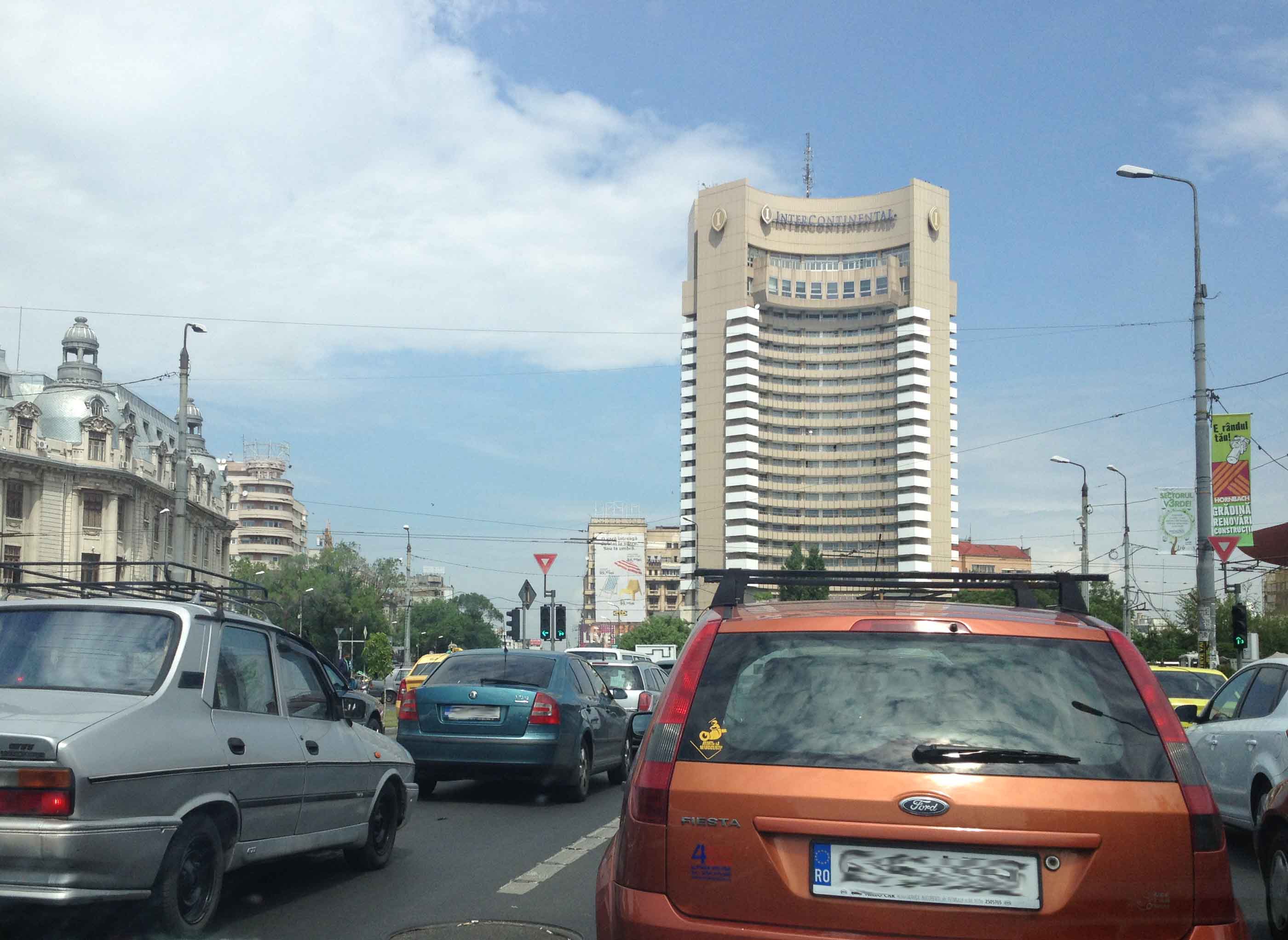
Blame the satnav. If only we’d looked left… Technically we do drive through the centre of Bucharest. ‘Kilometrul 0’ is just a bit further up on the right. But the actual centre of the city is here, the Pasajul Unirii tunnel, where Bvld Dimitrie Cantemir crosses Boulevard Unirii.

Boulevard Unirii is the one that you want. At 1.2 miles long – 1m wider and 6m longer then the Champs Elysee – it has the monumental Palace of the Parliament at its west end. One of the world’s biggest buildings, memorably driven through on Top Gear, it was the centrepiece of Ceausescu’s ‘Centrul Civic’ mass rebuilding programme which saw 20% of the city centre bulldozed.

The severe austerity needed to pay back the debts incurred by Centrul Civic lead to Ceausescu’s downfall. The brutal policy continued despite the money being repaid in early 1989. By mid-December protests were widespread. On Christmas Day 1989, Ceausescu and his wife Elena found themselves facing a firing squad.

.
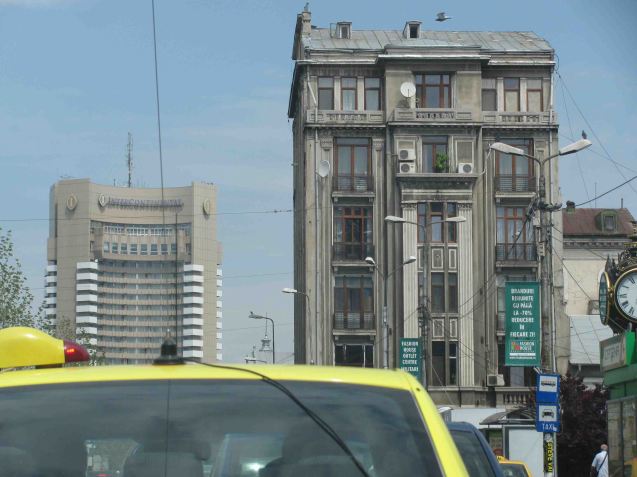
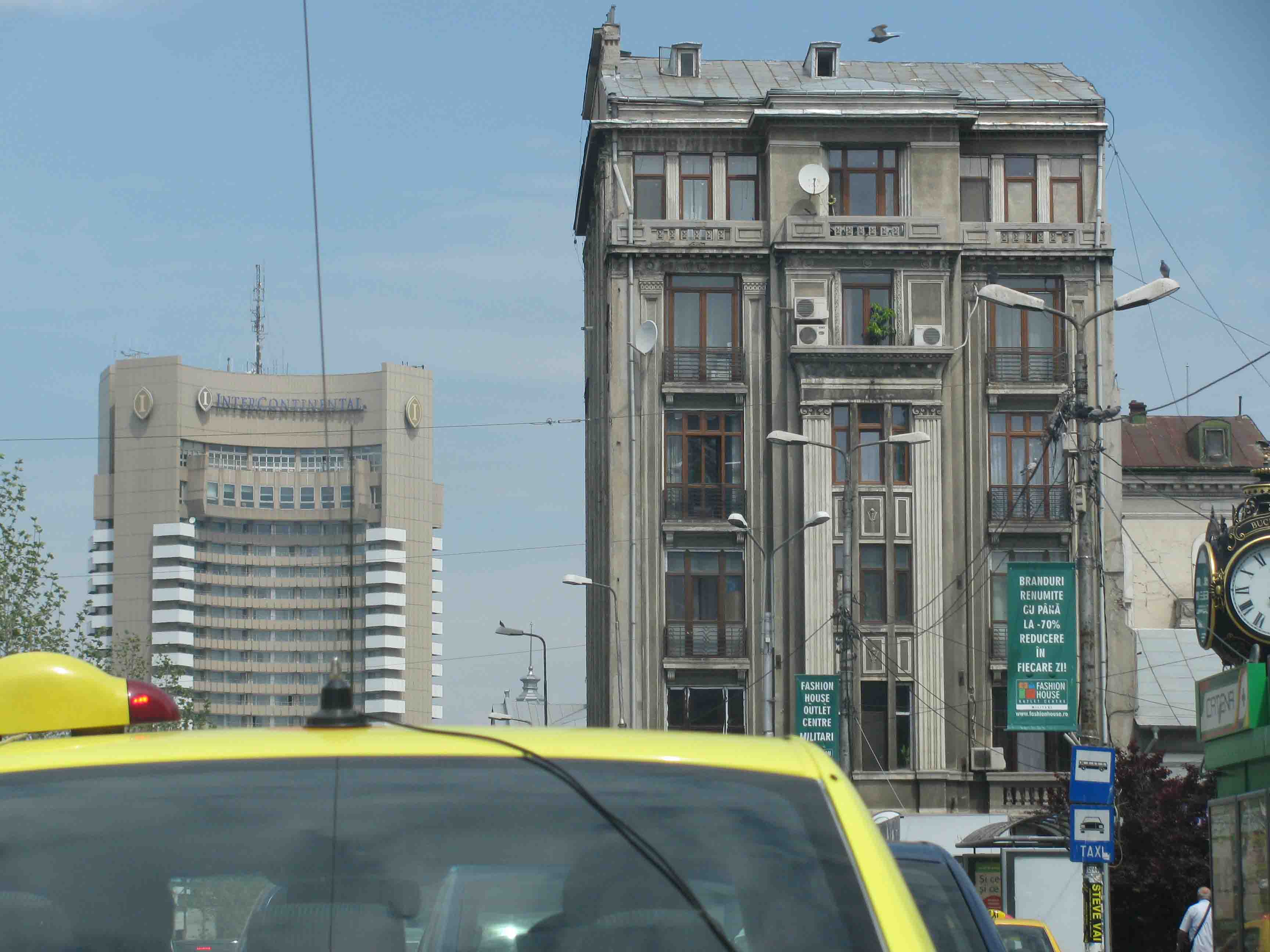
Built early on in Ceausescu’s ‘reign’ - started in 1967, finished 1970 - the 25 story, 250ft high ‘Intercontinental Bucharest’ (left) came at a time when Ceausescu was still considered to be a progressive leader. In 1968 he denounced the Warsaw Pact invasion of Czechoslovakia and always pursued a foreign policy independent of the USSR. The older building on the right was lucky to escape. Ceausescu demolished 20% of the old town to realise his Civic Centrul project.

.

Lipscani: The older building on the right was lucky to escape not just Ceausescu but WW2 bombing and a devastating earthquake which hit in March 1977. Over 1,400 people died and tens of thousands of buildings were damaged. The Lipscani district, mainly to the north west of Pasajul Unirii, is virtually the only part of the old town still standing.

.
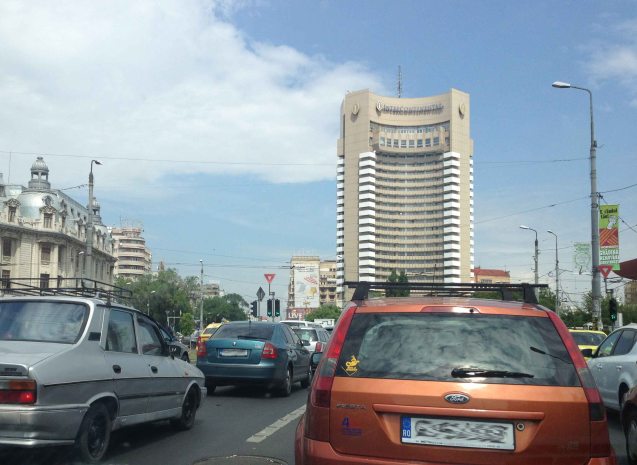
'Kilomterul 0' Bucharest

‘Kilomterul 0’ Bucharest

.

Two years after Ceausescu came to power in 1965, building started on the 25 story ‘Intercontinental Bucharest’ hotel. At this point he was still considered a progressive leader. In 1968 he denounced the Warsaw Pact invasion of Czechoslovakia and always pursued a foreign policy independent of the USSR.

Most western journalists covering the 1989 Revolution stayed at the Intercontinental. Exactly like the Holiday Inn in Sarajevo, TV news pictures filmed from the upper floors – of the army firing on protestors in University Square below – has become stock footage of the events.

With each room having a panoramic view of the city, it’s an obviously great place to stay. Prices start at €135.

.

Piata Victoriei, Victory Square

Piata Victoriei, Victory Square

.

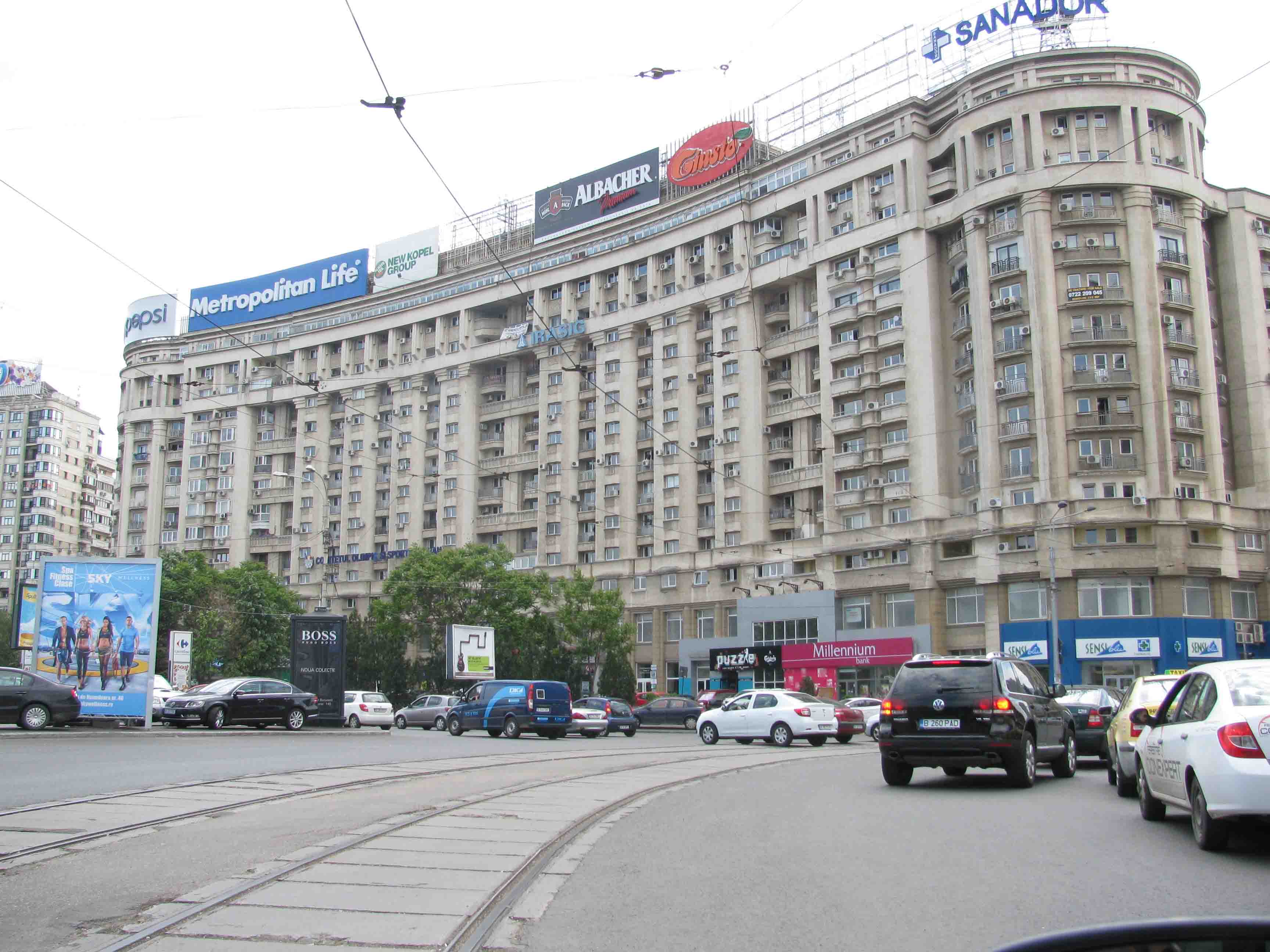
Finally, some proper Ceausescu architecture, on Victory Square, the major hub in the north west of the city centre. Similar to the apartment blocks opposite Ceausescu’s Palace, the style was directly inspired by his visit to North Korea in 1971, the pivotal moment in his rule. Soon after the personality cult and police state became overt. Under the all-seeing eyes of the fearsome Securitate, looking unhappy on Ceausescu’s birthday could get you into serious trouble.

Bucharest’s own Arc de Triumf is on the middle of the three roads heading north from Victory Square.

.
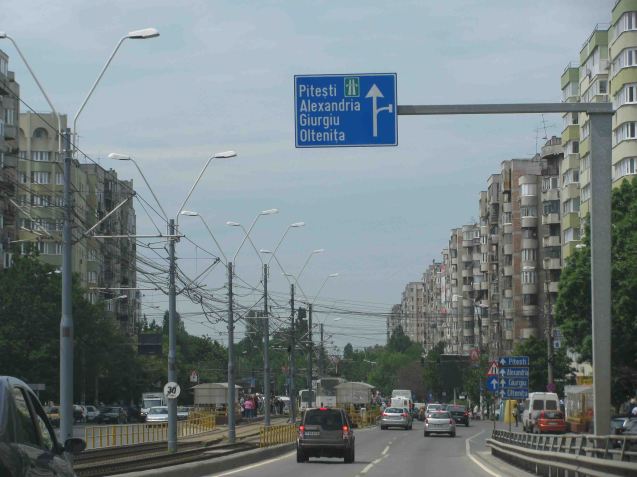
Exit through Sector 6: Bucharest is split into six administrative districts but spookily, they don’t have names just numbers. Sector 6 is in the west, roughly the direction of Pitesti. Lined both sides with the typical ‘panel’ housing blocks. Uniform - and a feature of every former eastern block country - not just out of ideology but because the concrete panels they are made from could be mass produced. Incidentally, the picture is taken just as we come off Podul Grant, a railway bridge, named after Effingham Grant, the British consul to Bucharest in the mid-19th century (and built by his son).

Exit through Sector 6

.

Bucharest is split into six districts but spookily they don’t have names, just numbers. Sector 6 is in the west, roughly the right direction for Pitesti.

As in all former eastern block countries, the major roads are lined with almost identical ‘panel’ apartment blocks. The uniformity stems not just from communist ideology but because the concrete panels they were built from could be mass produced. Whereas other countries used them in towns and cities Ceaucescu went a stage further. His policy of forced urbanisation Systematisation saw entire traditional towns and villages levelled – including churches and monasteries – and replaced with panel apartment buildings.

Incidentally, the picture is from Podul Grant, a railway bridge, named after Effingham Grant, the British consul to Bucharest in the mid-19th century (and built by his son).

.
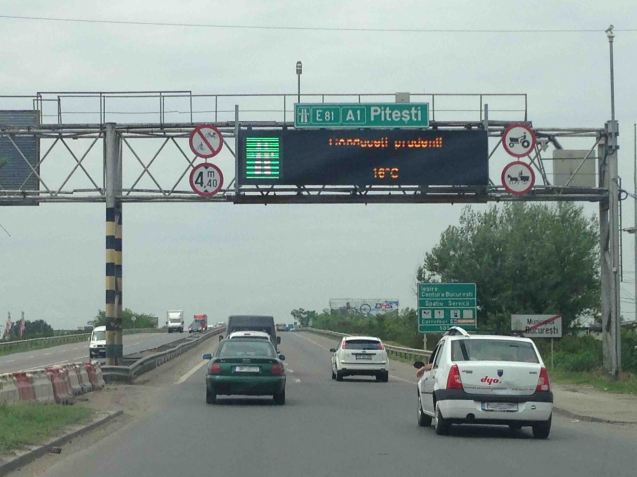
The A1 Bucharest-Pitesti.

The A1 Bucharest-Pitesti.

.

Opened in 1972, the 75 mile A1 between Bucharest and Pitesti was until 1987 the only motorway in Romania. It’s trite to say the network hasn’t developed much since because there is considerable work on-going, but there are only two other completed stretches, both starting in Bucharest: the 140 mile A2 to Constanta on the Black Sea coast, and the 40 mile A3 north to oil city Ploiesti (part one of the Transylvania Highway).

A1 was renovated in 2000 and is good condition though the scenery is pretty flat across the last part of the Romanian Plain. Eventually this road will stretch 360 miles north west to the Hungarian border near Arad, pretty much the direction we are going in. The entire route however will not open before 2020 at the earliest.

.

Pitesti: Dacia city

Pitesti: Dacia city

.

Pitesti, pop 148k, is Romania’s 12th biggest city but an important industrial centre. The wildly successful Dacia car factory is ten miles north west at Mioveni. There are some old lead-roofed buildings, just visible through the continuous avenue of trees, but from Bvld Republic the view is mostly of panel blocks.

The city’s darker claim to fame is the Pitesti Experiment, an attempt to mould the ideal Communist personality using young political prisoners and a de Sadian regime of extreme violence. Described by Alexander Solzhenitsyn as ‘the most terrible act of barbarism in the contemporary world’ it came to light after a BBC report in the early 1950s and was immediately disowned and disbanded by the State.

The point is, prisoners arrived in Pitesti by train and were then marched to the prison. One survivor told documentary makers there were no people on the streets and all the curtains were shut. Repression in Romania existed long before Ceausescu’s Securitate.

.
16

.

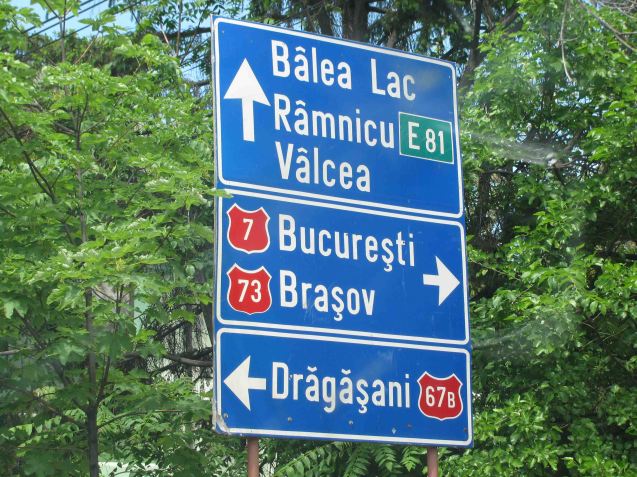
Not until you are within striking distance are there any signs for Transfagarasan. In the meantime, follow signs for Balea Lac, Romania’s highest lake. It’s only accessible by Transfagarasan (apart from a cable car) and, as one of the country’s top natural attractions, is very well signposted. The road you want is DN7c.

Tip: the locals say Transfagarasan is most spectacular from the north.

.
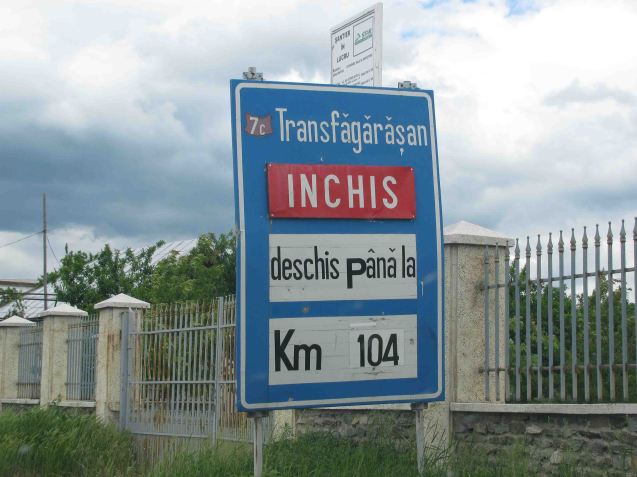
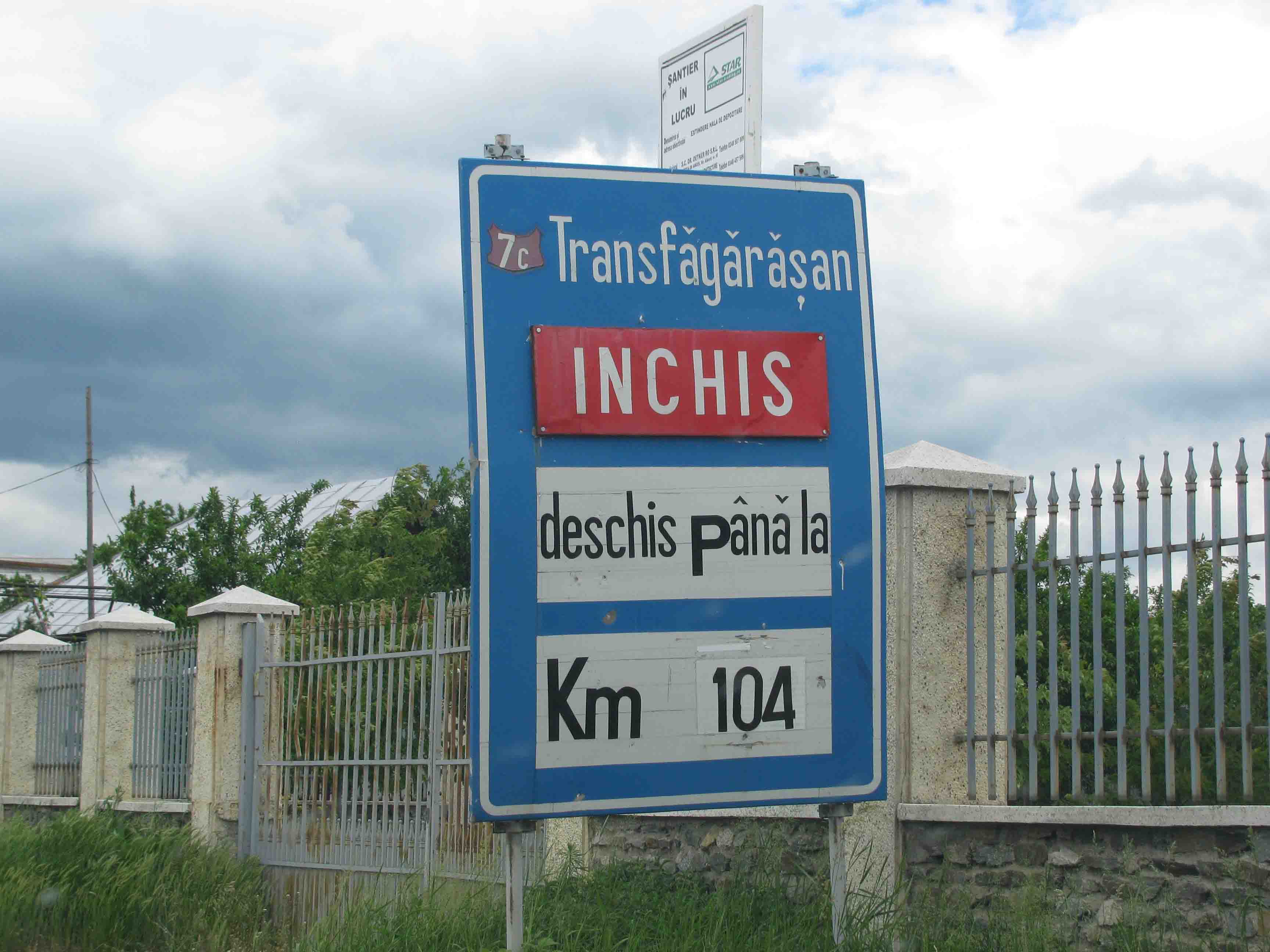
Inchis: closed.

Inchis: closed. Deschis pana la 104km – open until 104km.

.

It’s closed. Damn! Phew! It’s not an enormous shock or surprise. Well above the snow line at its highest, Transfagarasan is usually only open from late June to October. Best you don’t plan your trip outside of these dates. Because we’re here we decide to see how far we can get.

DN7C: Click for Transfagarasan’s exact location.

.
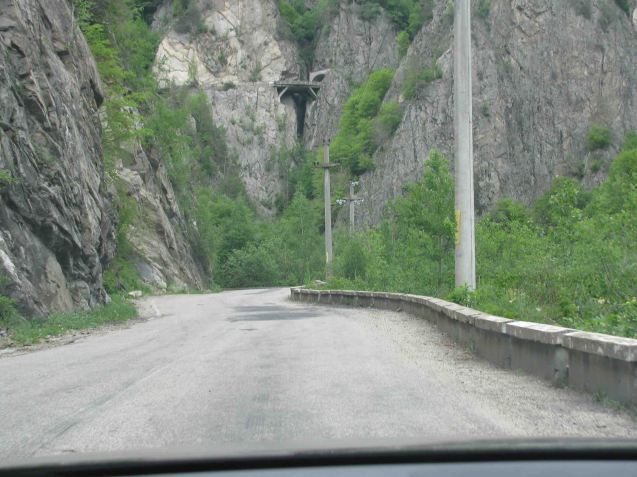
First sight, Transfagarasan

First sight Transfagarasan

.

It’s not because Transfagarasan was built out of Commie concrete forty years ago. Or that there are regular rock fall signs, and indeed regular piles of rocks by the side of the road (and we‘ve got a glass roof).

It isn’t even that high. Topping out at 2034m – 6,673ft – it’s considerably lower than most tourist trap mountain passes in the Alps.

What really freaks me out is that, in many places, rather than being carved out of the mountain the roadway is attached side-on to the rock face. Really, really, really don’t like that.

.
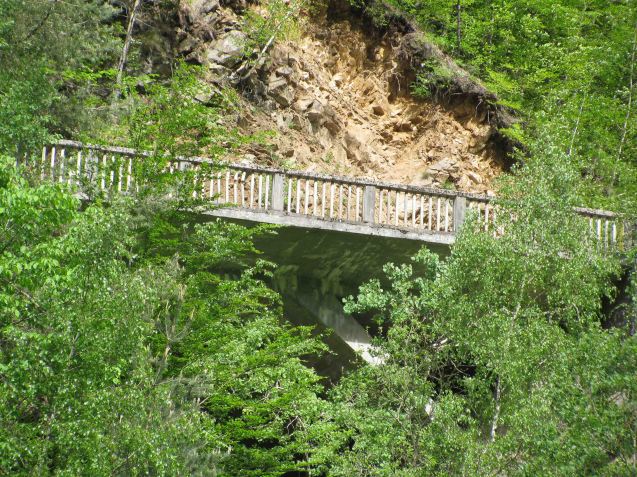
Transfagarasan

Transfagarasan: built for tanks.

.

Funnily enough, Transfagarasan wasn’t built to terrify tourists. In the early 1970s the risk of Soviet invasion was very real. Ceausescu ordered it built – over the Fagaras mountains, hence the name – as a military escape route if the worst happened. Nervous enough in our estate car, I wouldn’t fancy driving this in a tank.

.
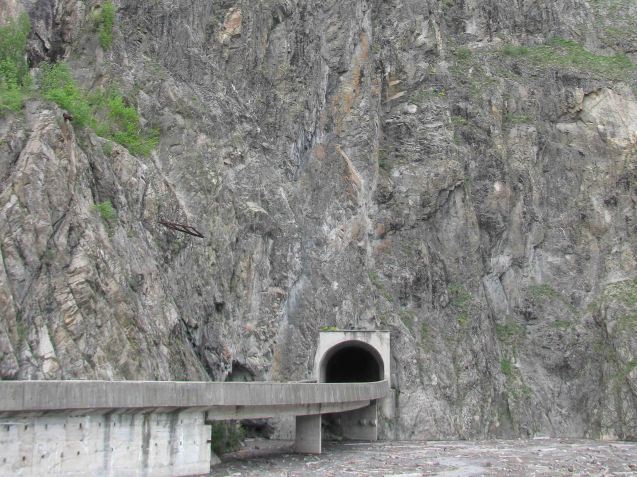
You wanna drive in there?

You wanna drive in there? To be clear it’s an access road around the lake, not part of ‘Transfag’.

.

Anyway, there’s a Dacia Duster parked across the road by Lake Vidraru, so that’s that.

For a snappily soundtracked video of driving Transfagarasan click here.

.

Transfagarasan goes on and on.

Transfagarasan goes on and on and on, for over 60 miles.

.

Now heading for level ground we can afford to be a bit indulgent. It’s so annoying! We were relying on Transfagarasan to get us up to Sibiu from where we can finally start to head west towards Hungary. Although it’s a much gentler way over the Carpathians the alternative DN7/E81 main road is bound to be packed.

There is another alternative. Romania’s other world class mountain pass DN67C Transalpina runs parallel the other side of DN7. But since it’s even higher than Transfagarasan there’s not much point investigating..

.

JKAFKJHF

DN7/E81 along the Olt River Valley

.

Romania desperately needs motorways. Driving DN7 up the beautiful Olt River Valley, between the Fagaras and Parang mountains, is an object lesson. It’s lined with tourist hotels and the road winds close to the river but there’s an endless steam of traffic, HGVs and cars.

Making progress – and with 250+ miles to go, we need to – means constant overtaking. That’s an important factor in Romania and Bulgaria coming at the bottom of EU road safety rankings.

To be fair we don’t see even a single crazy manoeuvre from any other motorist, but: double/triple check your mirrors before pulling out because the cars behind will have seen the gap too, and be aware of the regular dips in the road masking on-coming vehicles…

.

Holiday region

Holiday region

.

Fortunately, rural Systematisation never had the chance to extend much further than the north east region of Moldavia. As we cross into Transylvania – basically the entire north west of Romania – the traditional towns and villages are much neater than the Commie grot in the south.

The really good stuff, Transylvania’s old Saxon villages – which Prince Charles is busily buying up – are further east.

.

Benn to Serbia

A1 under construction.

.

Oh how wonderful it is to top 50mph, if only for a few minutes past Sibiu (former European Capital of Culture). More or less the only parts of A1 open so far are the bypasses around the major towns. It won’t be long before this western section is complete but the huge technical challenge of crossing the Carpathians means that part is still on the drawing board.

.

Favourite picture of the whole trip.

Our afternoon and evening.

.

It was hard to be completely miserable, surrounded by misty mountain peaks, but I had my cheek pressed against the side window for 150 miles looking for gaps in the traffic. The poor car never gets out of third gear just in case.

Near Deva it’s final decision time. Where are we going to spend the night? Arad is more convenient for the Hungarian border but doesn’t get any write up in Rough Guide. Meanwhile, equidistant Timisoara is ‘accented by regal Habsburg buildings’.

.

Welcome to Timisoara.

Welcome to Timisoara.

.

The last bit is the best bit. Just after Deva we come off onto DN68A, a wonderful country road winding into the hills. There‘s nothing to see in the pitch dark however apart from the steam rising off the road. Only 100 miles to go now.

It’s past eleven when we reach Timisoara. Guided by the sign on the roof we make straight for the twelve storey, 164 room Hotel Continental (another one!). It’s full.

So it’s round and round the city centre desperately looking for the next sign to Hotel Excelsior. This bit wasn’t a favourite part of the day. It’s not until 00:00 precisely that we finally manage to get our gobs around a bottle of – ice cold – Peroni.

.

Ruse-Bucharest-Pitesti-Curtea de Arges-Sibiu-Sebes-Timisoara: 447 miles.

Driving time: 14 hours.

.

.

Postcript: Timisoara. Revolutionary.
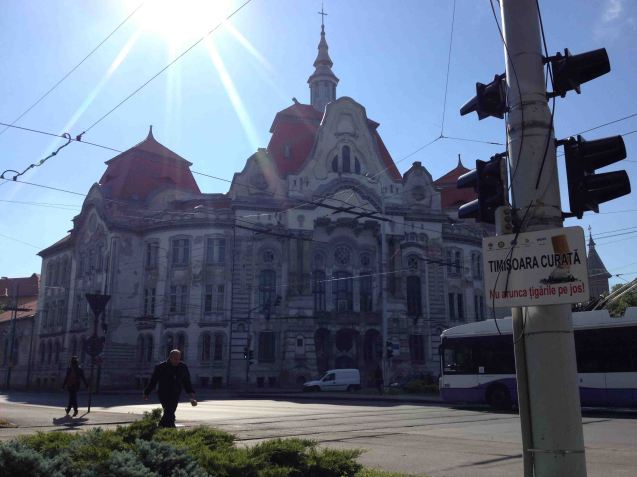
timisoara

Coming soon.

.

Next: Cruise Control. From Romania to Austria in (much) less than a day.

.

Driving in Bulgaria: The Pothole and the Policemen

Our worst fears are realised, but we get by with a lot of help from the locals.

Click here for the route.

7

We’d been in Bulgaria about half an hour when the car behind suddenly steamed past then jammed on the brakes. We’re being car jacked! But around the next corner it was immediately apparent what the problem was: standing next to his regulation two-tone blue Opel Kadett, radar gun in hand, was a traffic policeman.

We should have taken even more note of this random act of kindness than we did. Later on we were not so lucky.

Eh?! Relax, most of the signs are in English too.

Eh?! Relax, most of the signs are in English too. The word at the top is ‘Sofia’.

It’s a moment we all dread. You know you’re pushing your luck but on a quiet stretch you think you will get away with it. Then a policeman steps out, arm outstretched and flags you down.

‘Dokument machina’. They went through all the paperwork carefully, checked the lights and tyres, asked where we were going (all in German) then took me over the road to their car. According to the digital read-out we were going significantly faster than the 90kph national speed limit (on single carriageway); according to a printed sheet I was shown that meant a significant fine.

I didn’t have any Bulgarian cash on me and took my wallet out to demonstrate, just €20. He turned to his colleague who shrugged then plucked the two €10 notes out and tucked them away so swiftly I couldn’t help but smile. A chopping motion showed we were all done, then he shook my hand and that was that. Needless to say we scrupulously observed the speed limit from then on. Unfortunately, it wasn’t the only lesson driven home during our 24 hours in Bulgaria.

4

Apart from a little navigation mishap just after the border…

6

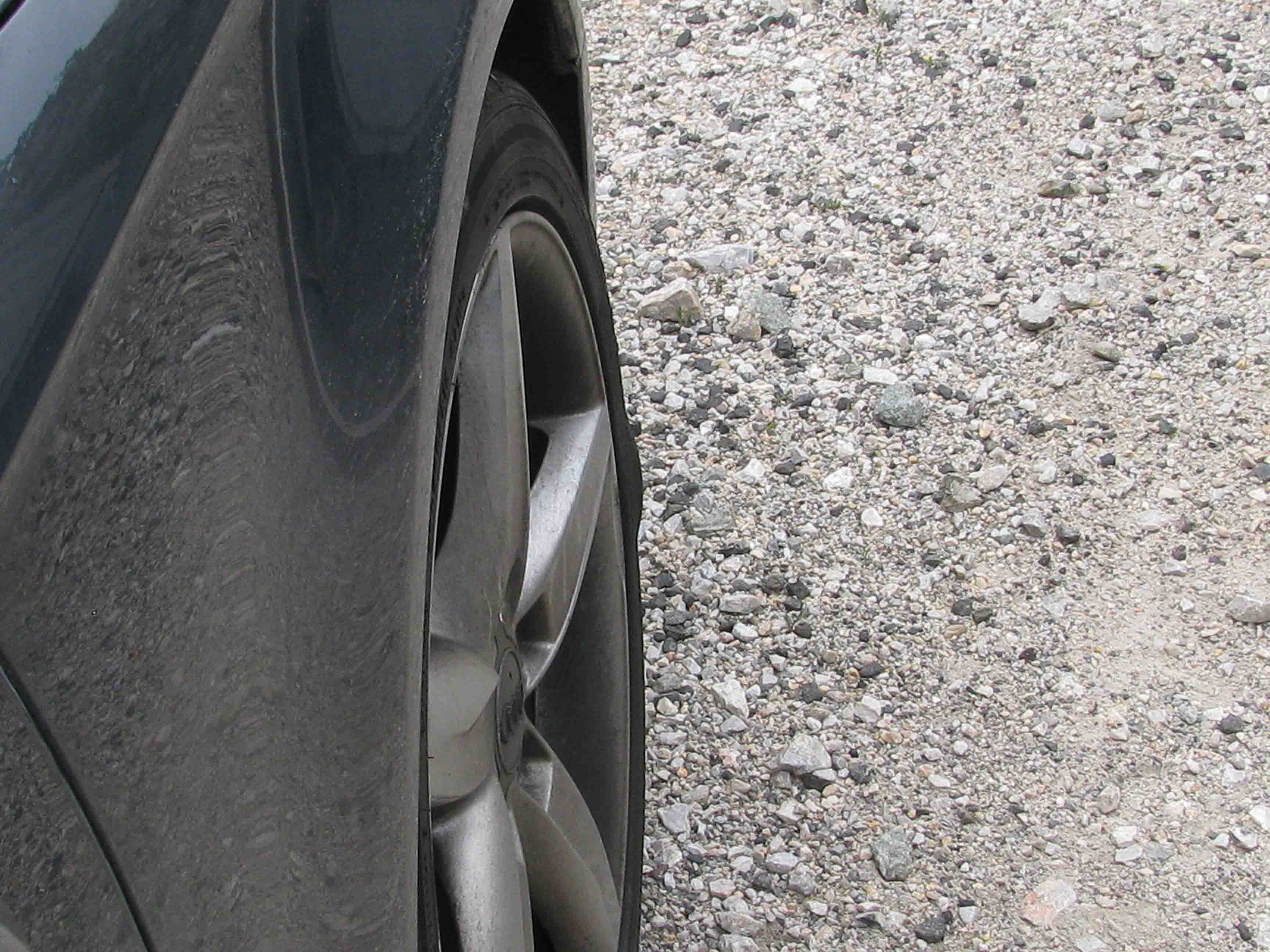
…the roads (motorway and main) were in decent nick. Except for one massive pothole. De facto we were too close to the car in front. The steering felt fine but we both knew we couldn’t possibly have got away with it, and so it proved.

10

The unsightly bulge in the front nearside tyre would need professional assistance, the sooner the better.

8

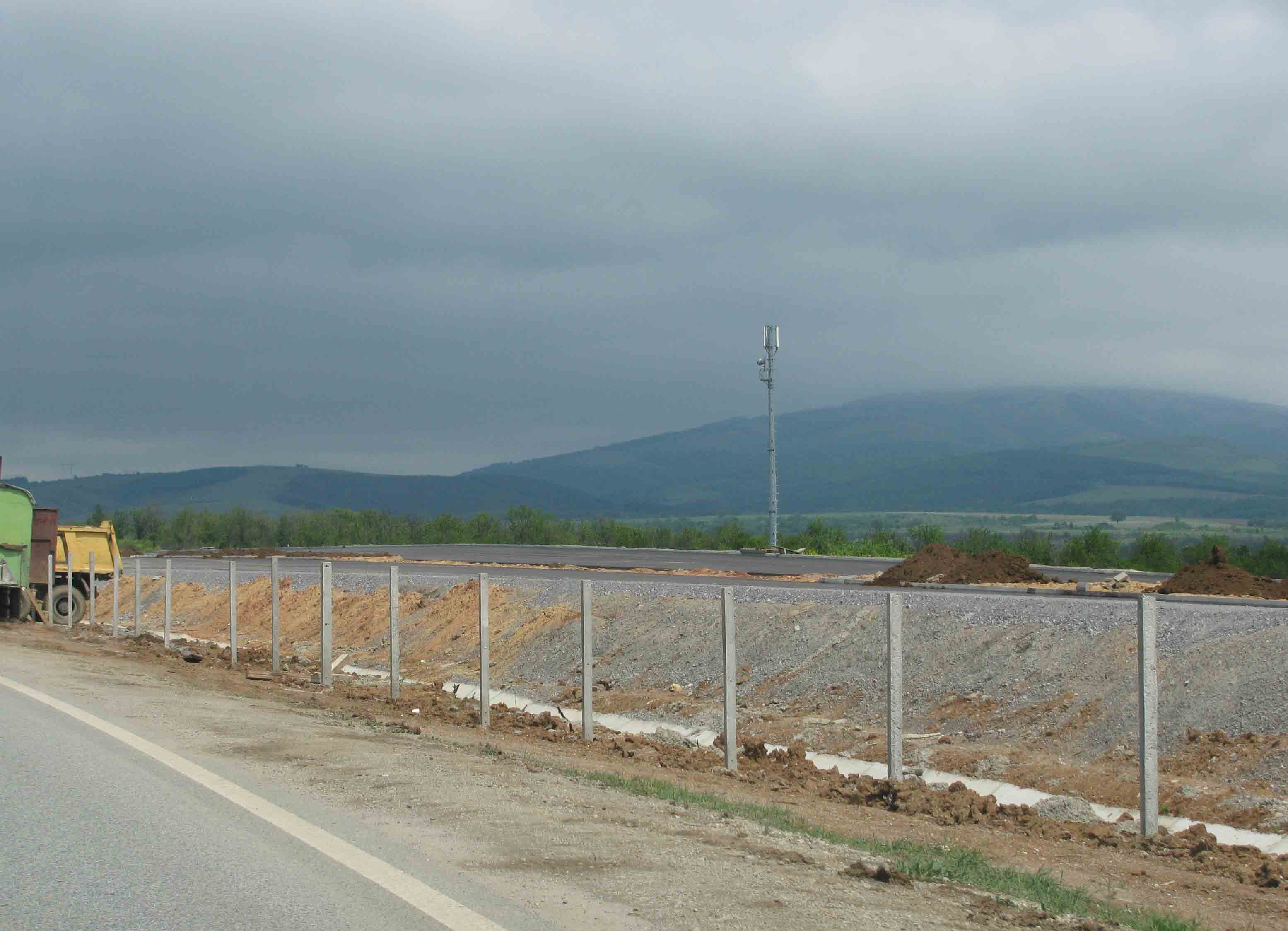
This E79 is one of the most strategically important stretches of road in Europe. It’s now one of only three missing motorway links between western Europe and Greece. The Greeks are well advanced in upgrading their section. Meanwhile the Bulgarians’ plans are taking shape more steadily.

9

From south of Sofia, E79 is split into four Lots, not counting the already-open 10 mile section in the north which connects to the capital’s ring road. The two Lots south of there, and the southernmost, are all under construction. That leaves just Lot 3, the 40 mile part through the Kresna Gorge. This 12 mile long canyon between the Malashevska and Pirin mountain ranges presents as-yet-unsurmounted environmental and technical challenges.

(Those fond of spectacular natural features should also check out nearby Melnik with its 30 mile long massive ‘sand pyramids’.)

11

When the Struma Highway eventually opens – named after the river running through the gorge – the existing road will be a great drive.

12

Improvement works on E79 have been on-going for some time.

13

The new sections are well underway.

16

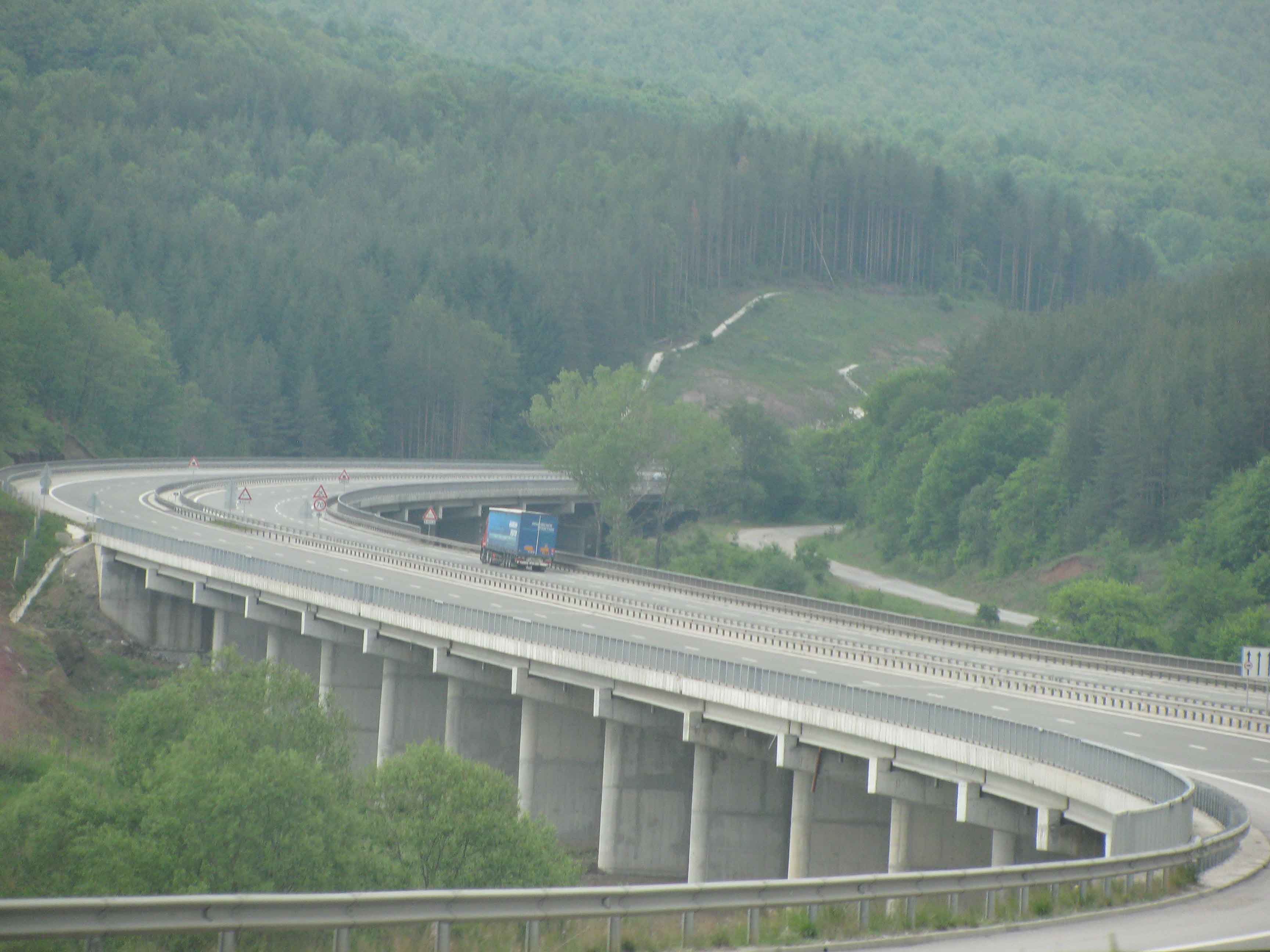
The finished part of Struma has some epic curves.

17

First sight of Sofia.

xx

Don’t think we wake up in the morning desperate to drive into foreign capital cities to source tyres for our extravagantly-wheeled lifestyle estate car. But the great thing about these situations is that retreating into a corner and hoping somebody else will sort it out is not an option. The only choice is to do the thing in front of you.

Largo: former home of the Bulgarian Communist Party, now housing members of the National Assembly (centre); the President’s Office and Sheraton Balkan Hotel (right) and the TZUM department store (left). Built in the 1950s and now regarded as a prime example of Socialist Classicism architecture, aka Stalinist Gothic.

Largo: former home of the Bulgarian Communist Party, now housing members of the National Assembly (centre); the President’s Office and Sheraton Balkan Hotel (right) and the TZUM department store (left). Built in the 1950s and now regarded as a prime example of Socialist Classicism architecture, aka Stalinist Gothic.

The strategy is to locate the official Audi dealership and throw ourselves on their mercy. We’ve come to rely on our in-car infotainment system. Despite being four years old it has taken us direct to some great hotels, for instance, but this time we end up at an address that clearly has never been an Audi dealer.

Sofia University: established ten years after the Liberation of Bulgaria, meaning the end of Ottoman rule after the Russo-Turkish War of 1877-78. Home to 21,000 students. Built in 1924.

Sofia University: established ten years after the Liberation of Bulgaria, meaning the end of Ottoman rule after the Russo-Turkish War of 1877-78. Home to 21,000 students. Built in 1924.

Thank God for smartphones, but sort out the translation software before you desperately need it. The Audi Bulgaria website is not in English. Eventually we work out the dealer is on Slivnitsa Boulevard. Luckily it’s just up the road.

20

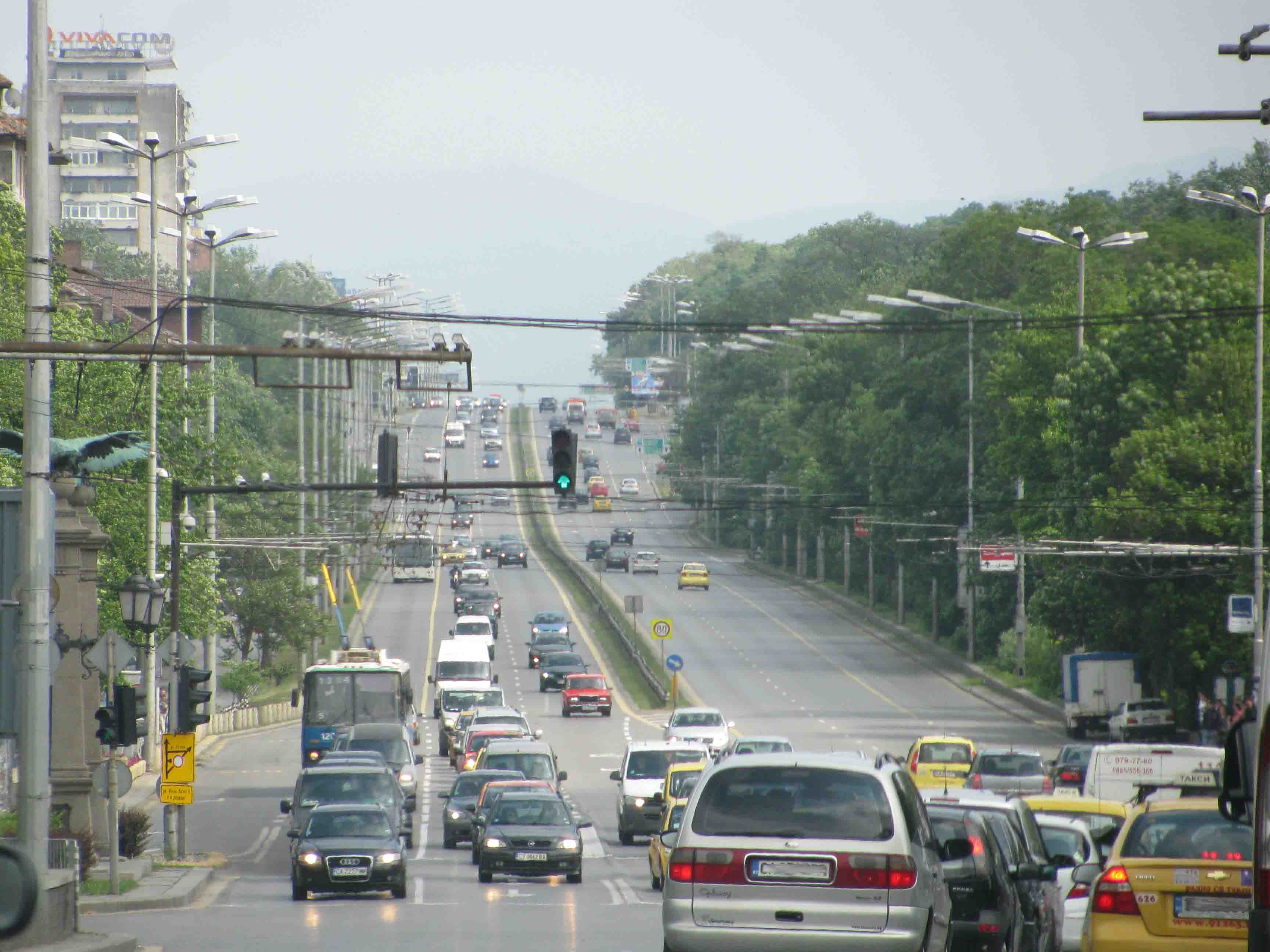
Central Sofia is laid out in a upright horseshoe shape, filled with an almost regular grid of streets. Slivnitsa Boulevard, running east-west across the north, connects the two ends.

On its way out of the city, Slivnitsa swings north west through the suburb Illinden – where we find the Audi garage – then continues, single carriageway, for the 35 miles to the border with Serbia. This is the second missing motorway link between western Europe and Greece. A tender has just been issued to upgrade the whole stretch. When it’s finished it will meet the Corridor XI road the Serbs are currently building from their second city Nis, the third and final missing link. Nis is already directly connected to Belgrade, Budapest, Vienna and on. No word yet on when this is likely to happen. XI should be ready by mid-2015. The new ‘Boulevard Bulgaria’ should only take two years to build but there’s no funding so far.

Traffic lights on Slivnitsa Boulevard

Traffic lights on Slivnitsa Boulevard

Our worst fears are realised. The Audi guy is really helpful and speaks very good English but the bottom line is, as we half expected, they don’t have our tyres in stock and it will take time to get hold of them.

Would we rather hole up in a Sofia hotel for three days while new tyres are flown out from Germany – and fitted by Audi-certified technicians – or would we like to try our luck at a tyre depot on a scruffy industrial park? It’s an apposite question. But news that this place is only round the corner, painted pink and called Diana is oddly reassuring.

Our luck turns: Would you believe they don’t try and sell us new tyres? First off, the chap in charge – who speaks perfect English – suggests they swap the tyres round to take the stress off the bulgy one. But with 1,500 miles to go we want to know how much new ones cost. A moment later he’s back with a printed price list. Twenty minutes after that we pull out of Diana wearing a brand new pair of Continental ContiSportContact 5s. They cost 806lev (€403), not cheap by any standards, but we were absolutely delighted with the service.

22

What now then? It’s after 17:30. The obvious thing to do is find a hotel and spend the evening exploring Sofia. Yeah! But that only puts us 190 miles from where we started this morning; with only four days left we need to make some more miles. The preferred destination is Ruse, on the Danube border with Romania, ideally placed for Bucharest tomorrow morning.

(Language tip: the third word down on the sign above – PYCE – is the Cyrillic version of Ruse. As those letters are all very common it’s a foothold, albeit a small one, on the alpahabet. Cyrillic ‘transliterates’ into Latin script, i.e. the words are spelt the same, just the letters are different. Easy. Now try it at 50mph).

23

Ruse is another 190 miles north east, only a quarter of which is on motorway. Before that we have to cross the Balkan Mountains – Stara Planina – that give this whole massive peninsula in south east Europe it’s name (the word Balkan derives from the Turkish for ‘chain of wooded mountains’).

24

Epic scenery. With more wildlife than you can shake a stick and scream at, and the highest waterfalls in the region, this is definitely somewhere we want to come back to.

27

All too soon the Hemus Highway (hemus means mountain) turns east for the Black Sea resort Varna. We turn off onto route 3 heading north then east. Surprisingly, all the trip planners – and our satnav – avoid Veliko Tarnovo, Bulgaria’s oldest city. About halfway to Ruse it might have made a good alternative.

The white and grey painted kerbstones are a characteristic feature of Bulgarian towns.

28

Equilibrium restored: It’s been a hell of a day but as the sun sets, and it looks like we will make it to Ruse, there’s a good atmosphere inside the cabin. If busting a tyre was a stupid error, so was leaving the passports in Arezzo.

30

Once over the Balkans the countryside turns rolling, vast hedge-less fields beside the road. Of course it’s pitch black by the time we roll into Ruse. Hopes of rooting out a chic river view room, diminishing with every tick past 22:30, revive as we latch onto the signs for the Danube Plaza Hotel.

Okay it’s a bit dated but our luxury, double-balcony room is huge, looks out over the central square and only costs €66 B&B all in.

.ends.

Postcript: Magnificent Ruse

1264a

Coming soon.

.
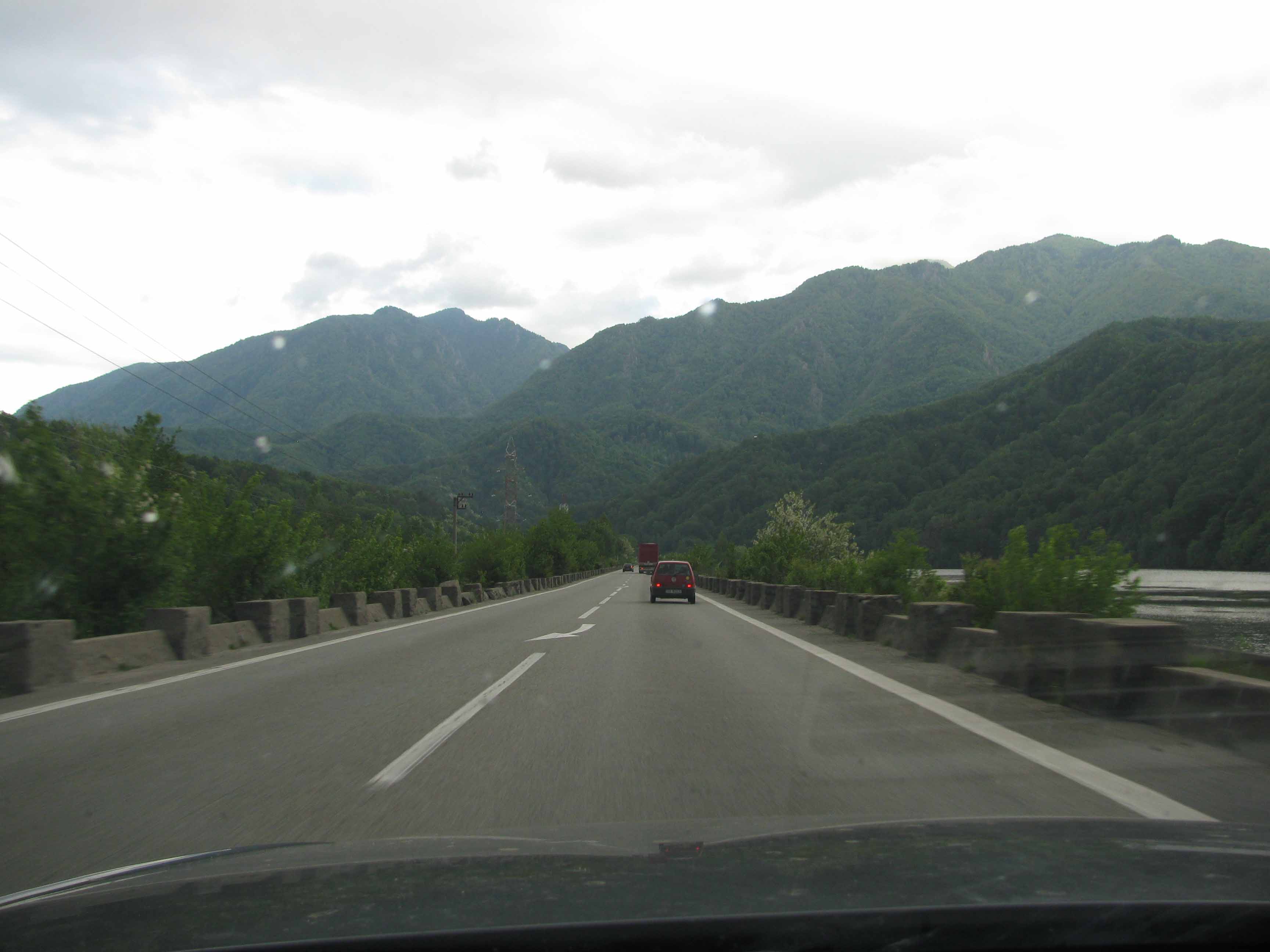
Next: Romania, ‘Tragedy’ on Transfagarasan.

.
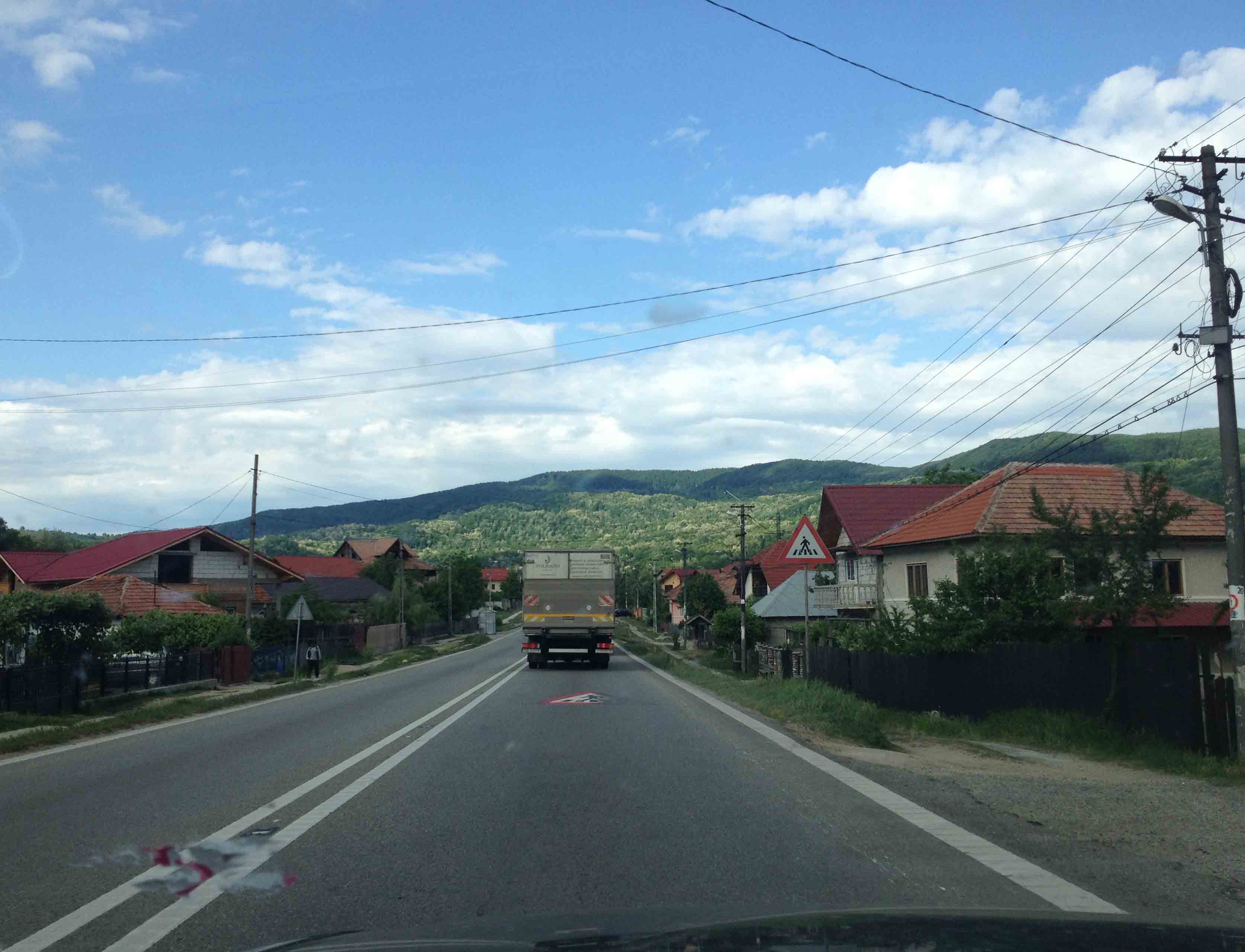
Driving in Greece: Olympic

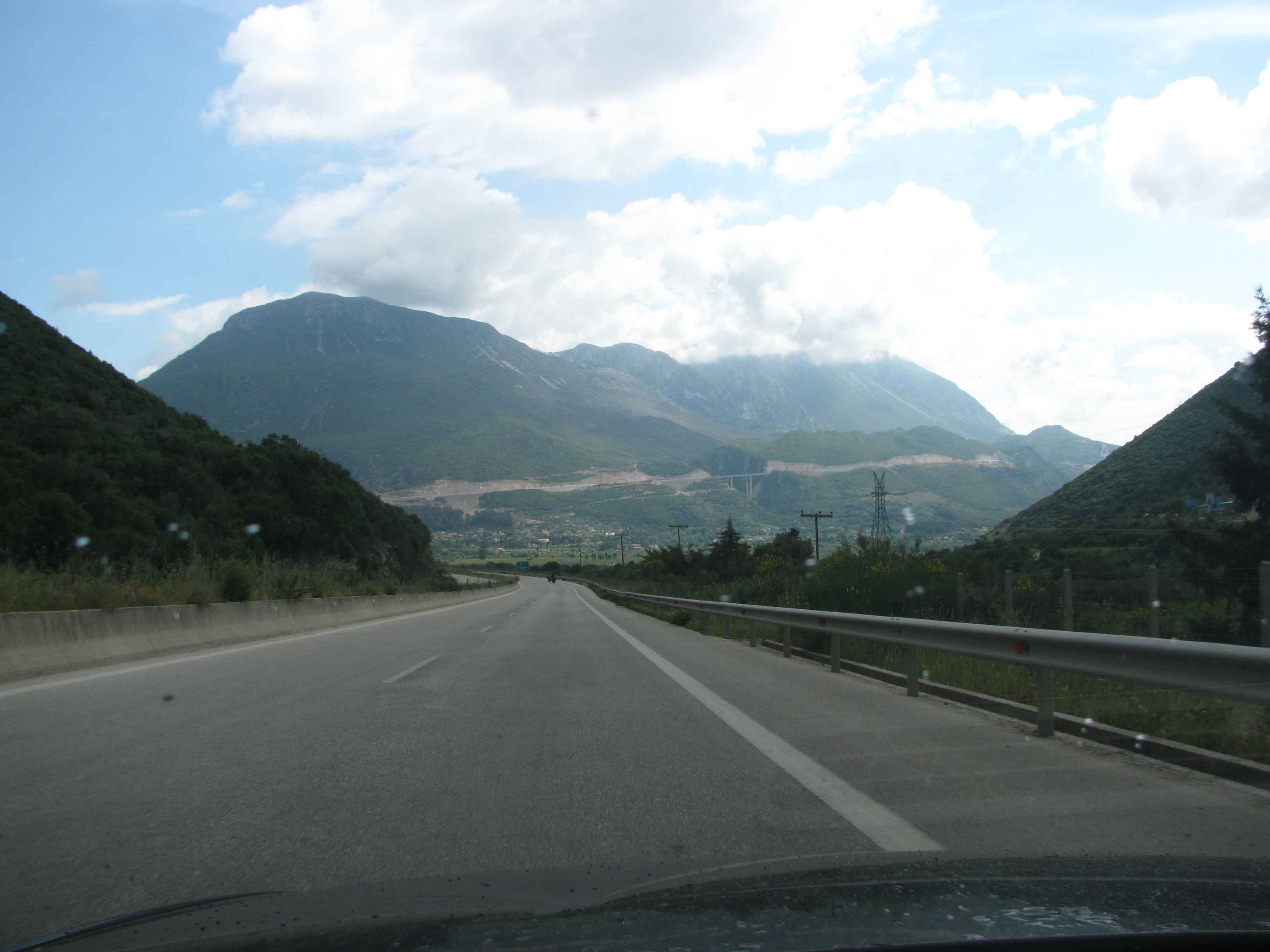
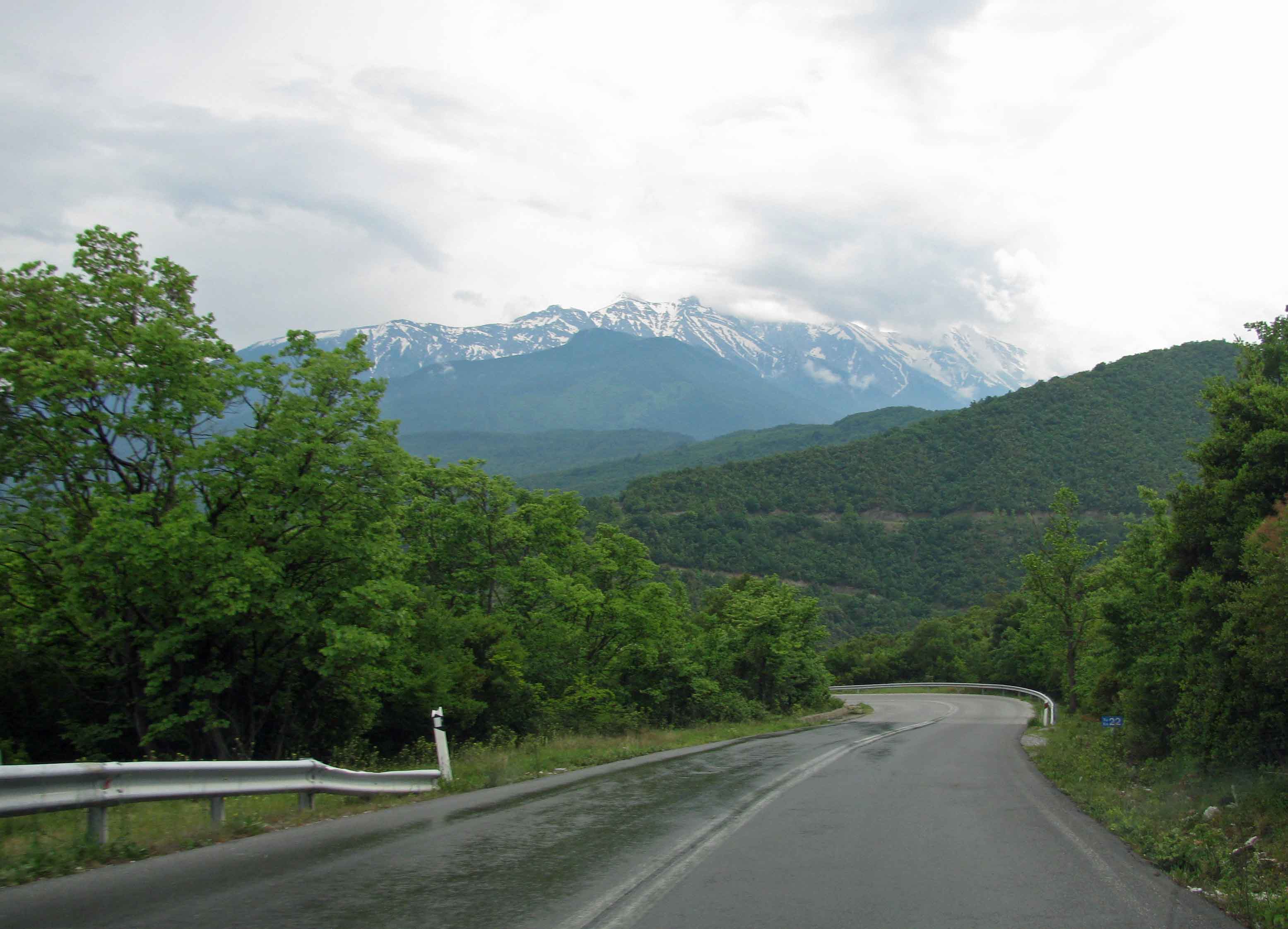
First impressions of Greek roads are extremely favourable and improve considerably as we take to the back roads around Mount Olympus.

Click for the route.

9848a

It’s a toss up for the Athens-bound whether to stay on the ferry until Patras. From there it’s just 140 miles to the Greek capital, the vast majority on motorway apart from around Corinth, plus an entire day steaming around the islands for only about €40 extra.

From Igoumenitsa it’s 310 miles to the Greek capital, two thirds of which is on motorway, though you have all day to get there even if you are an hour late like we were and don’t disembark until 09:30.

But the major destination from Igoumenitsa is Istanbul, a well-publicised six hours’ drive away (more like nine in reality). That was where we were headed but missing the first ferry from Italy means we don’t now have time…

Instead we drive across northern Greece to second city Thessaloniki. The almost brand new Egnatia Odos highway goes all the way there but to make it even more interesting we detour around the legendary Mount Olympus on local roads.

1

With enormous relief we note the roads signs are also translated into the Latin alphabet. Previously completely stymied by Cyrillic, the Greek alphabet on its own would have been too much. A brief shower cleans the windscreen. All is suddenly very good indeed.

2

The Egnatia Highway snakes straight above Igoumenitsa into the Pindus mountains, the so-called ‘Spine of Greece’ running 100 miles south east before plunging underwater to re-emerge as Crete. Covered with pine and fir forest, mainly, populated by lynx, wildcat, wolves, jackals and bears.

5

After 50 miles a tempting stop would be Ioannina, a fortress citadel city on the western shore of Lake Pamvotis. Refuge for Byzantines fleeing the sacking of Constantinople in the 13th century. The ancient Dodona ampitheatre is nearby. We don’t have that much time unfortunately..

9801b

Recent reports say traffic on Greek motorways is down 40% during the financial crisis. We can only say the roads were very quiet this particular Sunday morning.

9807a

All Greek motorways are tolled. Like the Italians, they believe in little and often, even charging the same €2.40. Because there are receipts – you get receipts with everything in Greece – it is possible to say we pay €4.80 for the 100 miles before we come off at Grevena.

14

These are not exactly the wild roads of Greece – the 15 we take south east then the 26 due east are both main roads (albeit the only roads) but again they are very quiet.

15

You can tell we’re in a good mood because instead of going to any lengths to find a modern, branded petrol station we’re happy to pull in at this local filling station. Such a friendly guy. Brimmed for €50.

17

Momentarily anxious that this road will be shortly winding its way up that mountain, then manfully disappointed as it swings east…

9848a

…into this shallow valley, dotted with massive goat herds.

24

Once through Elassona: Now in shouting distance of Olympus we fluff the turning for the windy road along the south slopes. Not all signs are in the Latin alphabet.

But we figure there’s more chance of finding somewhere for lunch-beside-one-of-the-world’s-most-iconic-mountains if we stay on the 13 which passes the 9,000ft peaks – 52 of them to be precise – to the west and north. There are no roads up or over Olympus.

9888a

This being Sunday however means everywhere is shut. We eventually find a roadside stall selling sweets – staffed by an Aussie expat – on the scruffy outskits of Katerini just before we join the Aegean Odos highway.

29

The mountains are far behind now, and only fleeting sights of the sea. Further south Aegean Odos famously runs just above the coast. The water is so clear drivers passengers can see the sea bed. The final 45 miles into Thessaloniki costs €3.40 in tolls.

30

We roll into Thessaloniki just after 16:00 after 256 miles and five hours driving time. A good day.

35

.ends.

31

Postscript 1: There isn’t a bad word to say about the Electra Palace Hotel, certainly not from our sea view room, right in the middle of its elegant stucco crescent. Apart from being in the epicentre of town, and costing just €170 for undoubtedly five star accommodation, what really sells it is the roof top restaurant. A lavish four course dinner later on nearly doubles the entire bill but the food and service are so good it’s worth every cent.

32

Postscript 2: We had just given up on Thessaloniki. The almost endless row of modern apartment blocks on the waterfront were packed out with loudly partying young people. But then a last-chance turn up a side street, also lined with massive apartment blocks – and our first set of ancient ruins – sees Thessaloniki turn from annoyingly busy into an exciting, bustling mass of humanity (a sixth more dense than Tokyo).

33

Throughout the city centre are entire blocks, fenced off, containing Roman and Byzantine ruins (now havens for stray cats). Or religious buildings that have gone from synagogues to mosques to orthodox to christian and back again, reflecting how many times this city has changed hands in its 2,300 year history (you’ll have to take our word for it..) Thessaloniki has only been part of modern Greece since 1913, shortly before a fire which destroyed the old city centre.

.

Next: Driving in Bulgaria. The pothole and the speeding police.

.

Taking your own car to Greece

Getting your own car to Greece needn’t involve a fifteen hundred mile transcontinental roadtrip. Car ferries sail regularly between Italy and Greece. Be warned: if you must have your creature comforts it can get very expensive.

Note: none of the products or services used on this website are sponsored.

aferry.co.uk's smartphone app really does make booking easy and convenient.

aferry.co.uk’s app really does make booking easy and convenient.

Most of this new-fangled smartphone-based travel technology eludes us, but one aspect we have mastered are the ferry booking applications.

These apps have their limitations – you cannot use them for immediate travel – but for booking absolutely at your own convenience they knock online and telephone booking into a cocked hat.

In this case we booked our trip over beers on Vrijthof Square in Maastricht. The idea had been to turn up at the port when we were ready but, after paying twice the normal rate to cross the ‘Channel earlier that day under similar circumstances, we chicken out.

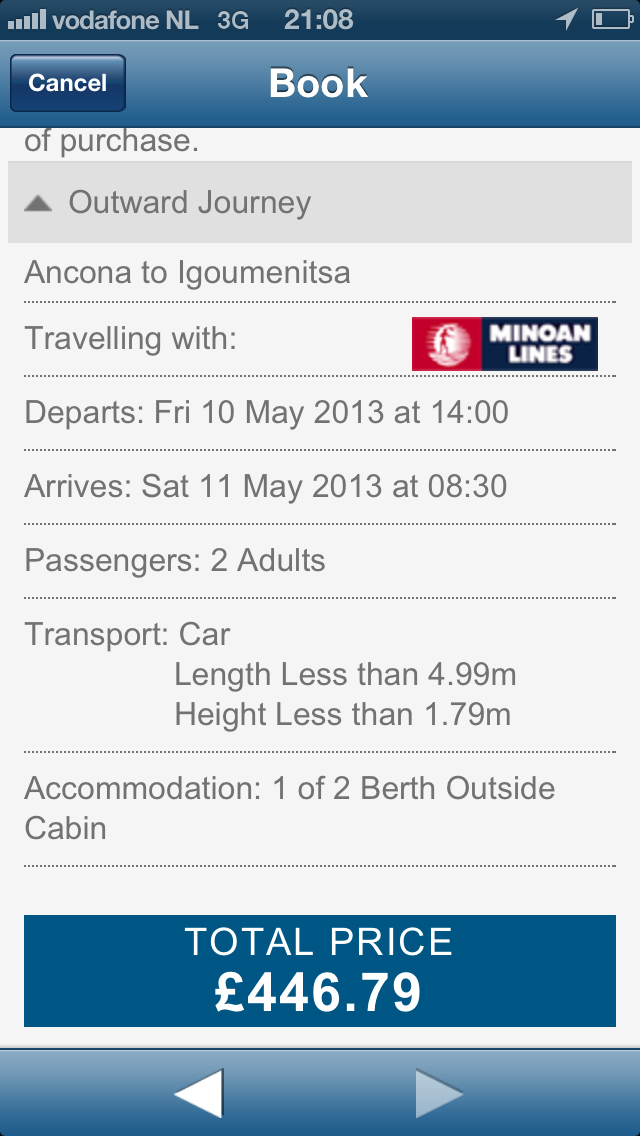
Maybe aferry.co.uk’s app is too easy considering that in five or six clicks we spent £446.79, the price for one car and two adults in an outside cabin on Minoan Lines three days in advance. That’s one way BTW.

In fact, it doesn’t seem to make much difference when you book. A similar journey this September would cost the same; in mid-July, £100 more (all prices are each way and approximate). An inside cabin saves £40 but the absolute cheapest way for two people and a car to get to Greece is by bedding down on deck or in the corridors (someone even pitched a tent). In September that costs £210 in total. Airline-style seats are £25 each while a four berth ‘junior suite’ is £50 more than a regular cabin.

Taking your own car to Greece is not cheapy cheap but the prices are comparable to Brittany Ferries’ UK-Spain sailings.

3

Cruise Olympia looks vast as it edges towards the quayside but at 55,000t and 224m it’s only a bit bigger than P&O’s latest Dover-Calais ferries. Built in 2010, it carries 3,000 passengers, 1,000 vehicles and has 413 cabins. It’s big enough that we don’t ever fully get our bearings.

4

The ship starts at Trieste in north east Italy. After Ancona, it calls at Igoumenitsa then Patras, on Greece‘s west coast. Both Ancona and Trieste are just over 1,000 miles from London. It only costs £30 more to sail from Trieste but the boat departs at 06:30. It leaves Ancona at 14:30, gets to Igoumenitsa at 08:30 and Patras at 17:00 the following day (see below for maps).

5

Only the driver is allowed in the car during boarding. Otherwise boarding/ disembarking is similar to crossing the ‘Channel though the lanes are sorted by destination. We got a large wooden card with ‘Igoumenitsa’ written in big letters to put in the windscreen. You are allowed to go back to the car during the trip.

6

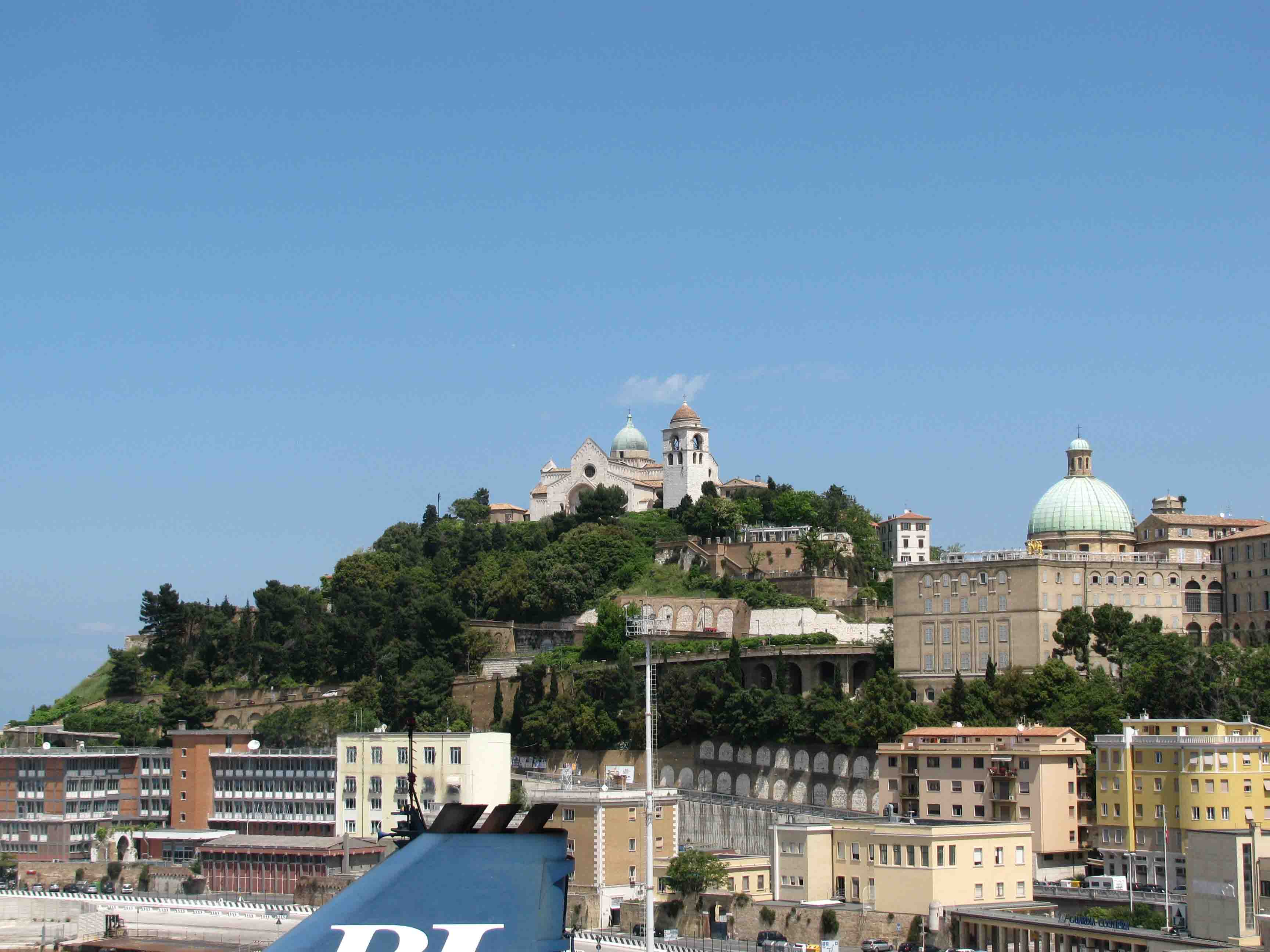
Ancona – population 100,000 – is definitely easy on the eye considering it’s the largest port in the Adriatic. The name comes from its early Greek settlers – in about 400BC – from the word for ‘elbow’, not because it’s lies on a bump of the east central Italian coast – which it does – but from the shape of the promontory which makes a natural harbour.

Apart from Greece, ferries also sail to several destinations in Croatia, just across the Adriatic.

7

Those thinking to stay in Ancona the night before their sailing should check out the Grand Hotel Palace, on this hill. Port/town view double rooms can be had for around £130 B&B.

8

DriveEurope last sailed from Italy to Greece (from Brinsidi in the far south to Corfu) in 1987 on an inter-rail trip. We slept under the stars and brought our own booze. This trip wasn’t quite like that. For one thing we sailed out of Ancona and into the rain, but with little else to do for the next 18 hours there was a definite party atmosphere as the boat steamed away.

The food on-board is good quality but quite expensive. There is a proper restaurant but we ate in the self-serve café. Dinner, desert and coffee was €19 each while breakfast was €12 each. Including some beers (€4.50/pint) and a nightcap we spent just under €100 on food and drink onboard.

9

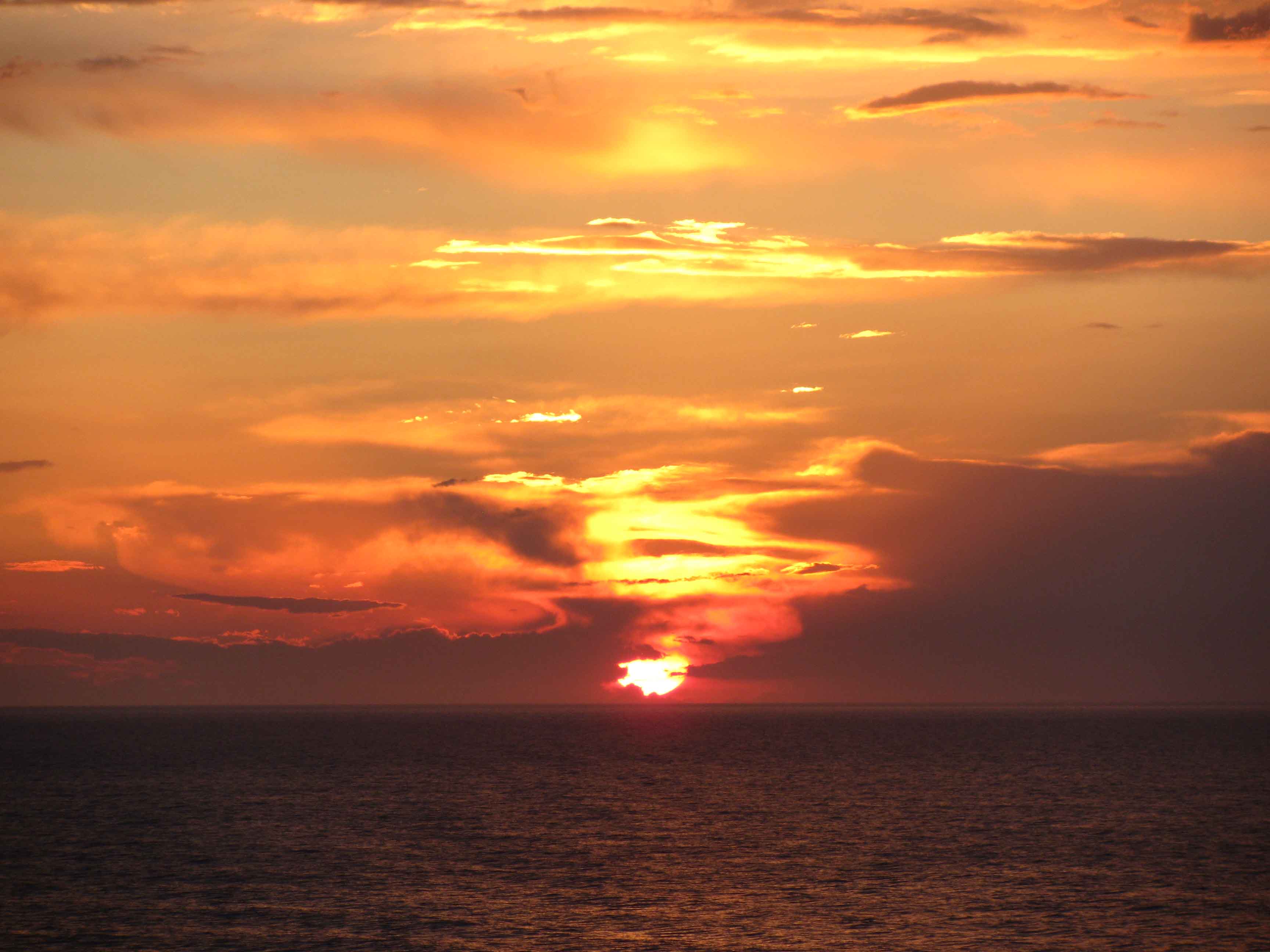
Luckily there was big enough gap under the clouds to watch the sunset…

10

…although it takes a zoom lens to see in all it’s glory.

Corfu through the porthole.

Corfu through the porthole.

Compared to the sheer glamour of the black marble reception area – where you check-in to get the keycard and directions to your cabin – the accommodation, with ensuite shower room and toilet, is rudimentary though scrupulously clean.

On the final run in to Igoumenitsa the next morning, there’s a (naturally) close up view of Corfu’s east coast.

11

Meanwhile on the other side the misty mountains of Albania slip by.

12

The surprise wasn’t just that there were a few other Brits on the ship but that some had their dogs with them. There were quite a few dogs around and all seemed to be coping okay. Pets cost about €40 each way but the owners are restricted to an inside ‘pet friendly’ cabin.

13

Minoan Lines’ main competitor Ancona-Igoumenitsa-Patras is Anek Ferries which sails to a similar schedule with similar prices. Arek’s Hellenic Seaways departs as we approach.

14

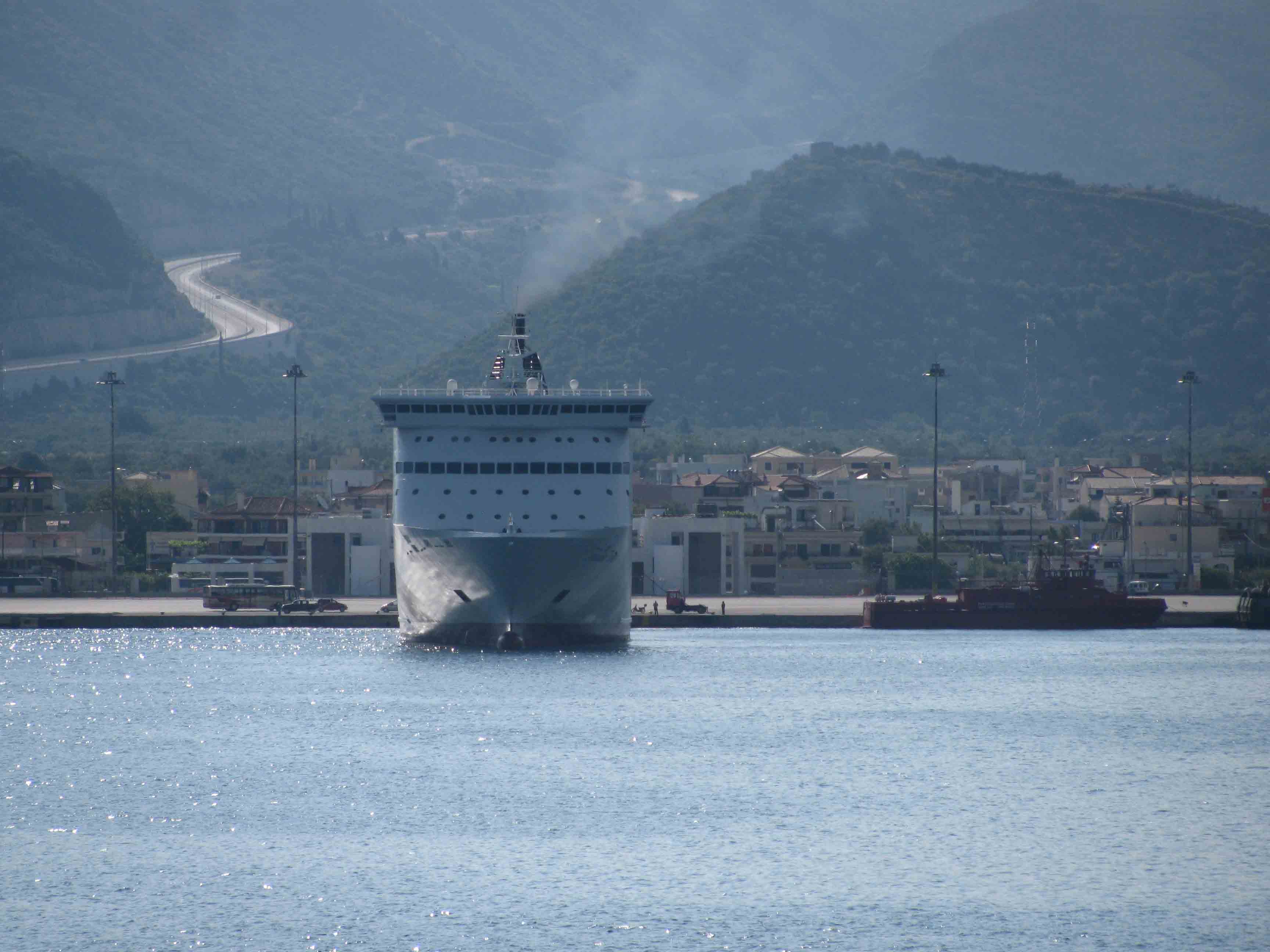
Despite the fine setting, off-puttingly Rough Guide describes Igoumenitsa it as ‘decidedly unappealing’ and ‘rather dodgy’.

Population 25,000, it’s the third largest passenger port in Greece after Athens (Piraeus) and Patras but thanks to the Via Egnatia motorway, opened in 2009, it is the country’s busiest container port.

At ten miles from the Albanian border it’s a frontier town too hence it was levelled WW2 and rebuilt in an apparently ‘bland utilitarian’ style. The coast just south however is very popular with holidaymakers.

.

Next: Driving in Greece. From Igoumenitsa to Thessaloniki via Mount Olympus.

.

Arezzo-Ancona-Arezzo-Ancona

An abortive attempt to catch the ferry to Greece gives us the chance to check out Arezzo.

.

43z

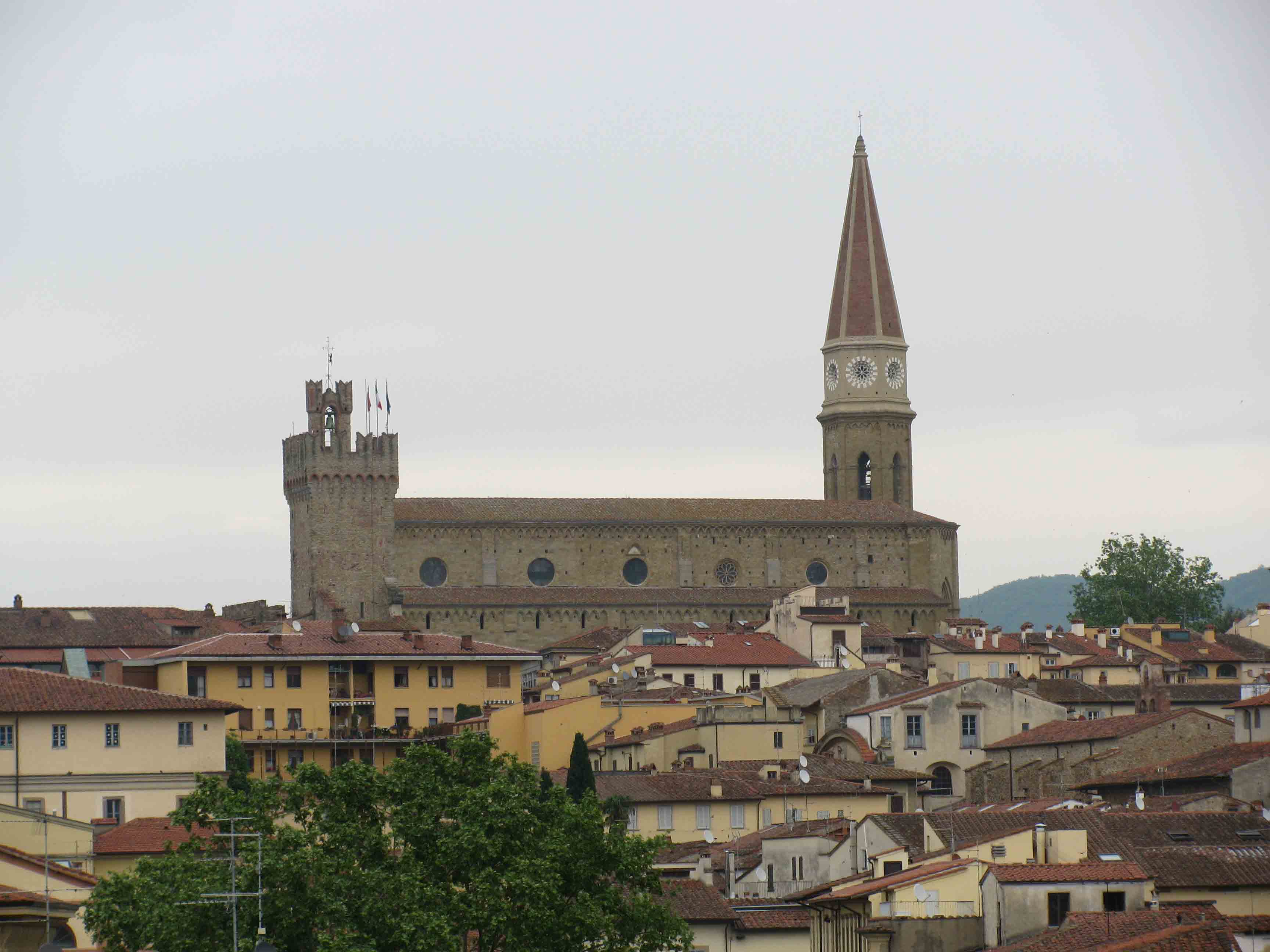
We leave Arezzo with hardly a backward glance. Sorry. But we’re not such philistines we don’t appreciate what a beautiful old place Arezzo is even if we only see it from the hotel’s roof top terrace on our fascist square.

2a

Nothing complicated about driving out of Arezzo though it was already busy by 8am, with school kids mainly (as it was on Saturday morning too).

2b

There’s no direct route between Arezzo and Ancona. We’re aware of the potential for delays on the mix of roads hence the early start. It’s only 120 miles and should take 2h32 according to Google Maps. The ferry leaves at 14:30 with a minimum two hour check-in for international passengers.

47b

Quickly back into the hyper green countryside.

4

There is a bit of navigating to do but well before half way Ancona is signposted. It’s expressway from then on.

5b

Now ahead of schedule we can relax and enjoy the fine scenery. SS76 is being upgraded on the final run-in to Ancona.

The brilliant sign-posting continues after check-in on the roundabout way to the boarding lanes. Considering it's a commercial port, one of the biggest in the Adriatic, Ancona certainly has its architectural flourishes.

The ferry terminal is brilliantly well signposted from a few miles out. It’s only as we get ready to check-in we realise our passports are still back at the hotel in Arezzo.. Thankfully Minoan Lines don’t charge us to change the booking, and while the Greece ferry only departs on alternate days in the week, it leaves on both days over the weekend so we are not losing as much time as first feared.

The moral of this story: he who checks in to the hotel should also check out.

10a

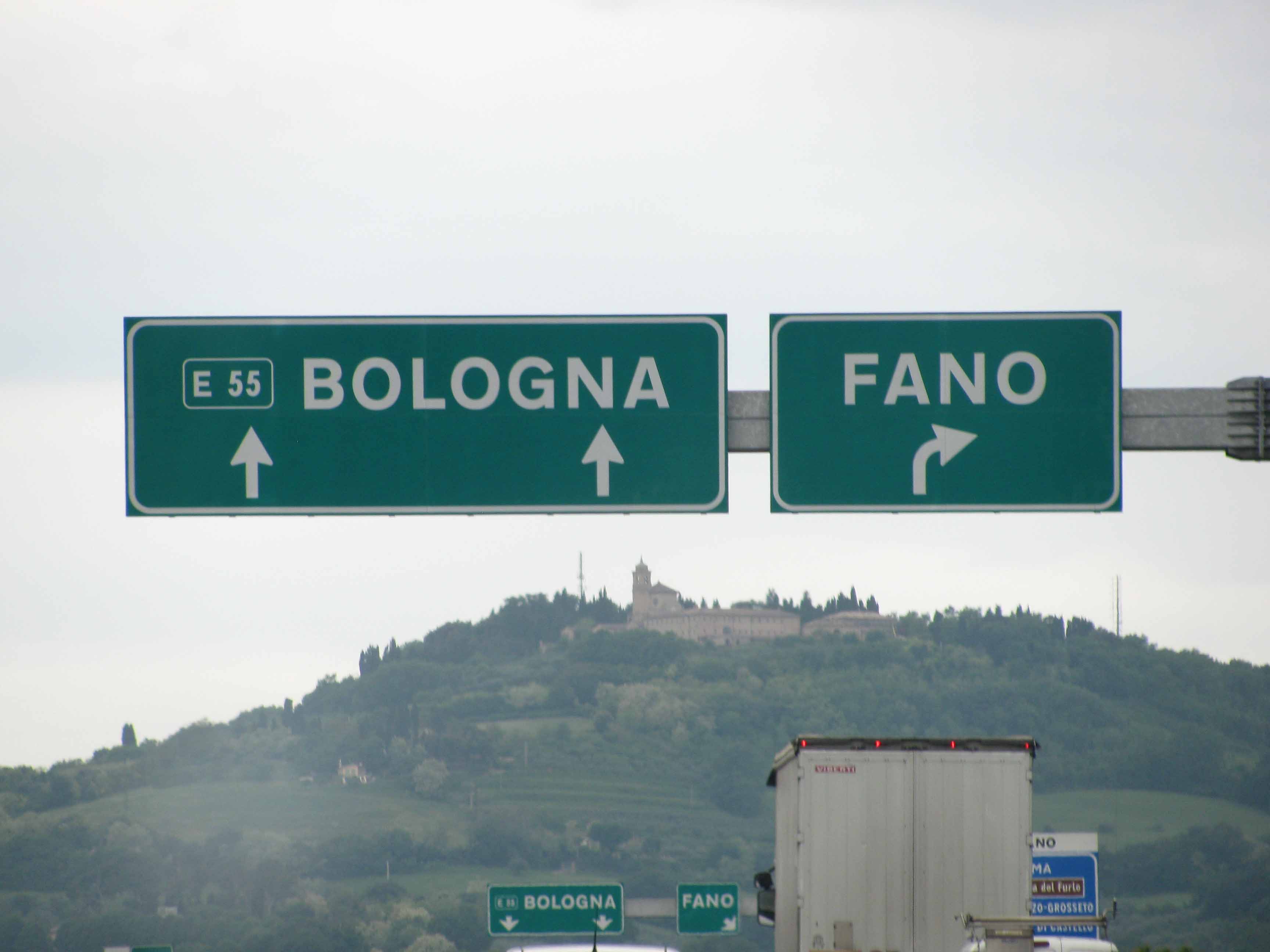
Re-tracing our steps so soon is unbearable so we join the coastal A14/E55 motorway north to Bologna then come off just past Rimini – and San Marino – on the E45 expressway southwest back to Arezzo. This way is 170 miles and should take about 3h30.

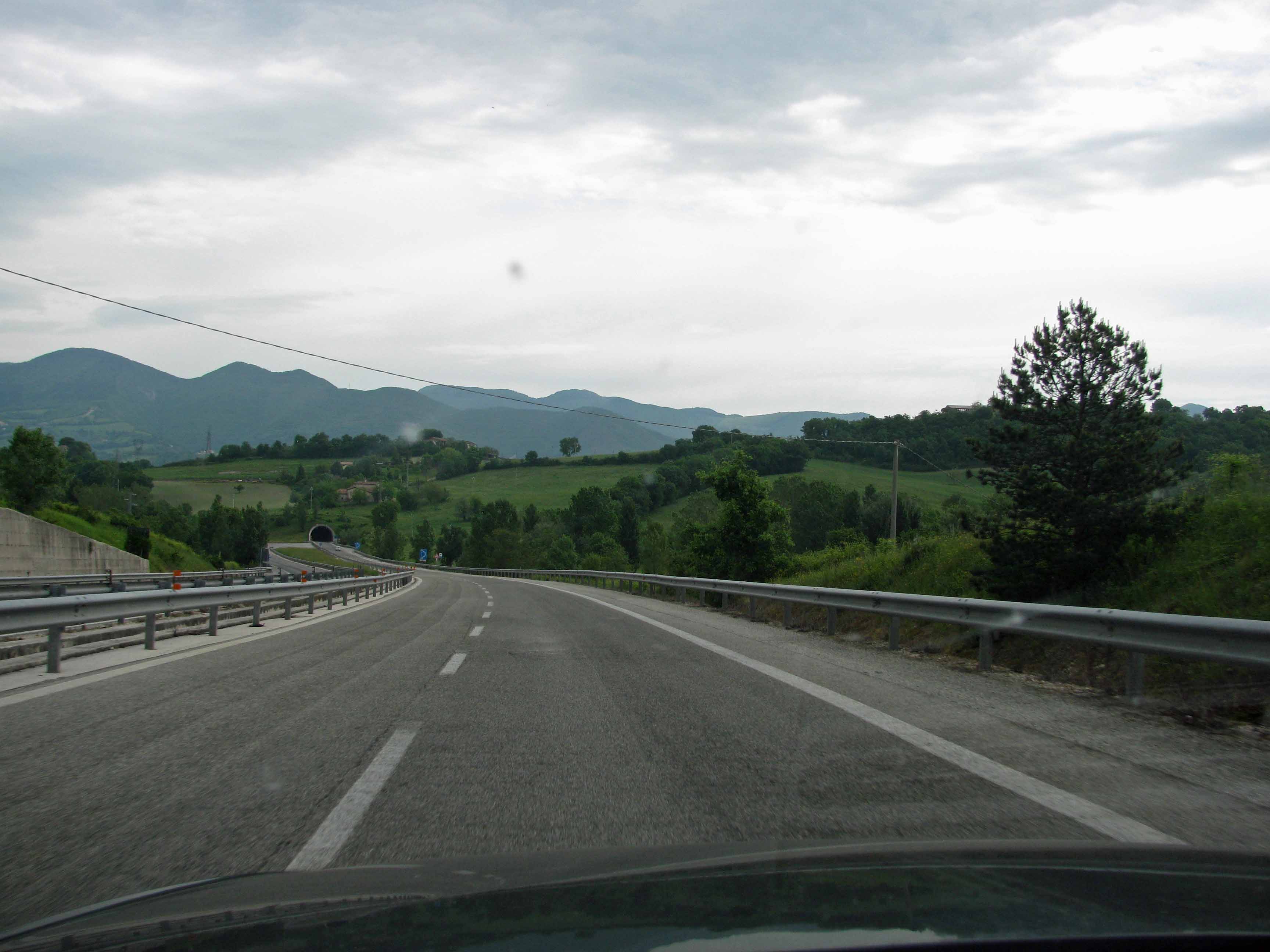
A14/E55 is being completely overhauled, roadworks most of the way, but it’s not that busy on this early afternoon Friday. Otherwise it’s a typical italian motorway: narrow lanes, very fast and nice scenery though there isn’t much of a sea view.

99xx

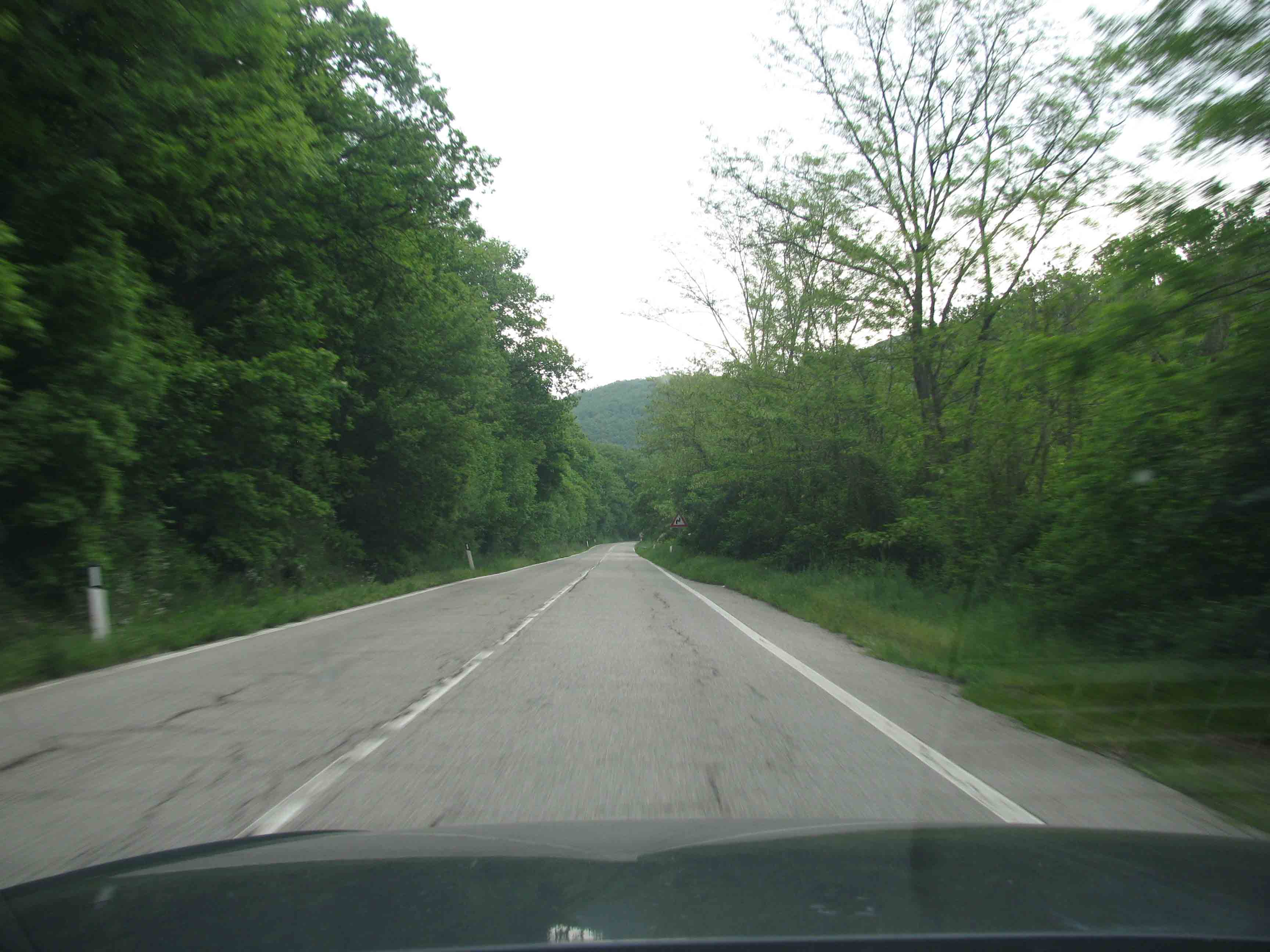
Initially the E45 expressway Via Tiberina is in shocking condition, lots of potholes and very bumpy but it smooths out later on.

12

The scenery is very rewarding.

13

On the way into Arezzo we cross paths with the Lamborghini Grand Tour. A policewoman stops traffic as a line of Lamborghinis approaches. They are on their way to do what we did yesterday only in reverse order, before a night in Bologna.

14

It lacks imagination to stay in Arezzo again – Siena is only 40 miles south west – but we feel bad for not having had a proper look round; we’re here; the Continentale has a room available – that roof top terrace is a bit attraction – it’s religiously clean and not bad value, even if breakfast is terrible (anything hot is extra).

Considering the kind of place it is, there are not that many hotels in Arezzo, certainly not parades of five stars as you might expect: ancient and beautiful but not chi-chi.

14a

Arezzo Cathedral sits at the top of the – surprisingly – steep hill on which the old town is built. Started in the late 13th century, the façade was finished in the early 19th century. This site has been continually occupied by a Bishop since the 4th century.

The cathedral is the largest but least impressive of the churches. Most intriguing is the square-towered Santa Maria della Pieve with rows of tiny cloisters (loggias) up the west wall, and the Episcopal Palace with random stone shields of various designs attached to the façade. Stunning, but hard to photograph in fading light.

The Early Renaissance painter Piero della Francesca (b.1415) was born and lived in Arezzo and one of his frescos can be seen in the rough faced Basilica of San Francesco. Another notable was the humanist poet Petrarch, born in 1304, who coined the term ‘Dark Ages’ and heavily influenced the development of the modern Italian language.

15

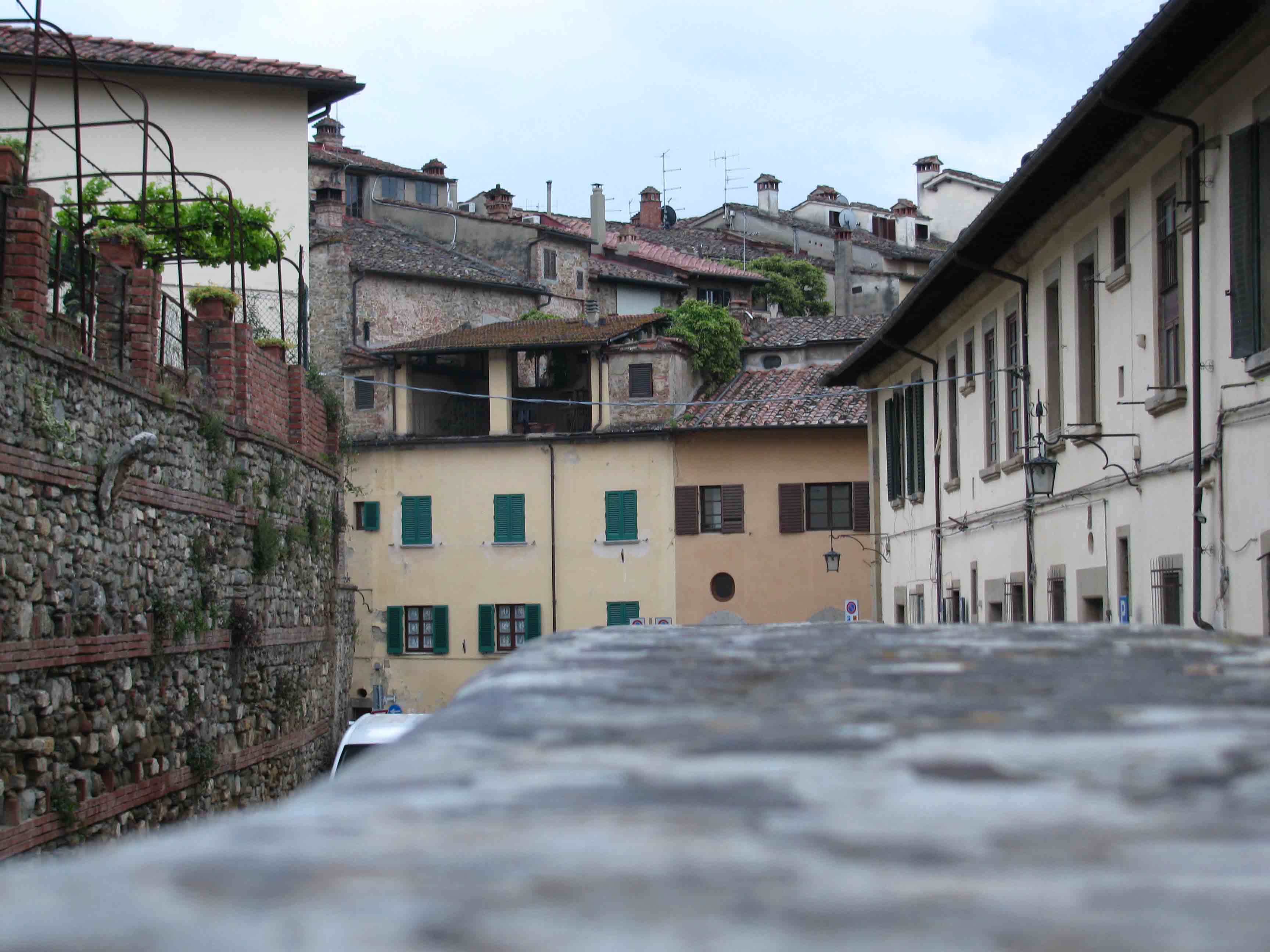
It’s a classic historic town to wander around though there’s an uneasy alliance between cars and pedestrians in this completely pavement free zone.

21

Arezzo was founded by the Etruscans, the ancient Italian civilisation who lived here in the millenium before Christ and gave the regions its name: Tuscany.

Renamed Arretium by the Romans, the town became an important staging post on Via Cassia, the major (round-about) road between Rome and Genoa in north west Italy.

40

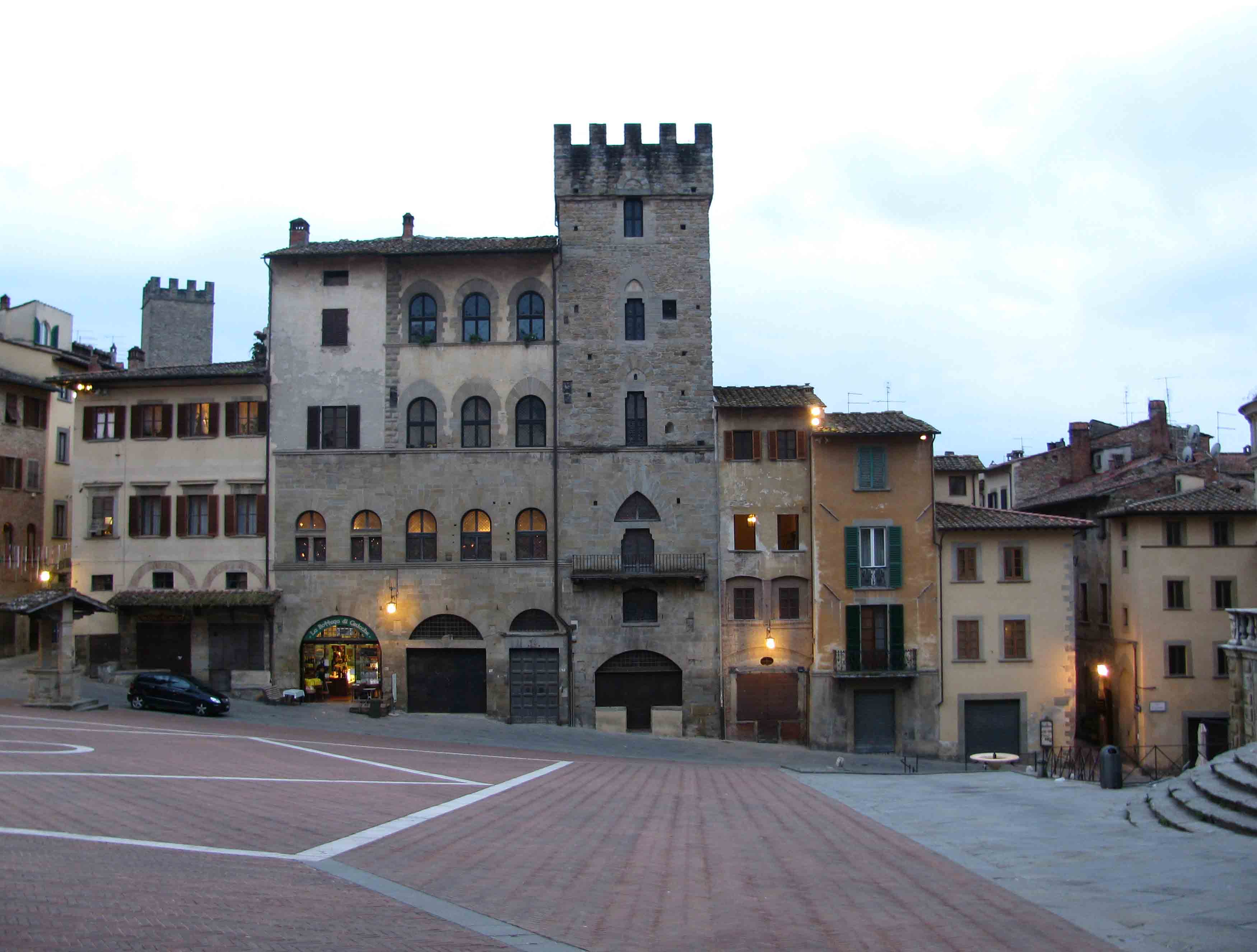
Piazza Grande: at the top of the hill behind the cathedral is the main square (one of several). There were a few restaurants but nowhere obvious to sit for a beer. That said, the other half of the hill is a formal park which we didn’t check out, probably full cafes, and nice views of the Arno flood plain too we suspect. So it’s back to our roof-top terrace.

.

Next: catching the ferry from Italy to Greece – how much, how long, what’s it like? And the sunset.

.