The Berlin-Dalmatia expressway. Coming soon

A new motorway between Prague and Linz cuts the drive from east Germany to the Adriatic.

D8/ E55 between Prague and Dresden.

D8/ E55 between Prague and Dresden.

The Berlin-Dalmatia express

A new motorway in the Czech Republic will plug an obvious gap in the central European road network.

Running the 150 miles north-south from Prague to Linz (Austria), the D3 will be especially handy for trips between eastern Germany and the Adriatic coast. It cuts the 730 mile Berlin-Rijeka drive to under 650 miles.

As well as being a popular destination for its tourists, many of whom drive there, Germany has long held sizeable business interests in Croatia and many other Balkan countries.

The new road will have the added benefit of linking České Budějovice – aka Budweis, the beer’s original home – to the fast road network for the first time.

Only 10 miles is motorway at present, around Tábor, fifty five miles south of Prague. Another twenty miles further south is under construction.

The European Commission has announced 50% funding for prep work on a new stage linking Budweis to the completed Tábor road.

The EU's map of the link between Budweis and Tabor

The EU’s map of the link between Budweis (České Budějovice) and Tábor (not marked).

The prep should be complete by April 2014 and final construction dates announced soon after. It will be a fair while before the entire route opens.

D3 is part of the 2,054 mile European route E55, from Helsingborg, Sweden, to southern Greece via central Europe and the Italian Adriatic coast. Just over 1,600 miles is motorway currently. Other gaps include the Italy/Austria border and in southern Italy.

Building on the first Czech motorways started in 1938. Citizens needed suitable roads to go with the cutting edge cars turned out by their car manufacturers. Look out for our upcoming feature on the country’s historic motorway network.

For information in English on Czech roads, including toll rates, click here.

Daily Briefing 19 Feb 2013

Good Morning! Welcome to our daily briefing for Tuesday 19 February 2013.

We don’t want to speak too soon but it’s looking like another great day folks, only minor disruptions.

For the latest and breaking news please see our Twitter feed @DriveEurope, see right.

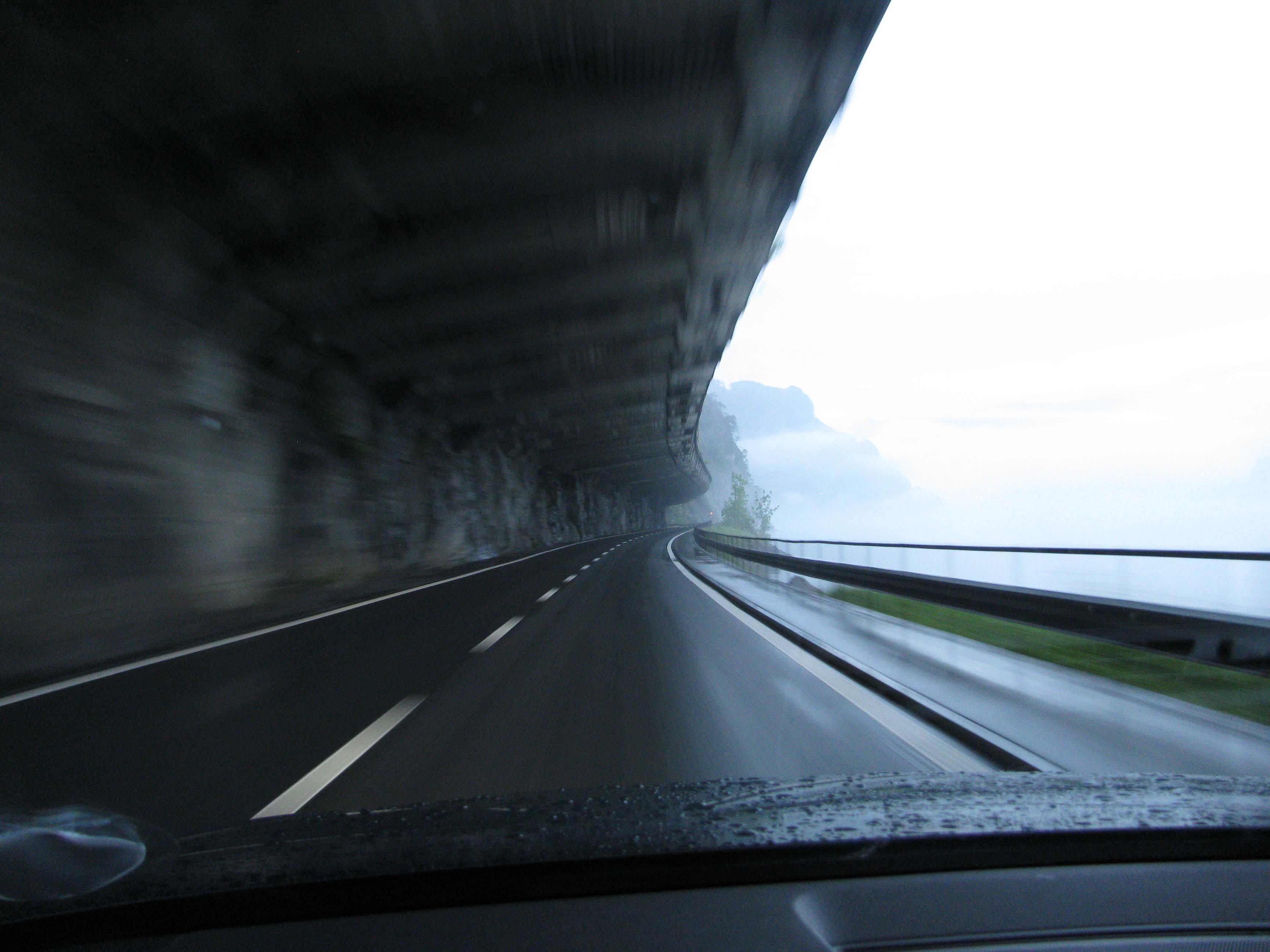
Random picture: 6:35am, the east bank of Lake Lucerne near Altdorf, Switzerland, 23 May 2012. The only hotel room left was a €560 junior suite at the Schweizerhof thanks to the World Rowing Championships. So that meant a night in the car, albeit parked beside the lake, and a very early start to avoid awkward encounters with the local police. It can never, ever fill the hole left by the 911 but our Audi A4 Avant, as intended, makes a reasonably comfortable place to sleep.

Random picture: 6:35am, the east bank of Lake Lucerne near Altdorf, Switzerland, 23 May 2012. The only hotel room left was a €560 junior suite at the Schweizerhof thanks to the World Rowing Championships. So that meant a night in the car, albeit parked beside the lake, and a very early start to avoid awkward encounters with the local police.
It can never, ever fill the hole left by the 911 but our Audi A4 Avant, as intended, makes a decent place to sleep. Amazing car though the 911 is, it will never, ever be somewhere you want to spend the night.

WEATHER

No severe weather warnings in Europe for today. For the latest click here. For the weather-where-you-are click here.

Snow, ice, low temperatures and high winds will affect most parts of Germany, northern Poland and the eastern Baltic region.

Heavy rain and storms likely in south west Spain, southern Italy and Greece.

Winter sports – predictions of ideal skiing weather are being born out on the slopes. For the latest click here.

CURRENCY

Figures from Monday 18 February, indicative ‘travel money’ rates from BBC. Guide only.

£1 buys €1.1350 – €1 is 88p – €5 is £4.40. The rate is unchanged from yesterday.

For other currencies click here.

CROSSING THE CHANNEL

As of 08:30 GMT, most services running normally. For the latest BBC Ferry Travel News click here.

The 13:30 Transeuropa Ferries Ramsgate-Ostend has been cancelled due to a technical problem.

For the latest updates by operator click links below:

P&OCondor FerriesBrittany FerriesTranseuropa FerriesEurotunnel – Stena Line

DFDS – Dover StraitWestern ChannelNorth Sea

TRAFFIC

For live traffic information in the following countries click the links below:

AustriaBelgiumFranceGermanyNetherlandsSwitzerland

Is electric car cold weather performance really that bad?

If electric cars don’t work so well in the cold then why do the Norwegians buy so many of them?

Meanwhile, in Other Tesla News: round up of NYT spat; the new $30,000 saloon while vital Q4 2012 financial results are due this week.

norway tesla coupe

Reduced battery power in low temperatures is one of the supposed main disadvantages of electric cars.

The terrible range in cold weather was a serious problem,’ writes Autocar’s Hilton Holloway about his time running a Nissan Leaf.

Sales of electric cars in Norway have been exaggerated but, per capita, the north west European country – famous for its sub-zero climate – has the most EVs in the world. The Nissan Leaf was thirteenth best selling car there last year.

Tesla tackled the issue head on last week with some compelling testimonials from its Norwegian customers. There doesn’t seem to be a tree-hugging leftie among them.

Jan S. Sørensen (his son, pictured) said, ‘I have used my Roadster every day for nearly a year now and this winter I have been in several ski resorts in Norway. I have attached a photo from Hemsedal. My son and I drove 250km in –20 C with skis on the skirack and full ski equipment in the trunk. The coldest temperature we experienced was – 25 C (when the picture was taken) but we had no problems with the car. Since December we have experienced very low temperatures and had temperatures below -10, -15 and -20 C in long periods.’

Other Norwegian customers provide back up in the comments and we didn’t see any complaints. DriveEurope is not in a position to judge the rights and wrongs of the issue, or whether cold weather affects particular EVs more than others. But clearly it is not as cut and dried as some might like to think.

A Tesla Model S on the German autobahn at an indicated 171kph - 106mph, on the company’s recent central Europe dealer tour. The cars make their final stop in Copenhagen on Friday and Saturday, 22-24 February. Contact for details.

A Tesla Model S on the German autobahn at an indicated 171kph – 106mph, on the company’s recent central Europe dealer tour. The cars make their final stop in Copenhagen on Friday and Saturday, 22-24 February. See www.teslamotors.com/copenhagen for details.

Cheaper Tesla due soon

Affordability is one of the other major disadvantage of electric cars. Including the £5,000 government grant, the Nissan leaf retails at £23,995 in the UK. The Model S costs about €72,000 in Europe (UK prices TBA). The upcoming Renault Zoe supermini though starts at £13,650. Last week, Tesla said its next car will sell for $30,000. The so-called BlueStar project, a medium-sized saloon car, is expected in 2015/16.

Spat roundup

Did you know Tesla is pronounced ‘Tessla’? That was one of many things we learned from Thursday’s ugly public spat between Tesla boss Elon Musk and the New York Times.

Musk called NYT’s highly critical report on the company’s Model S ‘fake’.

Green Car reports has a comprehensive round up of round one here. See the NYT original article, Elon Musk‘s rebuttal and NYT‘s reply.

Since then CNN replicated the NYT route saying ‘it wasn’t that hard’ but adding the trip would probably have been quicker in a petrol powered car.

We predict an outbreak of peace. There are enough cracks in the arguments for the conflict to seep away.

Update 20.02.13: we were right that peace would break out. The two sides seem to be settling down now with the latest more amenable blog post from Elon Musk. But that comes in the wake of a column – titled ‘Problems With Precision and Judgment, but Not Integrity, in Tesla Test’ – by the venerable Margaret Sullivan, The New York Times Public Editor.

Update 24.02.13: The New York Times cannot leave the issue alone! The spat was subject of another roundup on 22 February with a harder line than previously. Margaret Sullivan issued a clarification of her earlier blog post on the subject saying, ‘My opinions… are not those of The Times.’

Another blizzard of publicity this week…

Whether Tesla needs the media on side anymore will become clearer on Wednesday. The company will release its highly anticipated fourth quarter 2012 results at 17:30 EST (21:30 GMT). Late last year Elon Musk said the company was in trading profit for the first time, followed by a negative report from an analyst. It’s going to be another interesting week for the world’s most controversial car company.

UPDATE: 24.02.13: Gosh, what a boring conference call that was. All participants droned on. The upshot is that Tesla lives to fight another day. The $75m loss for the quarter was larger than expected balanced by a full order book and a successful move to full production capacity. The closing share price before the results was $38.54. They opened the next morning at $36.49 and at $35.72 on Friday. The shares finally closed at $36.11.

Daily Briefing 18 Feb 2013

Good Morning! Welcome to our daily briefing for Monday 18 February 2013. Not much to report today.

For the latest and breaking news please see our Twitter feed @DriveEurope, see right.

Fog in the Ardennes, Belgium. Not unusual. The weather in the forested part of eastern Belgium is notoriously quick to arrive and slow to leave. Visitors may be alarmed, the locals carry on oblivious. E25 south from Liege in eastern Belgium towards Luxembourg, May 2012.

Fog in the Ardennes, Belgium. The weather in eastern Belgium is notoriously quick to arrive and slow to leave. Visitors may be alarmed, the locals carry on oblivious. E25 south from Liege in eastern Belgium towards Luxembourg, May 2012.

WEATHER

No severe weather warnings in Europe for today. For the latest click here. For local weather click here.

Mild warnings over fog and snow/ice in Germany, Belgium and southern Netherlands, southern Norway and southern Finland.

Storms southern Italy; mild earthquakes reported in central Italy over the weekend, click for more.

Patchy fog across France.

Sunny only in Athens and Gibraltar, highs 15° C.

Winter sports – looking good for skiers in the Alps this week generally. For the latest click here.

CURRENCY

Figures from Friday 15 February, indicative ‘travel money’ rates from BBC. Guide only.

£1 buys €1.1350 – €1 is 88p – €5 is £4.40

For other currencies click here.

CROSSING THE CHANNEL

As of 08:30 GMT, all services running normally, for more click here. For the latest updates by operator click links below:

P&O – Condor FerriesBrittany Ferries –  Transeuropa FerriesEurotunnel

DFDS – Dover Strait – Western Channel – North Sea

TRAFFIC

For live traffic information on the following countries click the links:

Austria – Belgium – France – Germany – Netherlands – Switzerland

HEADLINES – BBC programmes hit by 24 hour strikeDavid Cameron on trade mission to IndiaCountry & Western star Mindy McCready found dead

A nice pull over: Pantano de Oliana, Spain

There are no facilities bar the shade of the road passing overhead, lots of places to hide behind for a wee and a massive wheelie bin for rubbish.

March 2008

March 2008

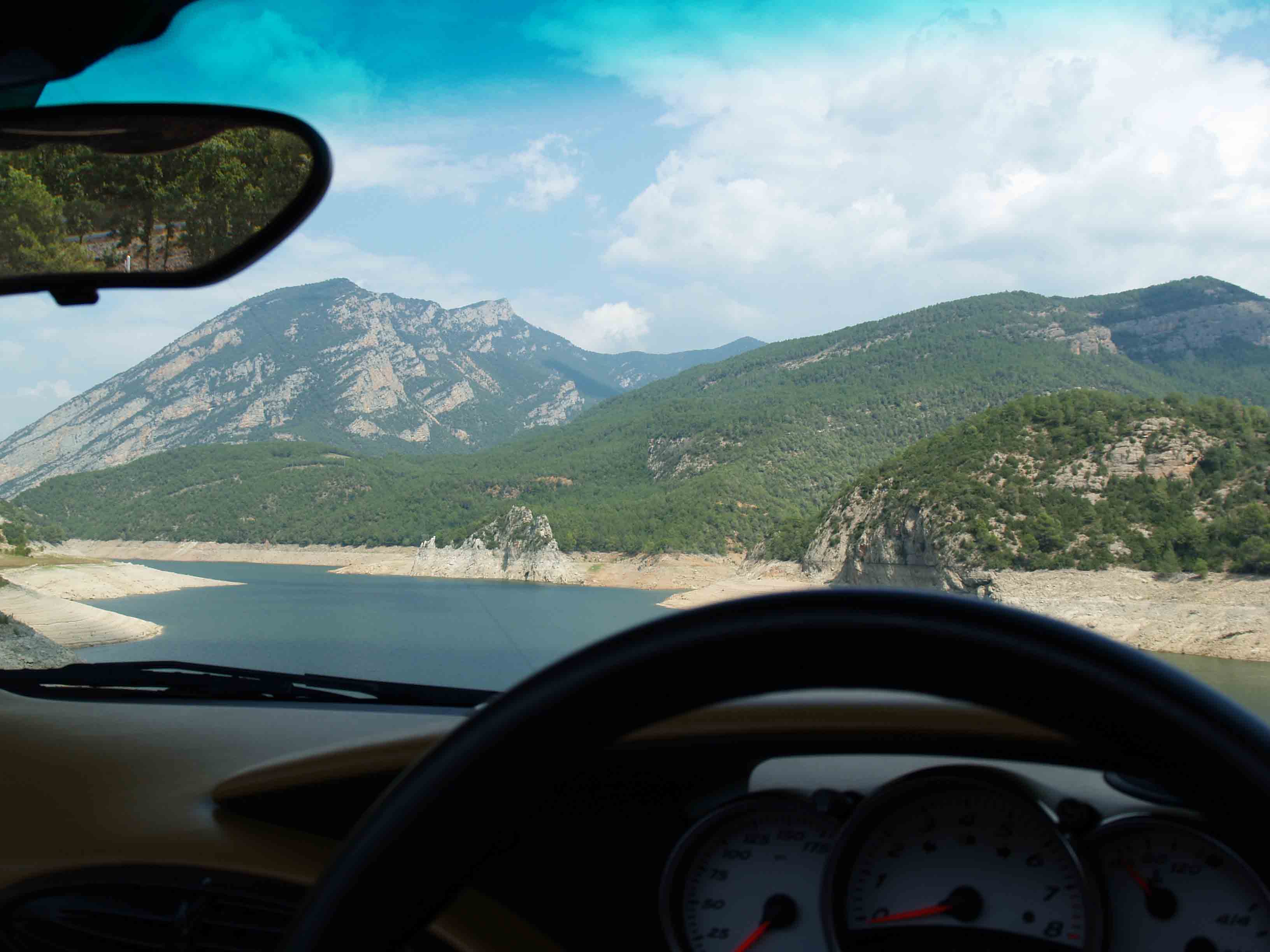
Non-deliberately we’ve stopped here twice. The Pantano de Oliana is 85 miles north west of Barcelona, on the C14 between Lleida and Andorra, in the north east of Spain and north west of Catalunya. Both times were a few years ago but, according to Google maps, nothing has changed.

In September 2006 we were heading south to the Ebro Delta past Tarragona, with 130 miles to go (most of it on the C14). The delta is an unspoilt area of marshland on the coast with quiet beaches and lots of wildlife – including Peregrine falcons (though they call them Maltese falcons) – next to the wild Els Ports national park.

In March 2008, we were heading north, to Perpignan, just over the border in France, with 120 miles to go. The long drop down into the city is along the spectacular Têt river valley through the Rousillon wine district.

September 2006

September 2006

Oliana is the village a mile south, population 2,000, well known for being the birthplace of the Taurus electrical appliance company. The old part is set on a hill with a ruined mediaeval castle, Romanesque church and an ‘ice well‘ museum with an original well, 5m in diameter, and zig-zag corridor to keep the heat out.

There was a controverisal plan to build a dual carriageway by-pass around Oliana a few years ago but it seems to have been dropped.

A Pantano is a hydroelectric dam reservoir, in this case dammed off from the River Segre.

The large peak on the left is El Coscoller, 4,420ft, part of the Serra de Turp ridge in the southern foothills of the Pyrenees. The village is 1500ft above sea level.

Hiking and climbing are well established in the area and there are skinny roads all over. There are plenty of campsites in Oliana but just one hotel, the well regarded Hotel Cal Petit. It has great views, a restaurant, breakfast terrace and rooms €60-150. The owners are motorbike fans but don’t hold that against them.

Romantic journey: Mrs Simpson’s desperate drive across France

Wallis Simpson motored to the South of France hoping that the Abdication crisis – and dense fog – would blow over. The press were in hot pursuit. We recreate the journey, based on contemporary reports.

.
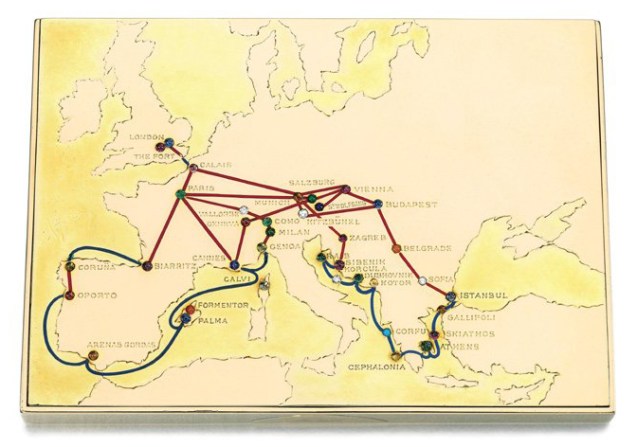
For Christmas 1935, Mrs Simpson gave the then Prince of Wales this gold Cartier cigarette case, decorated with a map of their travels around Europe. Each of their holiday stops was marked with a precious stone. Her journey this time was to be almost as convoluted. The box recently sold at Sotheby’s for £181,250.

For Christmas 1935, Mrs Simpson gave the then Prince of Wales this gold Cartier cigarette case, decorated with a map of their travels around Europe. Each of their holiday stops was marked with a precious stone. Her journey this time was to be almost as convoluted. The box recently sold at Sotheby’s for £181,250.

In early December 1936, two weeks after King Edward VII first told the prime minister he wanted to marry Mrs Simpson, the abdication crisis built to its climax.

On Wednesday 2 December British newspapers finally threw off their self-imposed censorship over an affair long played out in the rest of the world’s press. The ‘biggest news story since the resurrection’ was fully out in the open.

The next day, the New York Times quoted a friend of an ‘angry’ Mrs Simpson saying, ‘She is now determined that she will not leave the country unless the king commands her to do so. She does not want it said of her that she quit under fire. If she leaves at all she wants to go with banners flying and not creep from the country secretively like a fugitive.’

Later the same day though that is exactly what she did. Thick fog enveloped the king’s country house Fort Belvedere near Sunningdale as Mrs Simpson, accompanied Lord Brownlow, the king’s advisor, chauffeur George Ladbrooke and Inspector Evans of Scotland Yard, left on the seventy mile drive to Newhaven, ultimately heading for Cannes.
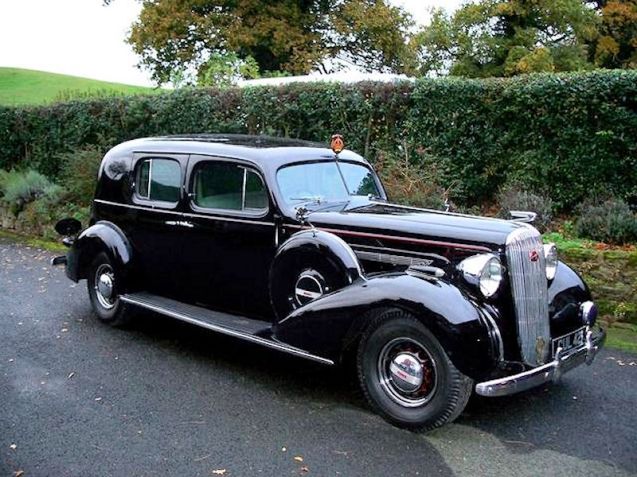
Mrs Simpson’s car was a Buick, identical to the king’s (pictured). To avoid accusations of disloyalty to the British car industry the chassis was re-bodied by Canadian coachbuilder McLoughlin. Powered by a straight eight cylinder motor and over 20 feet long, it could reach 60mph in 18.5 seconds. Dubbed ‘the most romantic car in the world’ at a Bonhams’ sale in 2007, the king's car sold for £100,500. Photo © Bonhams.

Mrs Simpson’s car was a Buick, identical to the king’s (pictured). To avoid accusations of disloyalty to the British car industry the chassis was re-bodied by Canadian coachbuilder McLoughlin. Powered by a straight eight cylinder motor and over 20 feet long, it could reach 60mph in 18.5 seconds. Dubbed ‘the most romantic car in the world’ at a Bonhams’ sale in 2007, the king’s car sold for £100,500. Photo © Bonhams.

Despite the conditions, they made the 10pm sailing of SS Brighton, reaching Dieppe in the early hours. The press were waiting for them on the quay side.

Their only advantage was that journalists weren’t sure where they were headed. They managed to shake them off initially until a brief stop at the Grand Hôtel de la Poste at Rouen at 3am when a customer recognised them and took a picture.

They turned towards Paris but by lunchtime had almost doubled back on themselves to Évreux.

At the Hôtellerie du Grand-Cerf in the shadow of the cathedral, Mrs Simpson phoned the King, shouting over a poor connection, pleading with him not to abdicate. Flustered, she left some notes in the phone booth, under the noses of reporters, later retrieved by the manager and kept in the hotel safe.

Fog gave way to sleet and driving snow as they motored past Orleans. Unexpectedly they then turned west, seeming to confirm that Mrs Simpson was really on her way to Biarritz on the Atlantic coast.

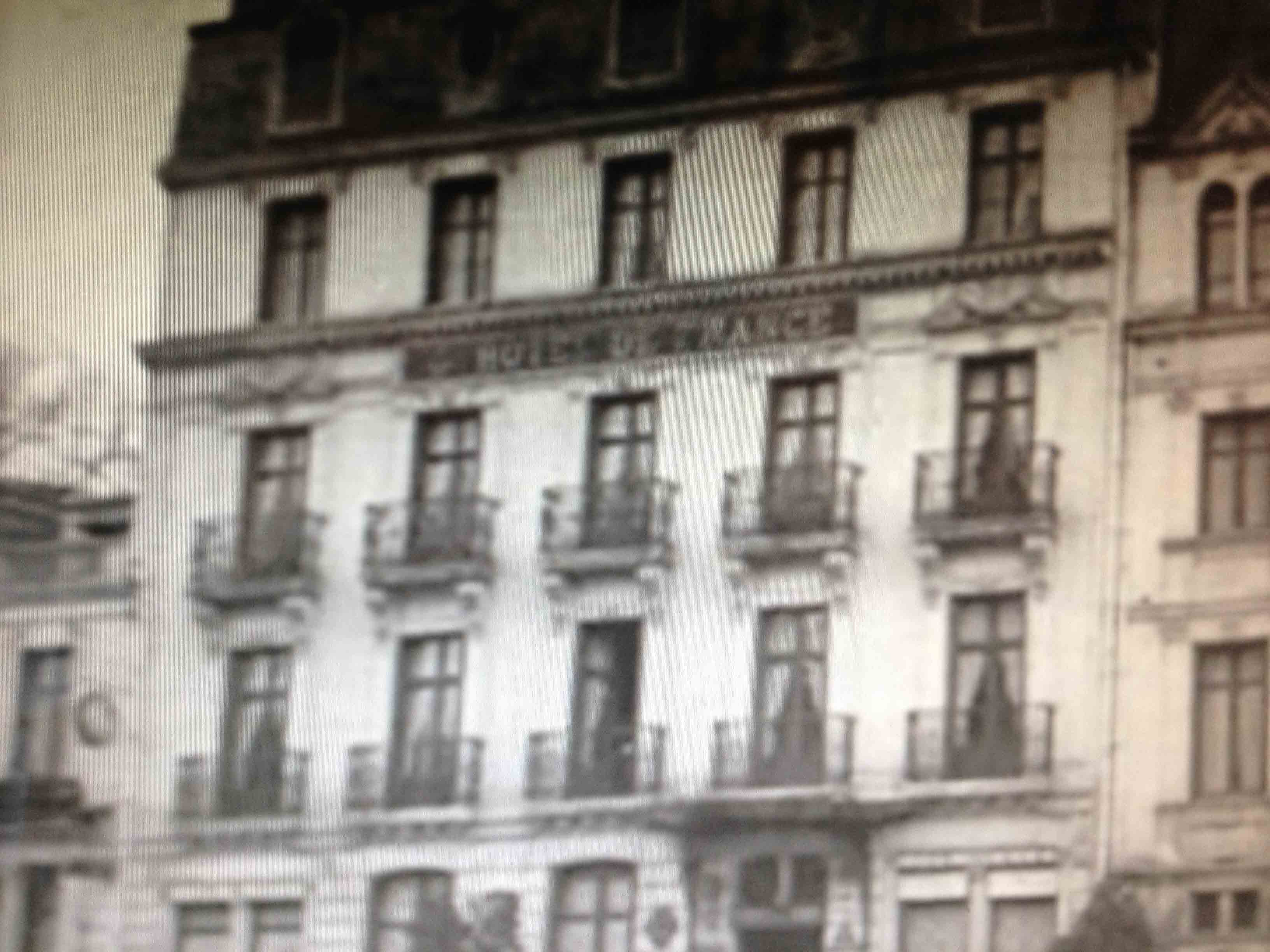
The Hotel de France at Blois, still open today. © British Pathé

The Hotel de France at Blois, still open today. © British Pathé

Shortly after they checked in to the Hotel de France at Blois, twenty four reporters gathered outside (watch the British Pathe news reel here).

The next stage of the journey would inevitably give away their final destination so they tried to put reporters off by booking an alarm call for 9am while really intending to leave at 4am.

But for the newspaper reading public the trick might have worked. Reports soon emerged from Châtellerault that Lord Brownlow had tried to buy some aspirin.

To make matters truely miserable, after breakfast at the Hotel de Paris in Moulins, the flask of whiskey in Brownlow’s pocket shattered. They couldn’t even open the windows because it was snowing too hard.

After a high speed chase through the streets of Lyon, journalists finally caught up with them at the Restaurant de la Pyramide in Vienne.

Mrs Simpson dined on pâté de fois gras, shrimp salad, fowl, and some sips of white wine before leaving through the kitchen window.

By 18:00 they were in Avignon, 140 miles from Cannes. The final leg, ninety miles on ‘twisted’ roads from Aix-en-Provence, took three and a half hours. They finally arrived at Villa Lou Viei, in the hills above the town, at three minutes to midnight on 5 December. The 830 mile drive had taken fifty five hours.
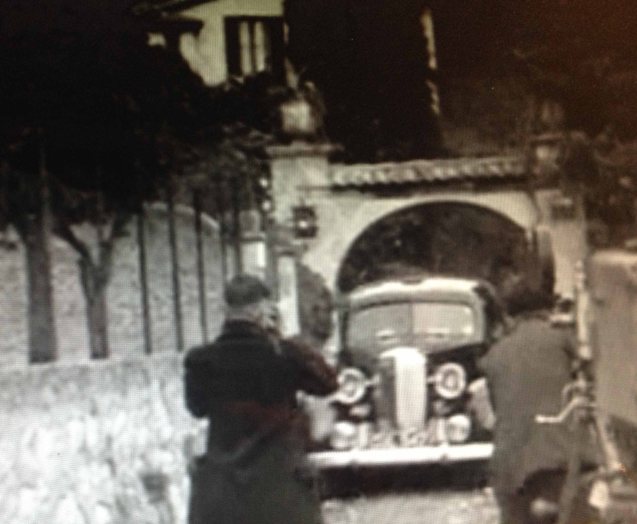
Mrs Simpson’s car arriving back at Villa Lou Viei, Cannes, on 7 December 1936 © British Pathé

Mrs Simpson’s car arriving back at Villa Lou Viei, Cannes, on 7 December 1936 © British Pathé

Progress had been torturously slow in the early stages. By Friday evening, after thirty hours travelling, they were only 275 miles from the start. However, in twenty hours almost continuous driving on Saturday they covered a very respectable 540 miles, especially given the conditions and state of the roads.

Mrs Simpson’s luggage – eight trunks and three suitcases – had already arrived. She stayed in bed until noon the next day when onlookers saw her on the terrace outside her room wearing, apparently, a pale pink négligée.

A few days later, in the face of frenzied speculation and continuing crowds outside the villa, Mrs Simpson said she would ‘withdraw forthwith from a situation which has been rendered both unhappy and untenable’ but it was too late. The king abdicated the following Friday and left the country immediately, bound for Austria. He sailed from Portsmouth on the destroyer HMS Fury to Boulogne where he was met by the Orient Express.

The couple didn’t meet again until their wedding at Château de Candé near Tours in June 1937.

.

Lost in the Auvergne

The plan was to drive to Spain on the motorway. But after pulling off the A31 seventy odd miles past Nancy – in response to a sign for Hotel Moderne at Montigny-le-Roi – we quickly reconsidered.

A random chateau somewhere south west of Montigny-le-Roi, eastern France

A random chateau somewhere south west of Montigny-le-Roi, eastern France

It was late. Montigny-le-Roi, up the hill from the hotel, was pitch black and deserted. The only lit building was the bar. We sat outside in shirtsleeves with a couple of beers. Presently, the idea of racing to Barcelona just seemed wrong.

So the next morning we set off cross country heading south west, navigating by compass – and good luck – after our ridiculously large scale map proved useless.

Consequently it’s impossible to say exactly where we went… Foothills soon gave way to the Massif Central mountain range, cutting down through the Auvergne.

Random roadside chateaus were the least of it. On the outside hairpin bends the view turned 270° through the windscreen, literally breathtaking, or at least breath-catching.

We ended up, late again, at Ambert after 280 miles.

The A13 Brennerautobahn. Not bad for a motorway

Just because it’s a motorway doesn’t mean it’s a horrible road. They go through the same landscape as everything else.

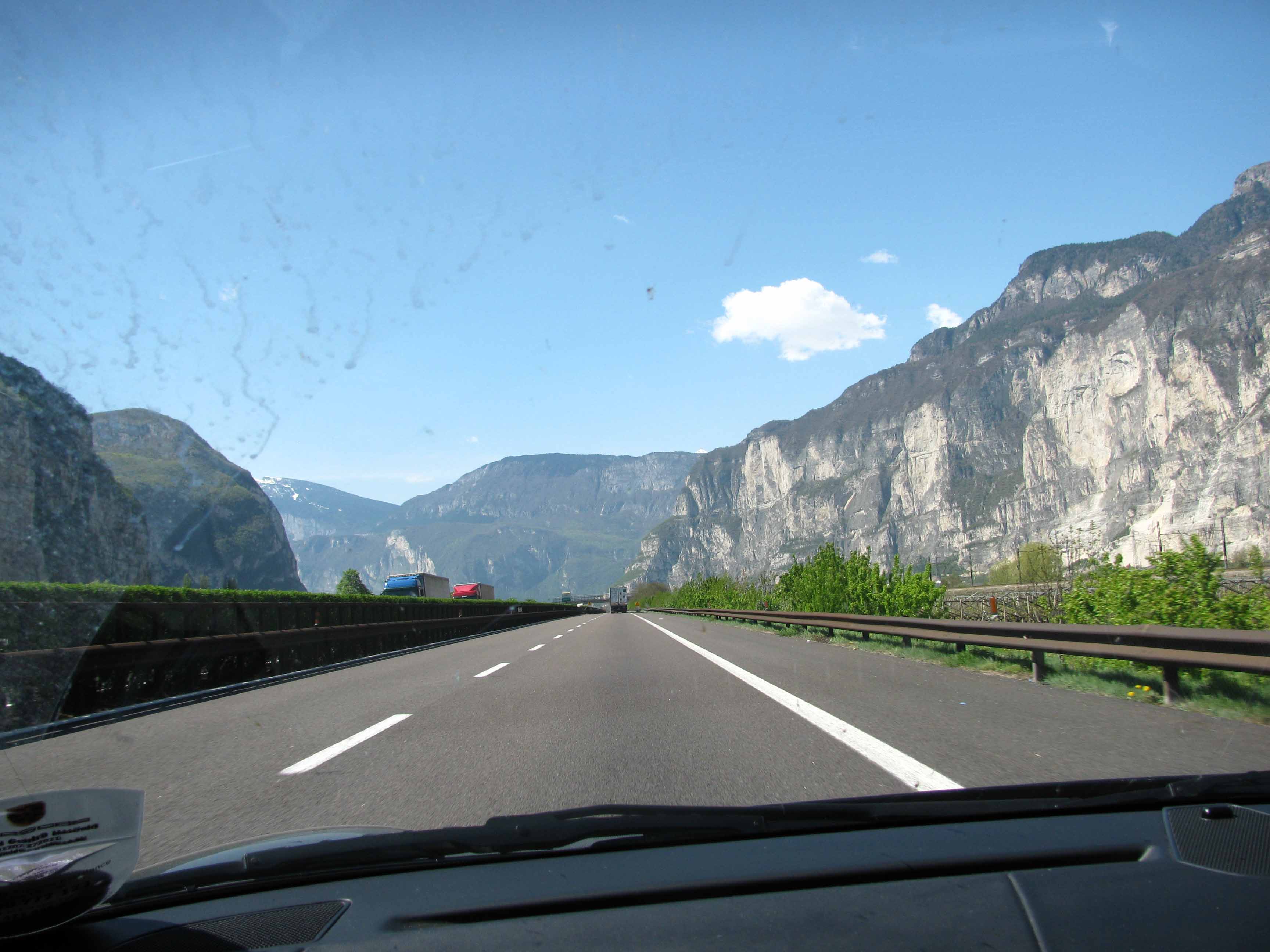
The A13 Brenner motorway in Austria, heading to Rome, 480 miles away. It’s mid morning, Wednesday 21 April 2010.

Heading south to Rome from Innsbruck, 480 miles, on the A13 Brenner motorway, Wednesday 21 April 2010, mid-morning.

The A13 Brennerautobahn, Austria

Particularly not bad for a motorway is the A13 Brenner road running due south from Innsbruck into north east Italy (part of the 3,000 mile Sweden-Sicily European E45 route).

The A13 is one of the few Austrian motorways not covered by the vignette toll sticker, you have to pay separately, but it only costs €8 for the 30 miles to the Italian border.

As the name suggests, the road crosses the Brenner Pass, one of the major historic routes through the Alps, not least because it only reaches 4,500ft. We’ve used it quite a few times because it’s the best way to avoid Switzerland – and its €33 one-size-fits-all toll sticker – to and from south east Europe.

An even better alternative

Running – more or less – alongside the A13 is the B182 Brenner National Road, the scenic route. A classic valley road, through small towns and villages, often in sight of the River Sill. Funnily enough the A13 – away on stilts mostly – is not obtrusive at all.

We spent an absolutely memorable night in the wooden Parkhotel in Matrei-am-Brenner in September 2006.

This road is also a great back-way in to Milan. At Vipiteno head south west, descending gently into the Po Valley on quiet, switchback country roads.

Meanwhile, the A13 becomes the A22 over the Italian border and continues south to Verona. Go left for Venice, right for Milan and Turin, or straight on for Florence and Rome.

An iron curtain, from Gretna to Berwick-upon-Tweed

The big guns are arguing about the implications of Scottish independence. A physical border between the UK and Scotland could be the least of it. Introducing: rUK.

4065c

From an agreement between a few north western European countries in 1985, the open-border Schengen Agreement – named after the town in Luxembourg where it was signed – has since grown to encompass the entire EU (plus even Iceland, Norway and Switzerland).

Like adopting the Euro, Schengen is now a prerequisite for joining the club, and for good reason. The Zone facilitates the free movement of citizens, an essential part of the single market, a fundamental pillar of the whole enterprise.

It’s a grand staircase of ifs and buts, but if Scotland voted for independence, and if it had to apply for EU membership like any other country – which both European Commission president José Manuel Barroso and the UK government’s legal advice (published yesterday) says it would – our northerly neighbour might have to throw open its borders to allow hassle free travel to and from the Continent.

There would be some advantages. Scottish citizens could go on holiday without passports. Not insignificantly, Scotland would also be included in the Schengen visa. Currently, visitors from outside the EU pay £25 for a Schengen Zone visa plus another £78 if they want to come to the UK.

That’s why France gets 600,000 Chinese tourists a year, Germany 400,000 while the UK welcomes just 200,000 (2011 figures).

Assuming that what remains of the UK didn’t then sign up to Schengen – and we can be absolutely sure it wouldn‘t – potentially that means a policed border between Scotland and England. Indeed, Home Secretary Theresa May gave some credence to this possibility in March 2012.

To paraphrase Winston Churchill, ‘From Gretna in the Solway Firth to Berwick-upon-Tweed in the North Sea, an iron curtain will descend across the land.’

Scotland says it wants to retain Sterling and the UK opt out from Schengen. After last week’s EU budget negotiations, who knows what it could achieve in accession talks?  But powerful voices in Europe wouldn’t be happy to see Scotland achieve seamless re-entry in case it encouraged their own separatist regions (Catalunya in Spain is top of a long list).

Meanwhile, what about the remains of the UK, the so-called ‘rump UK’ or to give it it’s official short-hand, rUK?

Technically, the ‘United Kingdom of Great Britain and Northern Ireland’ – the signatory to all the EU treaties – ceases to exist. Great Britain is the island containing England, Scotland and Wales. Would rUK therefore still be a member of the EU?

The government’s legal advice says it would: ‘No weight can be put on such changes of name.’

However, it may be to rUK’s advantage to reassess the legal opinion in the event of a ‘Scexit’. It would be the ideal no-fault opportunity for Britain to re-negotiate its membership of the EU, or even leave.

Remember, the Scottish independence referendum next year means the entire issue will be done and dusted well before the much messier ‘In-Out’ EU referendum promised for 2017. Just saying.

Driving digest: Sweden, Luxembourg, France and Gibraltar

Our weekly round up of driving in Europe news: Congestion charges for foreign motorists in Gothenburg next year… winter tyre law test in Luxembourg… new speed restrictions on the Paris Périphérique… and continuing tensions between Spain and Gibraltar.

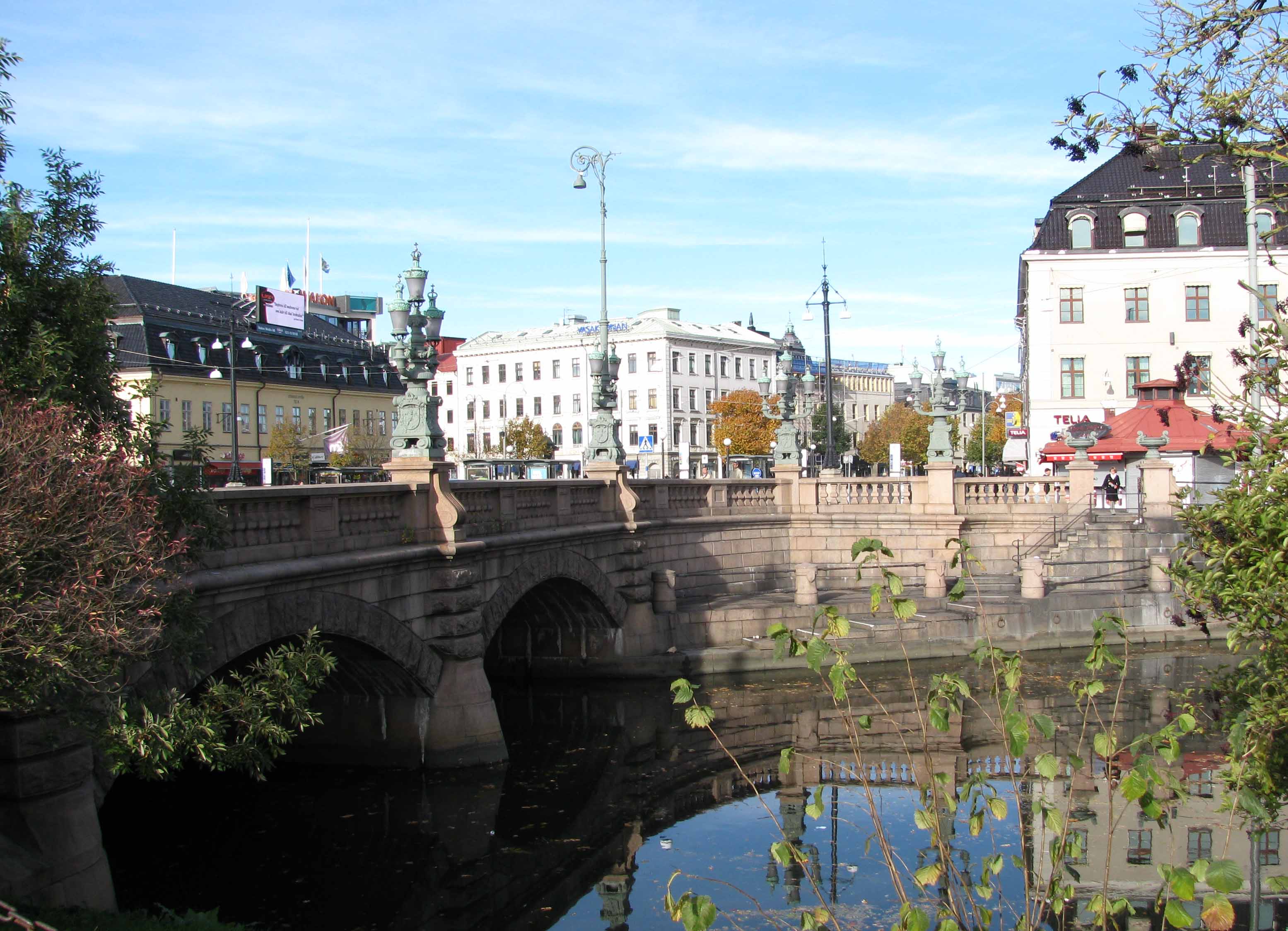
Central Gothenburg, October 2010

Central Gothenburg, October 2010

SWEDEN
As predicted, Gothenburg will levy its new Congestion Charge on foreign vehicles next year.
Newspaper Göteborgs-Posten quoted Sweden’s minister for infrastructure saying, ‘There is now an agreement at an EU level about the access to national vehicle registers, which makes it possible to charge foreign vehicle owners.’
This is the Prüm Treaty which the UK has so far failed to implement. Gothenburg authorities will also now be able to make changes to the zone’s boundaries, while the late payment charge has also been reduced.
The news comes a few days after 1,000 people turned out to call for a referendum on the congestion zone, introduced 1 January 2013, supported by the Motormännens Riksförbund, the Swedish AA. A similar referendum after the congestion zone was introduced in Stockholm in 2006 passed.

In other Sweden news, a drunk driver was let off after judges agreed his habitual drinking – before, during and after work – gave him a higher tolerance of alcohol than other motorists… Police investigating the pile up on the E4 near Helsingborg in January – the worst accident in the country’s history – say it may have been caused by two stationary cars. Early theories suggested a relaxation of winter tyre laws from 1 January 2013 – whereby winter tyres were only mandatory in snowy conditions, and even then only on the driven axle – seem to have been discounted… Finally, Swedish police are pushing for roadside narcotics testing equipment as currently used in Denmark, Belgium and Finland. Action is expected later this year. Officers currently measure pupil dilation with a (specialist) ruler.

On the way into Luxembourg from Belgium, looking forward to the cheap fuel, May 2012

On the way into Luxembourg from Belgium, looking forward to the cheap fuel, May 2012

LUXEMBOURG
This week’s heavy snow fall was the first test for new winter tyre laws in Luxembourg.
The tiny central European country, popular with transit drivers because of its cheap fuel – 112.18ppl petrol and 102.74ppl diesel average in January according to the AA – made winter tyres compulsory in snow and ice in mid-December 2012.
Some stranded buses initially came under suspicion until authorities revealed they were fitted with (fully legal) all-weather (mud and snow, M+S) tyres.
Police have also announced a crack down on motoring offences throughout the five week Carnival period from 7 February, particularly speeding and drink driving.

Approaching Paris, and the Périphérique, in September 2011.

Approaching Paris, and the Périphérique, in September 2011.

FRANCE
The speed limit on the Paris Périphérique ring road is set to fall to 70kph (43mph) ‘before the summer’ while the most heavily polluting vehicles could be banned from town centres at peak periods.
The plans were revealed by the Ecology Ministry this week as the European Commission gets serious about countries contravening EU air quality standards. Many countries, including Germany, Italy and Spain, are also at odds with the Commission over the issue – but not the UK.
The French may police the town centre bans with a windscreen sticker, final plans to be announced by the end of 2013. Be prepared for similar initiatives all over Europe soon.

GIBRALTAR
Tension between Gibraltar and Spain has moved off shore after a Spanish warship was challenged by a British navy vessel on Tuesday.
So far there has been no repeat of the border chaos at the end of last year when Spanish guards insisted on inspecting every car crossing in and out of the British overseas territory.
The incidents have been the subject of numerous official protests to the Spanish government and were even brought up in the European Parliament after a German family queued at the border for eight hours.
Webcams were set up on the border in December by a campaign group, see here.

Finally, a campaign for a 30kph (18.5mph) speed limit in urban areas across the continent is struggling to attract its target of one million signatures. Just 12,168 have signed so far.