Vauxhall’s intriguing new Cascada convertible

Somebody at Vauxhall has thought this through carefully. The Cascada’s price, spec, looks, engines and options see it hit a sweet spot. Seriously. It’s reminding us of the old Saab 900 convertible, still a firm favourite with touring drivers.

281474a

From amusing feel good gimmicks like motorised seatbelt presenters – remember those from the 1990s Mercedes SL? – to a heated steering wheel (the holy grail of convertibles) – a split folding rear seat (and a big boot) – a roof that raises or lowers at up to 30mph, lots of storage, fancy lights and the highly rated HiPerStrut front suspension: the Vauxhall Cascada looks like the complete package.

It’s about the same size as the Audi A5 Cabriolet but priced to compete with the Audi A3 Cabriolet.

281482a

The standard spec includes 18″ wheels, LED rear lights, cruise control, iPod connector and rear parking sensor.

Options include ventilated seats, dynamic ride controls, 20 inch wheels and an absolute raft of the latest electronic driver aids.

282145a

A six speed auto is standard on the torquey 1.6 turbo petrol, the first of a brand new engine range. There’s also a 1.4 turbo petrol and two 2 litre diesels. There aren’t any hotshoes as yet – the fastest is 0-60 in 8.9s. More powerful engines will be launched ‘in due course’.

Prices start at £23,995. Nobody’s driven it yet, there aren’t even any at dealers. First customer deliveries are expected in March. We think Vauxhall could have a hit on its hands here.

For the low down on the Cascada see here and here.

Eurotunnel concerns; all change at DFDS; congrats P&O

Congratulations to P&O which won Best Ferry Company at the Globe Travel Awards last night.

Deep Concerns about Eurotunnel

Eurotunnel broke several of its own records in 2012 – it’s busiest day ever on the Jubilee Weekend; 1,100 pets and a million passengers carried over Christmas.

Even so, the company seems reluctant to rely just on organic growth.

Back in June it bought the three ex-SeaFrance ferries and leased them to MyFerryLink in a move that disturbed competition authorities. Now it has pitched for the contract to run the ports in Calais and Boulogne for the next fifty years.

A Eurotunnel spokesman told Lloyds Loading List, ‘Our core business being the management of infrastructure, it’s quite natural that we are interested in running these ports.’

A P&O spokesman said however, ‘We’d have a situation where the group with the biggest share of cross-Channel trade would be running a key port, where its own ferries are operating and where P&O, its biggest competitor, has the core of its business. It’s unimaginable… Eurotunnel diversifying is one thing but this would be a big step too far.’

Dover MP Charlie Elphicke told the BBC he was ‘deeply concerned’ about the deal.

The winner will be announced later this year or early 2014. Funding of up to €500m has already been granted for improvements at Calais from 2015, including a new dock.

Even more ominously, Eurotunnel chief Jacques Gounon told Lloyds in March 2012, when the contract was first mentioned, ‘Why not include the state-owned port of Dunkirk too?’

electricferry-1[1]

Alternative fuels for ships are top of the agenda ahead of controversial new ultra low sulphur emission rules in 2015. It’s unlikely to be the solution across the English Channel but for crossings of less than 30 minutes, electric power could be the answer. Last week a pure electric ferry, linking up the E39 across the spectacular Sognefjord in the south west of Norway, was granted a 10 year operating licence from 2015. The 260ft double ended vessel, carrying 120 cars and 360 passengers, is powered by two 10 tonne electric motors, topped up at each end in ten minutes. Sognefjord is the longest fjord in Norway at 127 miles, surrounded by sheer cliffs of thousands of feet. The ferry will ply between Lavik and Oppedal.

All change at DFDS

According to LD Lines’ latest newsletter sent out Wednesday, DFDS has taken over all the company’s UK-France routes.

The two entered into a joint venture over the short Dover Strait crossings last year, using DFDS branding, but this is the first we have heard that DFDS will also operate LD Lines’ longer crossings, Portsmouth-Le Havre and Newhaven-Dieppe (though actually it was announced in October… ).

LD Lines will continue to operate its route St Nazaire-Gijon(Spain).

DFDS also announced a restructuring of its UK business this week, merging its entire UK operations. It also runs Newcastle-Amsterdam and Harwich-Esbjerg(Denmark).

The company has also been notably aggressive with its marketing recently, declaring its Christmas offers first and a host of other inducements, like free flexible tickets. It is also very active on Twitter. One to watch in 2013.

The deal opens up exciting possibilities to mix and match routes to France and northern Europe.

Roads: Hungary E-toll & CZ confusion; a useful new road Finland-Russia

What’s happening to Hungary’s new toll system?

This story was updated, see below. For the latest news click here.

1843a

Hungary’s new electronic toll system looks set to miss its July 2013 start date. A contract to build and operate the system, reportedly the biggest public procurement project in years, was due to be signed in early January but the date passed without a signature.

The deal was already controversial since the second bidder had publicly doubted whether the winner could fulfill the work at the stated price.

It is unclear so far if a fresh tender will be announced or whether the winner will be given more time, possibly thirty days. A later announcement that the deal would be signed on 15 January also passed without confirmation.

The pay-as-you go tolls were to apply to vehicles over 3.5t though passenger cars could join voluntarily six months later. Hungary last re-jigged its road tolls in 2008 when it abolished its sticker vignette system in place of a paper coupon applied for at border outlets via telex. The system is governed by number-plate recognition cameras.

Drivers can buy 1 day, 4 day, weekly, monthly or annual coupons. In May 2012 we paid £8.50 for a week’s ticket. For the official Hungarian motorway’s site in English click here.

Meanwhile, the European Commission says it would launch legal action to prevent the cancellation or delay of a congestion zone in Budapest. A CZ proposal was voted down by the city council last summer. EU loans made to extend Budapest’s metro system were dependent on the CZ. Budapest is 1,070 miles from London.

Update: On 19.01.13: Hungarian financial website Portfolio reported that the winning supplier had withdrawn its tender. It also reported a government spokesman saying the e-toll project was still on track to start 1 July 2013.

A useful new road Finland-Russia

pp_12_road

It looks like a staggeringly mundane thing to announce: a €4.4m EU grant towards a 6km new bypass for the Finnish town of Hamina.

Okay, it’s one of the tiny number of road programmes in the current Trans-European Transport Network plan. Hamina, pop 25k, is an important port; home to one of Google’s three European data centres; an historic and rare star-shaped fortress city (like Palmanova near Trieste), and just 20 miles from the Russian border. It also gave its name to a class of carbon-fibre stealth ‘missile boats’ of the Finnish Navy.

But the real significance is that the new road will plug one of the gaps in the important 270 mile Helsinki-St Petersburg E18.

Even on the Finnish side, only half of the 113 mile road from its capital to the border is motorway. The bypass will be completed by December 2014. The entire section will be upgraded by 2017, part of the Nordic Triangle project to link the Scandinavian capitals.

The Russian side – the ‘Scandinavia Highway’ – is only motorway for the 35 miles out of St Petersburg. Otherwise this route is two lane with occasional overtaking lanes.

In August 2011, the Russian government announced plans to improve the road to three lanes each way. When complete it will link to the new M11 ten lane, 420 mile highway St Petersburg-Moscow, opening in time for the 2018 World Cup.

Motoring in UK is ‘notably’ cheaper than Continent says road tolls consultant

474b

The Coalition is considering tolling existing parts of the road network because motoring in the UK is ‘notably’ cheaper than on the Continent says a transport consultant.

Scott Wilson, associate director at Leigh Fisher Management Consultants, a specialist in road pricing, makes the explosive claim on his blog.

Plans for reforming UK roads were not released as expected at the Coalition’s Mid Term Review in early January though reports say the ideas have not been abandoned.

Wilson says, ‘Discussion has moved to whether something can be done to allow tolling on existing capacity. There is one view held by some that, despite UK fuel taxes being amongst the highest in Europe, that if tolls are taken into account, some motorists in Europe pay notably more per mile than those in the UK (Italy has tax on petrol at around EURO 0.02 less than the UK, but tolls would easily be more for those using the motorways).’

The Department for Transport currently says it will only toll existing roads where they have been ‘improved literally beyond recognition’.

Wilson’s own five point plan includes commercialising the Highways Agency and splitting it into local entities, ring-fencing road taxes for maintenance and improvements, a new regulator, encouraging private sector involvement and finally allowing charging, even on existing capacity.

Audi’s next generation of head – and tail – lights. Coming soon

Audi’s controversial headlights are about to make the next step


Audi’s LED day time running and headlights drive some people mad, and other people wild with desire.

We admit to being upset when, three months after buying an A4 Avant, Audi facelifted the range, including new DRLs. A cool, thin continuously illuminated band replaced what suddenly looked no more sophisticated than a string of fairy lights.

Irritatingly, the next innovation means current cars will not feel the dead hand of obsolescence so heavily on their shoulders. The tech in the upcoming Matrix LEDs is all in the – normal looking – main beam.

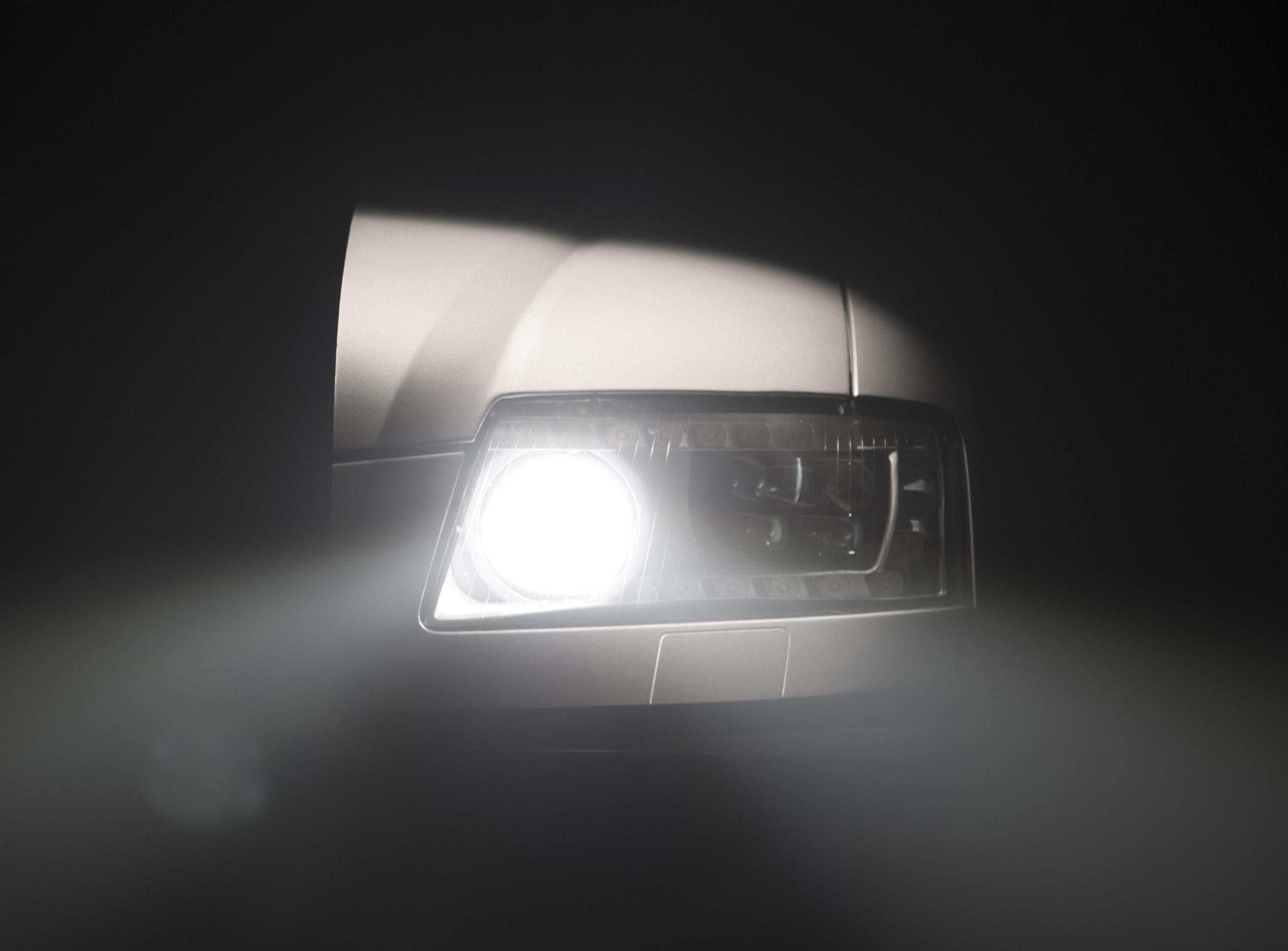
Made of multiple LEDs, each can be dimmed or switched off individually to avoid dazzling whatever is infront – another car, pedestrians, wild animals – all monitored via camera. They can full beam illuminate the spaces in between cars, on motorways for instance.

Backed with lenses or reflectors, and linked to the satnav, Matrix LEDs will automatically swivel on corners without complex motors like current adaptive lights.

Meanwhile, at the back, Laser Diodes – pointing slightly down – will project a red line on the road behind to show following drivers when they are too close. In rain or spray, the droplets catch the laser and turn the projection into a red (warning) triangle, visible even in thick fog or smoke.

At the Los Angeles Consumer Electronics Show last week, the company said it has overcome all the technical issues and will introduce Matrix LEDs and Laser Diodes on production cars ‘soon’.

After LEDs come OLEDs, Organic Light Emitting Diodes. Spread extremely thin and sandwiched between glass plates, with electrical current the whole surface lights up. The thinner they can make it the brighter it becomes. The plates can be arranged in any pattern, even to build 3D sculptures within the light housings, sure to impress your neighbours and friends. OLEDs can also be used on the car’s exterior to illuminate the door handles or main contours as the driver approaches.

Still someway from production reality is The Swarm, a development of OLEDs whereby the surface of the car itself is made into a light surface. Thousands of tiny lights react instantly to driver inputs, be that braking, accelerating or turning, leaving the driver behind in no doubt as to what the car in front is doing.

To see Audi’s nect generation lights in action see these videos on YouTube: Matrix LEDs; Laser Diodes; OLEDs; The Swarm. To read about all the tech unveiled by Audi at the 2013 Los Angeles Consumer Electronics Show click here.

Norwegian electric car sales have been exaggerated but are still significant. Massive subsidies.

We clean up the confusion over Norway’s green car sales

© Marek Nusl, doinitonline.com 'Murmansk Challenge'

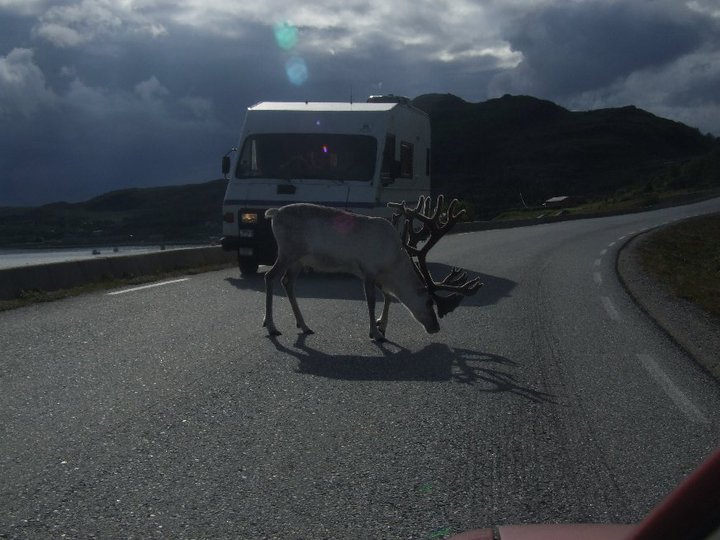
Near Nordkapp, northern Norway © Marek Nusl, doinitonline.com from ‘Murmansk Challenge’

Despite their alleged poor performance in wintery weather – Autocar says it drops off by 50% – electric cars have clearly had an impact in Norway. Sales though are not quite as good as many are suggesting.

Numerous reports say Norwegians bought 10,000 electric vehicles in 2012. In fact, according to official sources, 3,950 were registered (a 97.9% increase on 2011).

In the context of 137,967 total passenger car sales it’s a market share of 2.86% (compared to 0.1% in the UK). The 9,361 EVs currently on the road account for just 0.4% of the national car parc.

Even so, the Norwegian Electric Vehicle Association can justifiably claim, ‘This makes Norway the world leader on introducing electric vehicles. Norway’s capital Oslo is the EV capital of the world, with the highest EV density of any capital city.’

EVs enjoy a generous subsidy. They are exempt from import taxes – which make the cheapest VW Golf £27,000 – and 25% VAT. In sharp contrast to other countries, Norwegian EVs are around a third cheaper than equivalent conventional cars.

There are also no toll or congestion zone charges, municipal parking (and charging) is free and EVs can use bus lanes for faster commuting.

Additionally all electricity is Norway is hydroelectric making EVs, apart from the batteries, genuinely green (conversely, petrol and diesel, historically the most expensive in Europe, are now getting cheaper).

As of June 2012 the country had 3,208 charging points at 964 charging stations (compared to 1174 in the UK) in all parts of the country. 27 of those stations are fast charging with another 50 coming on stream.

The major constraint on the market is said to be lack of options. Overwhelmingly the best seller was the plug-in Nissan Leaf, thirteenth best overall in fact on 2,298 units (ranking 9th in October).

But with BMW’s i3 on sale later this year and Tesla’s Model S on sale in the summer, soon most levels of the market will be provided for (incidentally we cannot confirm rumours that Norway accounts for half of all European reservations for the upcoming Tesla Model S).

The big question is whether the rest of the world will follow Norway’s lead. Or, taking into account the unique environment, whether the rest of the world will be able to.

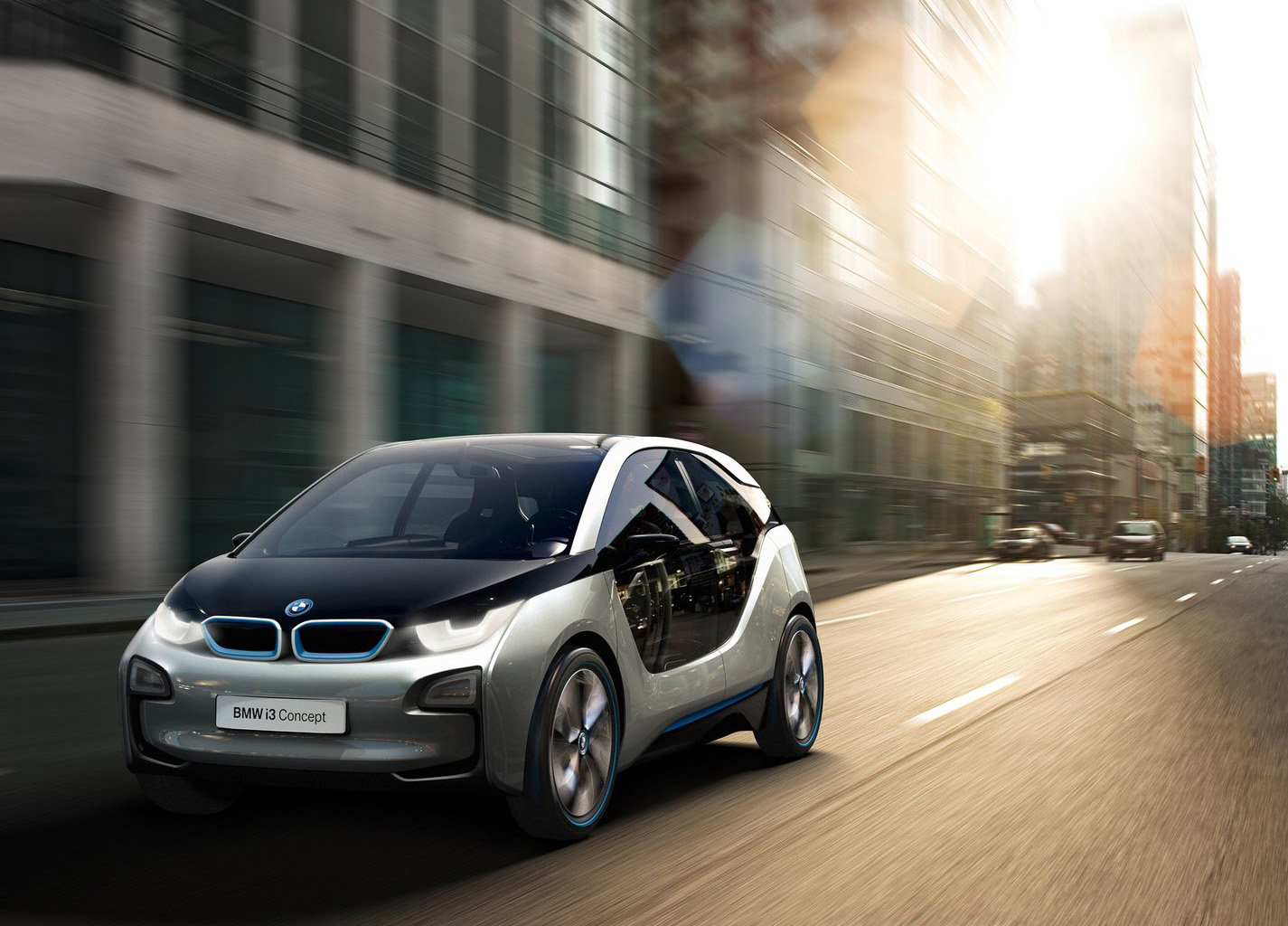
The new BMW i3, rear-engined and electric. It hasn’t got a hope, has it?!

In theory, BMW’s new plug-in city car couldn’t be any less appealing. In reality, it could be right on the money.

i3 city car a

2,237 electric cars were registered in the UK in 2012 according to The Sunday Times today. That’s almost exactly just 0.1% of the total passenger car market. But it’s nearly three times the number sold in 2011.

If you were the investment manager of a car corporation, where would you put your money?

According to a recent global survey by auditors KPMG – following disappointing worldwide sales so far, and buyers’ concerns over price, range and charging – only 8% of manufacturers will invest in pure electric cars in the next five years. Audi and Toyota have both canned their plans.

Meanwhile, 24% will focus on plug-in hybrids, cars powered by electric engines charged either from the National Grid as normal, or by small on-board internal combustion engines (ICEs). The rest will concentrate on conventional hybrids and ultra efficient gas, petrol and diesel power.

BMW is making a billion pound bet that the 8% are correct. Its brand new i3 city car – on sale later this year, previewed again at the Detroit Motor Show starting tomorrow – is powered solely by a 168bhp electric motor placed between the rear wheels.

This could be a double whammy for consumers well schooled in the received wisdom that rear-engined cars – like the VW Beetle, numerous Skodas and the Porsche 911 – are dangerous. However, electric motors are half the size of ICEs so drivers are unlikely to feel there’s a lump of iron slung out the back.

interiouer i3 b

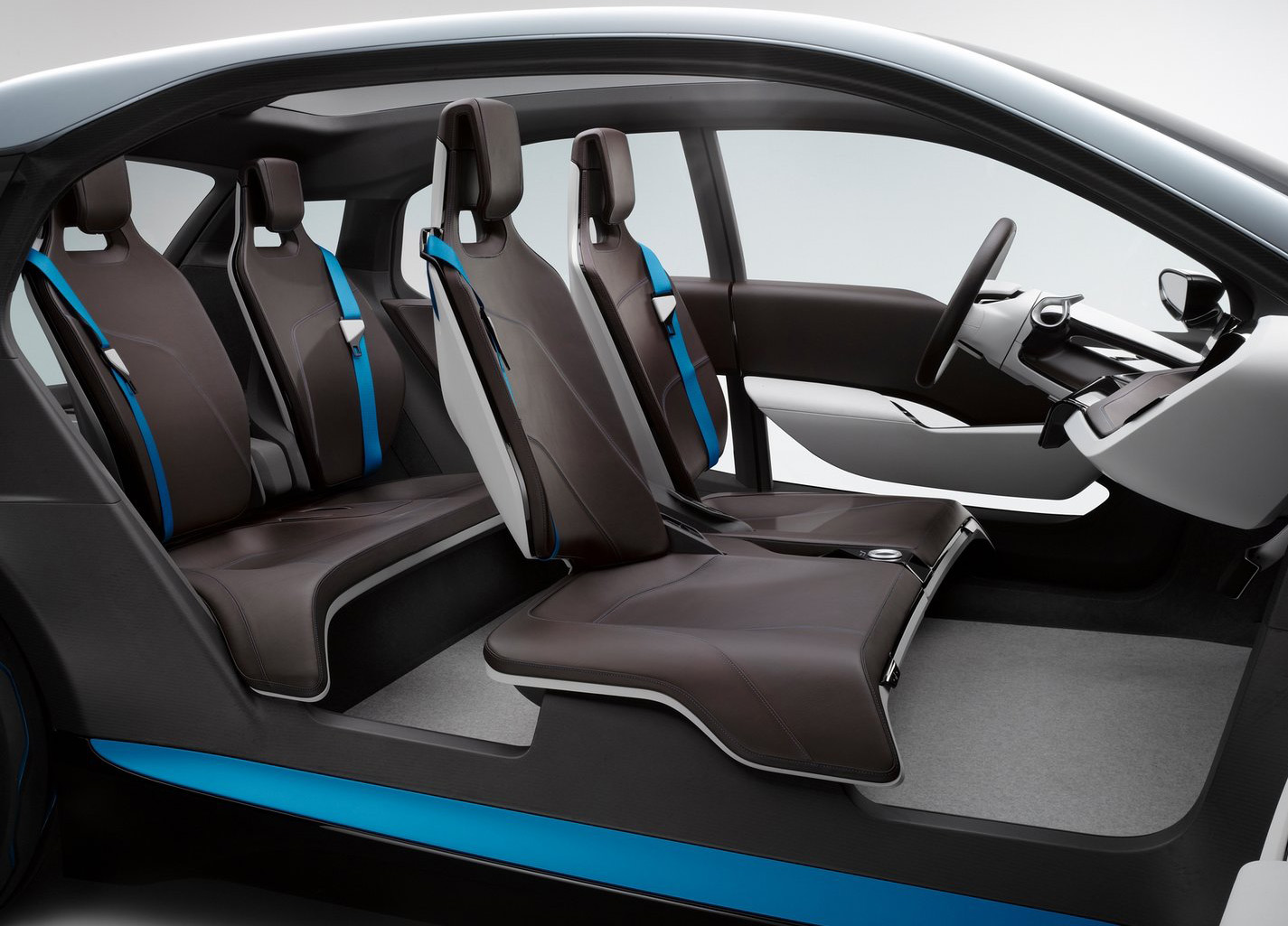
Conceived from the beginning as an electric vehicle, built from reclaimed aluminium with carbon-fibre reinforced plastic body panels (batteries tucked away in the floor pan) the i3 weighs a third of a tonne less than a conventional car. With no transmission tunnel or gear lever the i3 makes unhindered use of the space inside the bodyshell. Its inherently torquey electric motor sees 0-60 in under eight seconds while rear wheel drive and futuristic styling means the i3 lands bang on BMW’s precious core brand values.

The company’s research says its 100 mile range is all most people will ever need (the battery will recharge in 6 hours from a household socket, or 80% in half an hour from a high speed connection). The car also comes with a raft of bespoke internet technology and smartphone applications. That includes a fully integrated satnav which can not only direct the driver to the nearest charging point but, at the touch of a button, reserve it too.

Even more cleverly BMW is hedging its bet by offering a two cylinder petrol ‘battery charger’ as an option. This bumps the range to 250 miles (though it’s not clear what it does for the weight distribution!).

The i3 is a compelling package even on its own. Add in BMW’s market making ability and the launch of Tesla’s premium Model S in the summer (with its proven 200+ mile range). It’s clear the image of the electric car is about to receive a major boost.

Even exponential annual growth though would see only 72,000 electric cars sold in 2017, or 3.5% of the market. Current growth however is faster than merely exponential. On top of the threefold overall increase, it should be noted that 36% of UK sales last year were made in the final quarter.

Too much can be read into early figures. Yet-to-be-convinced drivers at least have the luxury of waiting to see what happens. But do car manufacturers? Either way, 2013 will be the year of the electric car. Future fortunes may be made, or lost.

Roads and tolls round up: Italy, Sweden and Bosnia

Italy toll rises and row, new hope for Budapest-Adriatic 5c, Gothenburg ponders foreign car charge

On the A22/ E45 Brenner Pass motorway, tolls rising by 1.2%

On the A22/ E45 Brenner Pass motorway, tolls rising by 1.2%

Annual increases on the Italian toll roads are still to be fully finalised. So far there’s an average rise of 2.91% though four operators are reportedly in dispute with regulators. Until this is settled prices will stay as they are on these particular roads, though they comprise a tiny minority of the national network.
Tolls on the Autostrade per l’Italia network, 56% of the whole – 25% owned, incidentally, by UK institutional investors – rise by 3.47%; charges on the all-important Brenner pass motorway to and from Austria rise by 1.2%. It will now cost €15.70 to drive the 150 miles Modena-Bolzano, for instance.
The biggest increase is on the Venice (Mestre) ring-road, up 13.5%, though the useful Turin-Aosta Valley E612/ A5 is the smallest at 0.82%. Calculate Italian motorway tolls here.

Driving down the Bosna River valley towards Sarajevo, May 2012, on the completed part of Corridor 5c

Driving down the Bosna River valley towards Sarajevo, May 2012, on the completed part of Corridor 5c

Corridor 5c (or Vc), connecting Budapest to the Adriatic Sea at the Croatian port of Ploče, via Bosnia and Herzegovina – mired in controversy and delays; subject of a notorious leaked Wikileaks cable, ‘The Road Not Travelled’ – received a welcome fillip this week when a contract to build a further 20km section south of Sarajevo was signed with a Turkish company. The project will employ 3,000 local workers.
If and when the road is completed it will cement Budapest as the major hub of the central European road network. We drove the existing part of this road in May 2012, click here for more.

We caught the Stena ferry to Gothenburg from Frederikshavn in Denmark. Sailing up the Göta River is a great way to arrive. Älvsborg Bridge is the western border of the city’s new congestion charge zone.

We caught the Stena ferry to Gothenburg from Frederikshavn in Denmark. Sailing up the Göta River into the city centre is a great way to arrive. Älvsborg Bridge is the western border of the city’s new congestion charge zone.

Gothenburg is not currently levying its new congestion charge on foreign registered vehicles but, according to the Roadpricing blog, Sweden’s second city is examining how it could do so in the future. A report is expected in February.
Even if foreign car charges are levied the max each day is about £6, with evenings, weekends and the whole of July, currently, free of charge. Traffic is down by 19% apparently since the introduction of the new zone on 1.1.13. Interestingly, Roadpricing also says London’s TfL has a 33% success rate in pursuing non-compliant foreign motorists.
At the same time, the Daily Mail has worked up some blather over the UK’s failure to implement the Prüm Treaty, whereby EU police forces have direct access to the DVLA (and DNA and fingerprint) databases. We face fines of £7.5m for each ruling if we do not adopt the treaty by the end of 2014. Absent any comment from the Home Office, it’s not clear if the matter is caught up in the 134 Lisbon Treaty opt-outs (which include the notorious European Arrest Warrant).

Destinations 2013: around Iceland, northern Germany and central France

Iceland’s terrifying ring-road, some background on the mysterious Bird Island, and Indre, ‘unknown’ France

Iceland
Independent perma-traveller Jennifer Dombrowski has written a short photo feature on driving Iceland’s Route 1, its 832 mile ring road, in the winter. ‘It’s not for the faint of heart,’ she says, ‘we had at least two ‘oh sh*t’ moments’. But they survived to tell a great tale (via @Laurel_Robbins).

Looking out from the NordSeeHotel at Husum, directly onto the emerging Bird Island, really

Looking out from the NordSeeHotel at Husum, directly onto the emerging Bird Island, really

Bird Island
A mysterious island has spontaneously emerged from the North Sea, fifteen miles off the German coast. Called ‘Bird Island’ for the time being, it’s already home to 49 plant species and countless migratory seabirds.
This region, Wattenmeer, or the enormous Wadden Sea National Park, land and sea, is a major stop on the East Atlantic Flyway, between the Arctic and South Africa.
Bird Island has built up steadily over 10 years by shifting sands and is now 34 acres and 16ft high according to the Daily Mail, though it could be subsumed in the notoriously rough seas at any time.
It’s an acquired taste this part of the world, no doubt, the western edge of the Great European Plain, around Hamburg and the Elbe estuary. The mainland, city excepted, has been described as ‘endless flat countryside, marshland and silver birch trees’.
Bird Island though is part of the Frisian Archipelago which stretches along the coast from Holland to Denmark via Germany. They are mostly haven’s of ‘health & wealth’ for the moneyed upper middle classes, including the ultra-exclusive Sylt, a hammerhead outcrop just short of the Danish border, with several Michelin starred restaurants, connected to the mainland only by car train.
The Dutch and Danish islands are better value, mostly car-free and very family friendly.
We visited in October 2010, staying in Husum, next door to the national park, and were literally blown away by the natural beauty. Strictly limited visits to Bird Island by tourists could be allowed in the summer.

Central France, near Nevers, from Route National 7, September 2011

Central France, near Nevers, from Route Nationale 7, September 2011

Indre
A chance encounter with Mark, an (English) chef on a New Year break from his rural restaurant in central France, lifted a veil on what was – for us – an unknown enclave in our nearest continental neighbour: Indre.
We almost looked for somebody else to talk to when we heard where he was from, this region is f-l-a-t. But it turns out the area between Poitiers and Châteauroux, is home to not just a large forest – Parc naturel de la Brenne – but also two former winners of the ‘most beautiful village of France’ award.
The park is bisected by the Creuse River, regularly dammed into lakes, with artificial sandy beaches, well known for watersports and, around, cycling.
Saint-Benoît-du-Sault, built around a Benedictine monastary founded in 974, on a rocky butte overlooking the River Portefeuille, is on the park’s southern edge.
Seventeen miles north east is Gargilesse-Dampierre, at the head of a gorge in the heavily wooded Creuse valley, built around a chateau and Roman church. Subject of numerous Impressionist paintings, the village was discovered by ‘George Sand’, aka Lucile Dupin, partner of Chopin, whose later trip to Majorca was immortalised in the brilliantly rude ‘A Winter in Majorca’.
If you find yourselves in the area, check out Mark’s restaurant – he’s a hardcore foodie, the lunch set menu is €11. It‘s the only one apparently in the tiny village of Lureuil, ten miles north of the capital Le Blanc in the west of the Brenne.

Road Tolls roundup: if not now, then when? Soon

157a

Surprisingly, there was nothing about road tolls in the Coalition’s Mid-Term Review published on Monday.

Well, nothing obvious. As AA president Edmund King tweeted after some head scratching, ‘Coalition mid-term review [to] invest in infrastructure by debt guarantees to support £40bn of privately funded infrastructure investment. How?’

At regular intervals last year the government dropped hints it was developing an initiative on road tolls, culminating in briefings to the Daily Telegraph, Daily Mail and the Financial Times on the last day of business before Christmas.

We watched the public reaction carefully and concluded that while there was (vocal) opposition, it was nothing like the overwhelmingly negative response seen in 2007 when the idea was last suggested.

It seems we are not alone in this assessment. According to the Financial Times yesterday, ‘George Osborne believes that the public would support paying to use roads if that boosted the likelihood of major improvements to the network.’

The FT says the idea is not being kicked into the long grass and that a timetable and consultation would be set out to make the idea work.

To recap: the government’s idea is to use road tolls to fund improvements via private investment with a structure similar to the utility industries.

The government is clearly treading carefully but apparently not slowly. Already this morning we read on a Kent news website that local (Tory) MPs Damian Collins and Charlie Elphicke have both been talking up the government plans.

One thing in particular has been bothering us. The EU is planning to roll out its own proposals for pan-European ‘Road User Charging’ in June but there has been no reference to it in the UK press. Surely even worse than tolls would a system at odds with what the rest of Europe will be doing?