Trucks Did Avoid France Over The Summer

New official figures shed more light on how the strike and migrant disruption affected freight crossing to the Continent this summer. Meanwhile, the number of UK-registered trucks continues to fall.

Meanwhile, the Czech Republic is in trouble with the EU over ‘Driving Licence Tourism’ – and other countries for not connecting to the EU driving licence network – while Poland still lacks an electronic register of haulier infringements, and has not implemented EU laws on ‘interoperable’ truck tolls.

Also, a heads up on ‘Snowmageddon’ and a roundup of closed mountain passes. DFDS told to warn passengers about ‘imminent impacts’. Warnings over new speed camera smartphone app. Serbia sets 2017 deadline for completion of in-build motorways.

.

TRUCKS AVOID FRANCE OVER THE SUMMER

Calais disruption hits July-September results but numbers grow strongly overall.

dunk truck

The number of trucks crossing from the UK to the Continent fell by 3% between July and September this year (Q3) compared to the same period in 2014 – but it was still the second best Q3 result since records began more than thirty years ago.

More than 718,000 HGVs made the crossing in the three months – split 525,000 trucks: 193,000 unaccompanied trailers – according to new figures from the UK Department for Transport.

However, the number of trucks disembarking in France fell by 8%, the first fall since 2011.

‘There is currently insufficient information to assess whether this decrease is a new trend or a fluctuation associated with disruptions at Calais and the closure of MyFerryLink,’ says the DfT.

However, numbers were up 15% to the Netherlands, to 42,000, and by 31% to Belgium, Spain and Denmark, to 9000.

‘These increases may represent powered vehicles rerouting from Dover Strait sailings to other ports,’ says the DfT.

Meanwhile, in the year to September the overall number of HGVs travelling from the UK to the Continent grew by 6%.

Volume is now 4% higher than the pre-recession peak in 2007 and has grown consistently since June 2012.

The bulk of the increase crossed via the Dover Strait – 111,000 of the extra 173,000 taking the total to just over 3 million. The Dover Strait takes two thirds of all HGVs with the remainder split 4% English Channel and 28% North Sea.

However, 94% of unaccompanied trailers go via the North Sea and 89% of trucks cross the Dover Strait.

The number of foreign-registered HGVs grew by 8% to just under 2 million in the twelve months to September continuing an upward trend seen since 2009. Foreign trucks have grown fourfold in the past 20 years.

UK-registered trucks were down by another 5% to 297,000, 14% lower than 2009. Numbers have been tailing off steadily since 1999 though the peak was in 1996 with a share of 52%. That has now fallen to 13%.

The biggest share now goes to trucks from Poland which have grown from 3% in 2004 to 21% now.

Next biggest is Romania on 9% followed by Hungary and the Czech Republic on 4% each and Bulgaria at 3%.

Since 2005 the Netherlands’ share has fallen from 13% to 9%, Germany from 11% to 6%, Spain from 7% to 6% and France from 11% to 5%.

Also: as the summer results from Port of Dover showed freight booming while tourist numbers fell, Q3 results from Dover-Calais/Dunkirk operator DFDS today say freight volumes increased by 4.7%, and passengers by 10.3%, even while one ship was laid up on the Calais route.

And: the Czech Republic is in trouble with the European Commission for failing to combat so-called ‘Driving Licence Tourism’. In the period 2004-2011 licences were apparently issued to people living outside the country. In addition, the Czech Republic has not connected to RESPER, the EU driving licence network, and neither have Estonia, Italy, Portugal or Slovenia. Meanwhile, Poland is being taken to task for not establishing a national electronic register of road transport undertakings – on authorisations, and possible infringements by hauliers – and thus not connecting with similar system in other EU states. Poland has not implemented EU legislation on ‘interoperability’ of electronic truck tolls either. The actions were all notified in the Commission’s November 2015 infringements package.

.

France's Col de l'Iseran closed for the winter today ahead of the expected, week-ending 'Snowmageddon', as has Switzerland's awesome Grimsel Pass (until 19 June 2016 according to TCS). Austria's Silvretta Hochalpenstrasse has also pulled the shutters down since our last roundup, but overall the amazing thing is that most high roads are still open*. That might change from tonight onwards - the latest forecast shows up to two meters of snow falling in the Alps until Monday (23 November), especially in the west, and up to 70cm in the Pyrenees and northern Spain. Snow will settle at above 200m to start with then work its way down to 700m. Overnight Saturday will see 5cm on the A43 near Chambery in south east France and 15cm between Annecy and Grenoble says @AutorouteInfo. Germany and Luxembourg are also likely to see at least a smattering. Photo @DriveEurope. *Petit St-Bernard, Galibier, Madeleine, Mont-Cenis, Croix de Fer, Glandon and Cormet de Roselend, all in France, all closed today too.

France’s Col de l’Iseran closed for the winter today ahead of the expected ‘Snowmageddon‘, as has Switzerland’s awesome Grimsel Pass (until 19 June 2016 according to TCS). Austria’s Silvretta Hochalpenstrasse has also pulled the shutters down since our last roundup, but overall the amazing thing is that most high roads are still open*. That might change from tonight – the latest forecast shows up to two meters of snow falling in the Alps until Monday (23 November), especially in the west, and up to 70cm in the Pyrenees and northern Spain. Snow will settle above 2000m to start with then work its way down to 700m. Overnight Saturday will see 5cm on the A43 near Chambery in south east France and 15cm between Annecy and Grenoble says @AutorouteInfo. Germany and Luxembourg are also likely to see at least a smattering. Photo @ASFINAG. *Petit St-Bernard, Galibier, Madeleine, Mont-Cenis, Croix de Fer, Glandon and Cormet de Roselend, all in France, all closed today for winter too.

.

roundup: CROSSING THE CHANNEL. Injuries sustained after an ‘unintentional and unexplained’ loss of steering control on DFDS Dover Seaways – which saw it hit the breakwater while departing last November – could have been prevented if ship staff had issued a ‘timely warning’ says the report by the Marine Accident Investigation Branch. Minor injuries were reported by ‘several’ passengers and crew. MAIB recommends DFDS improve crews’ response to emergency situations, including ship systems failure, and prioritise warnings when impact is imminent. SPEED CAMERAS. Intelligent Transport Systems consortium ERTICO highlights a new, free Android smartphone app from TomTom which marks positions of fixed and mobile speed cameras in real time. The locations are updated by 4.6m users says the company. However, as pointed out by @DriveGuideGuru, such applications are illegal in many countries and subject to heavy fines, notably France. SERBIA. All motorways currently in-build, including between Belgrade and Prishtina (Kosovo) and Nis and the Bulgarian border at Dimitrovgrad/Kalotina, will be completed by April 2017 reports InSerbia.info. ‘By the beginning of April 2017, we will complete all motorways that we have started building. We have been building them for decades and talking about this for 70 years. It will dramatically increase the number of people travelling in our country and lead to economic growth,’ said Serbian PM Aleksandar Vucic.

.

EU Responds to ‘Secret Road Toll Report’

As the Austrians alleged, the European Commission is mulling a system of road tolls in the EU, but the prime mover is Energy, not Transport.

Also, legal trouble for the upcoming Denmark-Germany Fehmarn Tunnel. A new motorway link boosts route between Rotterdam and Germany. A major road reopened to traffic in Brussels’ new pedestrian zone. New truck check-in lanes at Eurotunnel France.

.

Electronic road toll gantry, Austria. Photo ASFINAG

Electronic road toll gantry, Austria. Photo ASFINAG

On 4 November, Austrian motoring club OAMTC denounced what it called a ‘secret’ EU report on road tolls.

The Commission apparently wants to replace existing methods of road charging – in Austria’s case its beloved windscreen vignette sticker – with a pan-European system of pay-as-you-go tolls.

Two days later, AA President Edmund King said there had been ‘Much talk about road pricing [being] on the European Commission’s agenda’ at an FIA meeting in Brussels which both the OAMTC and AA attended.

Now a Commission Transport spokesman has exclusively revealed how such a system might work.

The new road tolls would actually be part of the EU’s Energy Union plan – rather the transport per se – and would tie car drivers into the EU principles of ‘User Pays’ and ‘Polluter Pays’. The revenue would go towards road maintenance.

It would work on the basis of an expanded Eurovignette Directive, a common system of electronic vignettes which currently applies only to trucks and five north European countries.

So-called ‘interoperability’, i.e. each country using the same or interchangeable system for seamless payment, would be used to rule out discrimination against foreign drivers.

In a statement, Jakub Adamowicz told @DriveEurope, ‘Matters related to road toll systems raise the question of a possible revision of the Eurovignette Directive. Such possibility would require further discussion but the objective would be to apply the principle of “user-pays” to support infrastructure maintenance.

In addition, the interoperability between tolling systems (EETS) could be further pursued and new provisions on passenger cars could be proposed to prevent discrimination of foreign users.

As part of the Energy Union project – which is one of the key priorities of the Juncker Team – the Commission will promote the use of road charging schemes based on the polluter-pays and user-pays principles and increase efforts to create a single European transport area, based on a more optimal use of the fleet.’

The Energy Union is a plan for ‘secure, affordable and climate-friendly energy’, run by Commission Vice President Maros Sefcovic (the boss of Transport Commissioner Violeta Bulc).

It was the subject of a major update briefing in Brussels today though there was no specific mention of road tolls. However, ‘Decarbonisation of Road Transport’ is one of the plan’s major aims, presumably hence the use of the phrase ‘more optimal use of the fleet’ in the EU statement.

Meanwhile, in an interview in January 2015, when Violeta Bulc first raised the idea of pan-European road tolls, she said the Commission would publish its proposals in eighteen months.

Next year has been earmarked ‘the year of delivery‘ for the Energy Union too.

.

Denmark-Germany ferry operator Scandlines will take the European Commission to the European Court of Justice saying its approval of the financing model for the upcoming Fehmarn Link amounts to unfair state aid. Due to open sometime early next decade, the tunnel underneath the Fehmarn Strait – on the direct route between Hamburg and Copenhagen - will be in direct competition with the Scandlines’ Puttgarden-Rodby route. The link was awarded €589 million funding in June under the Commission’s CEF ‘Connecting Europe Facility’. A Commission transport spokesman declined to comment on the case.

Denmark-Germany ferry operator Scandlines will take the European Commission to the European Court of Justice saying its approval of the financing model for the upcoming Fehmarn Link amounts to unfair state aid. Due to open sometime early next decade, the tunnel underneath the Fehmarn Strait – on the direct route between Hamburg and Copenhagen – will be in direct competition with the Scandlines’ Puttgarden-Rodby route. The link was awarded €589 million funding in June under the Commission’s CEF ‘Connecting Europe Facility’. A Commission transport spokesman declined to comment on the case.

.

roundup: NETHERLANDS. An agreement has been signed to extend the A15 by 12km to join the A12 between Arnhem and Nijmegen in the eastern Netherlands. It opens up the east-west route between Rotterdam and Germany. The €840 million project also includes widening the existing final stretch of the A15, and the A12 between Arnhem and where it joins the German A3 near Emmerich. The first traffic should take to the new road 2021-23. BELGIUM. Brouckereplein, at the northern end of the main Anspachlaan thoroughfare inside the Pentagon ring in central Brussels, a centrepiece of the new pedestrian zone, will be opened back up to traffic reports Flanders Today. It is the first major revision of scheme since it was introduced in June. From next month, cars will be able to turn right into Brouckereplein (aka Place de Brouckere) from Wolvengracht/Fosse aux Loups, and along to Adolphe Maxlaan (Boulevard Adolphe Max) and the R20 Pentagon. It is designed primarily to allow direct access to Hotel Metropole. CHANNEL. Eurotunnel has opened two new check-in lanes for trucks at the terminal in France to take the total now to six. The work is part of its Terminal 2015 plan to boost freight capacity.

.

Dubious Claims on Paris ‘Terror Traffic’

Parisians allegedly avoid public transport in favour of record breaking traffic jams this morning – but if so, why were the Netherlands and Belgium busy too?

Also, an award-winning film of winter driving from Norway as first snow set to hit the Continent later this week. And, winter tyre or snow chain obligation applies to roads in Slovenia, and more roads in Italy. Luxembourg burglars reveal Britishness at every turn. Extra heavyweight Ecocombi trucks to be allowed cross-border between Belgium and the Netherlands.

.

DUBIOUS CLAIMS ON PARIS ‘TERROR TRAFFIC’

Record breaking jams in Paris but also in the Netherlands too.

paris traffic

Photo @DriveEurope

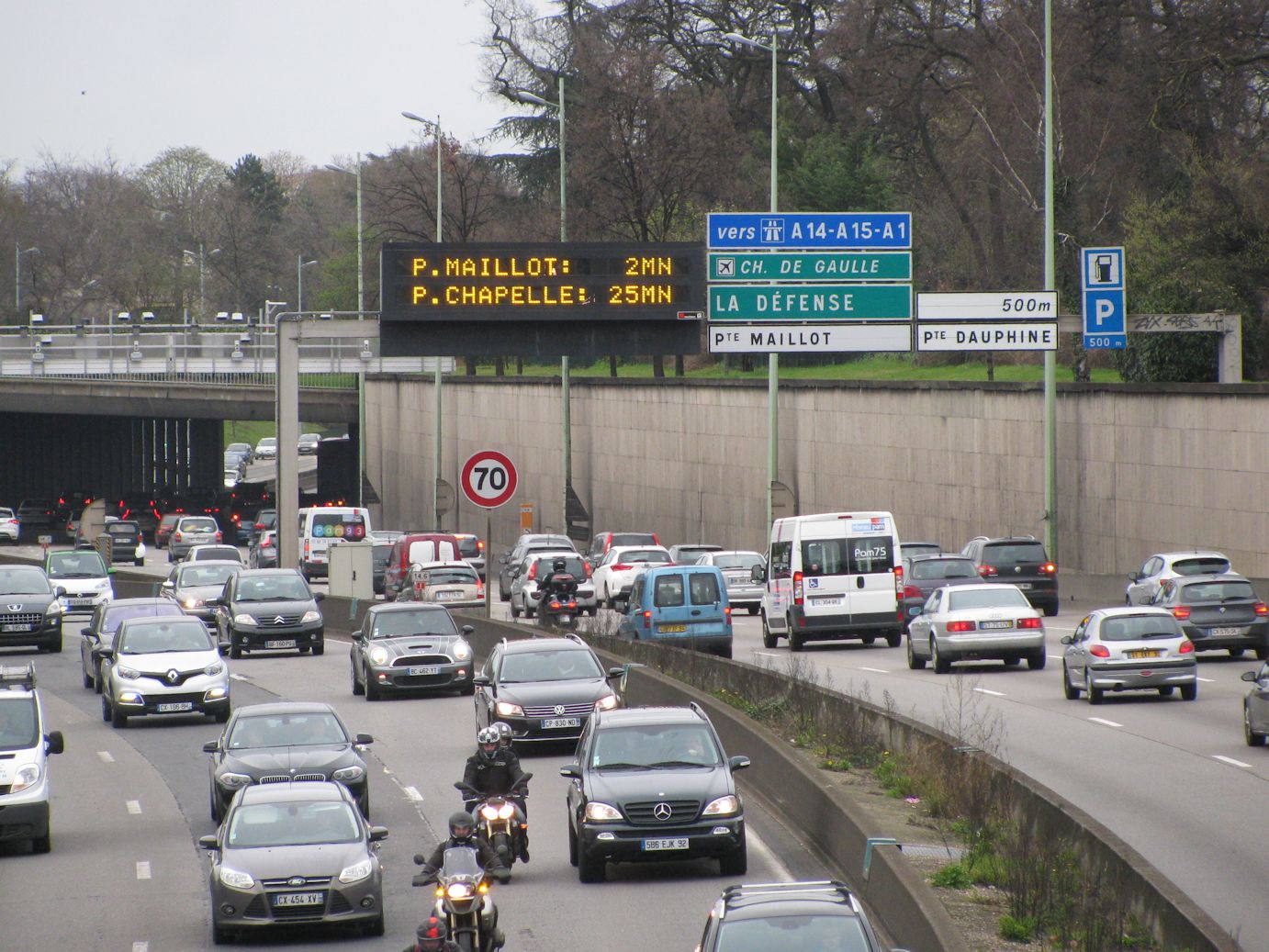
The record breaking jams in Paris this morning were caused by locals avoiding public transport due to the weekend’s terrorist attack says @Autoroutes.

Congestion peaked at 529km at 08:54 in the French capital – more than twice as much as usual – smashing the previous record of 499km.

However, it wasn’t just the French capital experiencing exceptional jams today.

At 527km the Netherlands saw its busiest rush hour of the year, easily beating the previous high of 472km set in February during a snow storm according to @VID.

Meanwhile, at 393km, Belgium saw its fourth busiest morning on the roads of 2015 reports national traffic co-ordinator Hajo Beeckman.

While it would be a perfectly understandable for Parisians to avoid large crowds at the moment, even on buses and trains, there are other factors which may explain today’s congestion.

A combination of bad weather, the first full working day of the week – ‘terrible Tuesday’ – the thick of the autumn/winter work season and recovering economies has seen record jams set in similar circumstances already this year.

Meanwhile, the previous record for Paris rush hour was set just two weeks ago, on 6 November, during a Friday getaway.

Also: yesterday’s relatively short delays during the first working day of enhanced border controls in France came as a relief to hauliers but today’s were considerably worse, see more in the daily blog.

Update Friday 20 November: after an apparent 50% drop in ridership at the weekend, public transport volumes have reportedly been down 10% overall this week. This is not an insignificant fall but it doesn’t imply Parisians have deserted buses and trains en masse. Traffic has certainly been busier in the French capital this week albeit at the top end of the normal range with the exception of today. Meanwhile Thursday evening saw the Netherlands’ busiest rush hour of the year at 581km and the second busiest in Belgium.

.

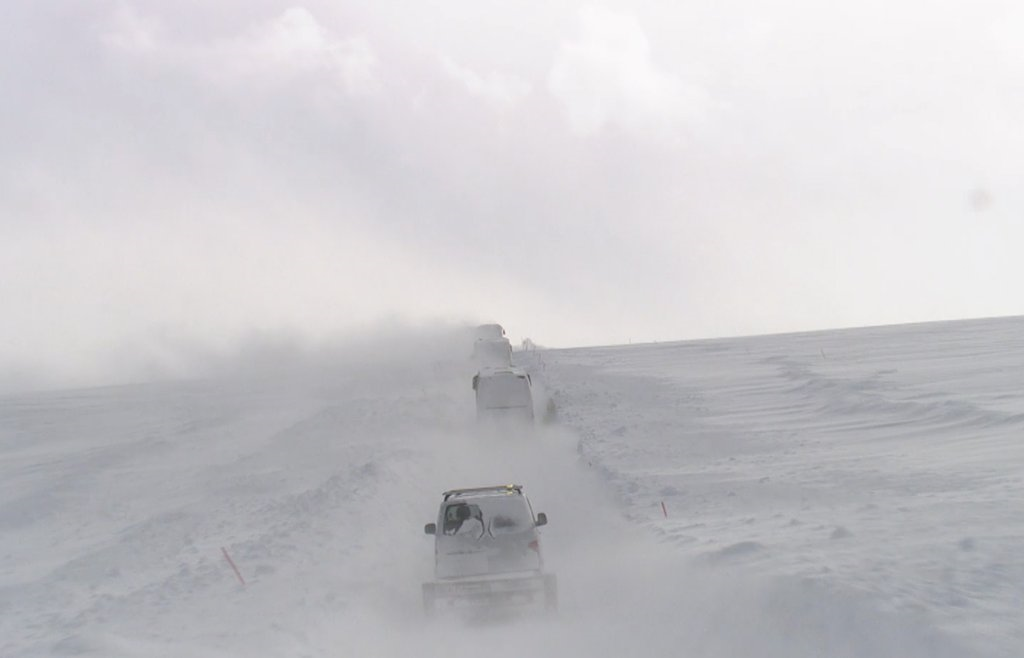
Great film from Medier24 about driving in snow storms in Norway.

Still from an award winning film short by Medier24 on winter driving in northern Norway, including the infamous ‘columns’ through snow storms. Coincidentally, Oslo finally saw its first snow yesterday, albeit briefly. Winter is late everywhere this year – most high mountain roads are still open – but by the end of the week snow should start to fall across the Continent, see more. Photo via @Presserom.

.

roundup: WINTER TYRES. As of 15 November, and up until 15 March, all drivers in Slovenia, of vehicles up to 3.5t, must either have winter tyre – or carry snow chains – in wintry weather conditions reminds @UKinSlovenia. Vehicles 3.5t+ must have winter tyres on the driven axles. Fines range from €125 to €417 for causing an obstruction. See Automobile Association of Slovenia for more. Meanwhile, from 15 November drivers on more roads in Italy are subject to winter tyre (or snow chain) obligations. See the CCISS Transport Ministry site for more. LUXEMBOURG. Two burglars fled a house in north east Luxembourg in a right hand drive UK-registered car reports Wort.lu. The two men were discovered by the property owner inside a farm in Hoscheid-Dickt on the N7 near the German border yesterday. The pair reportedly apologised profusely as they left, surely leaving their nationality in no doubt whatsoever. TRUCKS. So-called Ecocombis – also known as LHVs, Longer Heavier Vehicles – will be allowed to drive between the Netherlands and Belgium from 2017 reports TTM.nl. Limited to 60t and a maximum 25.25m, the extra large trucks are already in use in the Netherlands though only recently started trials in Belgium. ‘It is incomprehensible that Ecocombis are admitted in the territory of neighbouring countries but cannot bridge the few meters across the border. This goes right against the principles of freedom of movement and is incompatible with our European internal market,’ says MEP Philippe De Backer.

.

Arlberg Tunnel Reopens + Now Puymorens Too

Austria’s Alberg Tunnel reopens on schedule for the winter, and now the Pyrenees’ Puymorens too after a mysterious postponing.

Also, an autoroute tribute to the Paris victims. More migrant trouble on Calais port access road. Boy crashes mum’s car at the Nurburgring while she waits in the car park. A new road toll for heavyweight truck goes live in Russia.

.

ARLBERG TUNNEL REOPENS BUT PUYMORENS POSTPONED

Semi-renovated Arlberg reopens on time but Puymorens hit by last-minute glitch.

The S16 Arlberg Tunnel in western Austria - on the A14/S16 between Innsbruck and Bregenz - reopened on schedule on Saturday for the winter. It saves car drivers using the Arlberg Pass, above, and truck drivers the major detour via Munich. Meanwhile, however, the N20 Puymorens Tunnel in the French Pyrenees, on the direct route between Toulouse and Barcelona, skirting eastern Andorra, remains shut. It was expected to reopen this weekend, right up until Thursday. Renovation works are complete, and security checks, but some ‘administrative procedures’ are still outstanding reports La Depeche. The opening date is expected to be announced today. More later. Photo Arlberg Classic

The Arlberg Pass. Photo Arlberg Classic

The S16 Arlberg Tunnel in western Austria reopened for the winter, as expected, on Saturday.

Car drivers are now saved from the 1793m Arlberg Pass, above, which is very scenic on a nice day but not so great at night, or when in a hurry.

Truck drivers benefit in particular having previously had to detour via the fiddly B179 Fernpass, or Munich.

The tunnel, on the A12/S16 between Innsbruck and Bregenz, closed in April for the first half of a full, €160 million renovation.

There are now thermal scanners at each end for trucks, complete with cooling bays for vehicles found to be too hot.

Single-lane Arlberg now also has ‘rumble strips’ between the carriageways to rouse drivers who stray off-line.

The fans have been replaced and the drainage and fire water supply both renewed. A test 400m stretch of LED lighting has also been installed which could be extended to the tunnel’s entire 14km length.

Arlberg will close for another six month renovation in 2017, between mid-April and late September, to finish 37 seven new escape routes and eight more lay-bys, and the construction of a high-pressure spray system.

Meanwhile, however, the N20 Puymorens Tunnel in the French Pyrenees, on the direct route between Toulouse and Barcelona, skirting eastern Andorra, remains shut.

Right up until Thursday it was expected to reopen this weekend after a similarly length renovation this year.

The works are complete but some ‘administrative procedures’ are still outstanding reports La Depeche.

It is not clear if the delay has been caused by the Paris Attacks. Long delays were seen on N20 over the weekend due to new security checks.

A new opening date is expected to be announced today. More later.

Update 18 November 2015: Puymorens fully reopened at 15:00 local time today according to @VinciAutoroutes.

.

sanef

Sanef Autoroutes pays tribute to victims of the Paris Attacks today. Photo Sanef_1077

.

roundup: CALAIS MIGRANTS. Police reinforcements sent in from last Tuesday evening cut down then eliminated the protests by migrants, which had blocked the N216 access road at the port for three nights running. However, truck driver Colin Petts reported the N216 was blocked again overnight Friday/Saturday while P&O tweeted that N216 was blocked again on Sunday afternoon with traffic rerouted through the town centre. However, the latter incident was quickly cleared up. GERMANY. On the final day of the open tourist drive days at the Nurburgring yesterday, a sixteen year old boy crashed his mother’s Chrysler Crossfire halfway into his first lap, while she waited for him in the car park reports Bridge to Gantry.com. The pair had previously been stopped on the A61 autobahn at 215kmh in a 130kmh zone are were facing a €1260 fine and three month driving ban. RUSSIA. Truckers are not happy with the new toll for vehicles more than 12t. The new ‘Platon’ system – derived from the Russian for ‘pay per ton’ – went live yesterday (15 November) with a charge of around €0.02 per kilometre (1.53RUB/km) on 51,000km of federal roads. Angry hauliers set up road blocks in St Petersburg, Novosibirsk and Yekaterinburg last week according to Moscow Times. The new charges can be pre-paid, or logged by On-Board Unit (OBU). Register via the official English-language website at Platon.e100.eu, or see more information at DKV Benelux.

.

Border Blog: Travel Aftermath of Paris Attacks

All France borders are open and all Channel crossings have operated normally, but drivers should expect delays due to extra security checks at all crossings, in both directions (including Dover).

To be on the safe side we do not record border delays (or police controls) in France in real time but do update this blog on a regular basis with the latest developments.

Controls have now been lifted on the A16 Dunkirk-Ostend and A31-A3 Metz-Luxembourg but are still in place on the A14 and A8 into Lille, the France-Spain Mediterranean and Atlantic motorways, and Dover.

The longest delays are on the three motorway connections between Austria and Germany, the A12/A93 Innsbruck-Munich, A10/A8 Salzburg-Munich and A8/A3 to Passau.

Also, controls Sweden and GermanyTurkey-Bulgaria, Romania, Lithuania and now Poland and Norway.

.

Monday 4 January: border delays of up to four hours at the Mont Blanc Tunnel, Frejus Tunnel and the Spain-France Mediterranean AP-7/A9 to Perpignan crossing on Saturday. The Turin Red Cross was called out to drivers waiting at Frejus + Mont Blanc. Today, Denmark announced temporary, random checks at the German border – for at least ten days – in direct response said the Prime Minister to new enhanced checks between Sweden and Denmark.

Tuesday 29 December: strange there would still be regular delays inbound to Lille on the A8 and A14, the A7 to Valenciennes and – in both directions – on the Mediterranean border with Spain A9-AP-7 Perpignan-Barcelona, and none at any other border crossing, but that is how it is playing out.

Wednesday 16 December: shhhh.. whisper it, but it seems the French border controls really are coming down – with the exception of the A14 and A8 into Lille, the France-Spain Mediterranean and Atlantic motorways, and Dover.

Tuesday 15 December: no queues on the A3-A31 Luxembourg-Metz motorway, or on the A16 eastbound from Dunkirk, or A7 towards Valenciennes. However, drivers waited up to 20mins on the A14 and A8 into Lille across the Belgian border while there was a late night 3.5km queue on the Spain>France Mediterranean frontier.

Monday 14 December: as France lifts border controls with Luxembourg, see a roundup of the situation over the past week.

.

Monday 7 December: a relatively quiet weekend save for persistent, substantial queues at the Spanish-French Mediterranean border, on the AP-7/A9 Barcelona-Perpignan, mainly inbound. Same again this morning though much quieter this afternoon. On the roads around Lille and Valenciennes the delays – up to 1h20 for the latter – were inbound too. Meanwhile, the Belgium haulage association FEBETRA says border queues have so far cost its members €3 million.

Monday 7 December: a relatively quiet weekend save for persistent, substantial queues at the Spain-France Mediterranean border, on the AP-7/A9 Barcelona-Perpignan, mainly inbound. Same again this morning though shorter, and quiet this afternoon. On the roads around Lille and Valenciennes the delays – 1h20 for the latter – were inbound too. Meanwhile, Belgium haulage association FEBETRA says border queues have cost its members €3 million. Photo @InfoAutopista

Friday 4 December: on 15 December the European Commission will bring forward proposals on tightening security around the outer border of the passport-free Schengen Zone according to a statement from the French interior minister. This would include travellers to and from the UK.

Thursday 3 December: by now routine delays on the A16 from Dunkirk, around Lille and Valenciennes and Luxembourg, as below. Also, the Swedish government wants to change the law to allow it to shut the Oresund Link between Copenhagen and Malmo in the event of a large influx of migrants though, according to Radio Sweden, a spokesman says, ‘Today there are no plans to use this.’

Wednesday 2 December: another consistent 90min+ delay heading south to Metz from Luxembourg today, “25km of traffic jams” due to border controls, which is a lot “in a country 65km wide” quipped the FT’s Brussels correspondent Duncan Robinson. Queues on the A16 eastbound from Dunkirk built steadily to top out at 45mins but those around Lille and Valenciennes dipped to around 20mins each way. Meanwhile, Norway is having trouble policing its ferry borders with Denmark because the passengers are so drunk says thelocal.no (we can believe that). Also, an EU law professor at Essex University got hold of a leaked Commission plan to suspend the borderless Schengen Zone for two years (to be considered by ministers on Friday says the FT). The only way they could do that is over ‘‘serious deficiencies’ in the border control of a particular Member State’, i.e. Greece (see below).

Tuesday 1 December: as if to remind that police are keeping an eye on borders other than those around Dunkirk, Lille and Luxembourg, delays of up to 1h30 were seen last night on the AP-7/A9 Mediterranean border between Barcelona and Perpignan. Similar to other crossings recently the queue was inbound to France (with the exception of the A16 Dunkirk). Meanwhile, the big news today is that Greece is apparently being threatened with ejection from the borderless Schengen Zone unless it tightens its borders..

Monday 30 November: getting boring now, and not just for the poor people stuck in border jams. Familiar queues today, A16 Dunkirk-Ostend, around Lille and Valenciennes and Luxembourg (see below, et al). The point to make is that the longest delays recently are all inbound, of up to 30mins at any time of day. Meanwhile, for the duration of the COP21 UN climate conference, drivers are warned the most heavily policed borders will be those in closest proximity to Paris, i.e. north and east France.

Sunday 29 November: another if-there-weren’t-any-border-delays-there-wouldn’t-have-been-any-delays-at-all-days (A81 Stuttgart excepted again) in this lull between half-term holidays and Christmas. A16 Dunkirk-Ostend competed with A10 westbound from Salzburg though the former lost spectacularly later on as drivers at the German border waited for up to two hours.. Also, Oxford prof and Guardian columnist Timothy Garton Ash writes that this latter part of 2015 is exactly like 1989 when the walls came down, but in reverse.

Saturday 28 November: apart from a road works closure of the A81 south of Stuttgart there might have been no delays anywhere on the Continent all day except at borders: A16 Dunkirk mercifully a bit quieter but 90min delays inbound A7/A2 to Valenciennes later on. Usual half hour on A31/A3 Luxembourg-Metz. Also typical weekend mega delays Austria>Germany, notably on the recently-quiet A12/A93 Innsbruck-Munich.

Friday 27 November: long queues again on the A16 Dunkirk-Ostend border but with admirable randomness the A2-A7 Valenciennes-Mons saw consistent delays too, especially inbound.

Thursday 26 November: distracted to a certain extent today by the migrant trouble at Calais and, for the first time at Dunkirk too but there was no missing the queue on the A16/E40 at the Belgian border between Dunkirk and Ostend. Eurotunnel noticed it too. This stretch was fairly quiet when border controls started nearly a fortnight ago but has got progressively busier this week with delays of up to two hours. There are still consistent controls on the border roads around Lille and Valenciennes – even on the very minor roads the Belgian press notes today – but at the moment it’s probably a better bet to head east from the Channel on the E42 via Lille and Charleroi than the E40 via Brussels. Meanwhile, European Commission President Jean-Claude Juncker tells the European Parliament that the single currency doesn’t make sense without the borderless Schengen Zone (which he described as ‘partly comatose’) according to Politico.eu.

svinesund

Norway has introduced border controls on all ferry crossings from Sweden, Denmark and Germany, and on some land border crossings from Sweden reports the UK Foreign Office. Photo Svinesund Bridge, E6 Oslo-Gothenburg via @SwedenSE

Wednesday 25 November: entrenched now in an uneasy routine, pretty much like yesterday except really huge delays on Belgian border on the A16 along from Dunkirk. The French interior ministry revealed today that 8,000 Police Nationale and Gendarmerie are deployed at the borders, from a total mobilised force of 120,000 officers. Meanwhile, there was a 9km rush hour queue to the Spanish Mediterranean border at La Jonquera this morning according to one driver but it disappeared shortly after. That highlights a particular hazard: sudden queues of slow moving traffic in border regions. Finally, Deutsche Welle investigates the state of cross-border business and trade on the A8-A3 Germany-Austria border near Passau. Not great.

Tuesday 24 November: drivers heading between the Channel and north or east Europe are bearing the brunt of French border checks. The roads around Lille and Valenciennes and – particularly over the past couple of days – the A16/E40 between Dunkirk and Ostend have seen consistent queues, the latter up to two hours eastbound. At least it seems a bit quieter along the A3/A31 Luxembourg-Metz though half an hour delays are not uncommon. Meanwhile, Norway will introduce border controls at ferry ports from Thursday reports thelocal.no, and Sweden will further tighten its border controls as it seeks to stem the flow of migrants says Copenhagen Post.

Monday 23 November: journalists from La Voix du Nord described checks on the major and minor roads to the Belgian border around Lille and Valenciennes as random today. Delays were noticeably less than previously (typically 15mins throughout the day), as they also were on the A31-A31 Luxembourg-Metz route, maxing out at around 30mins. Busier was the A16 Dunkirk-Ostend crossing point though exacerbated by road works at Ghyvelde and a major accident in the afternoon. More significant was the announcement from Poland that it would reinstate border controls. It’s not clear if this applies to the outer Schengen border or internal borders too. Until it’s clarified, TheNews.pl advises anyone travelling in Poland to take their passports. Meanwhile, in the wake of an attack on the electricity supply to Crimea on Sunday night, Ukraine authorities have suspended freight deliveries to the peninsula though a list of approved goods is being drawn up in consultation with the ‘Crimean Tartar People’ says a statement.

Sunday 22 November: it was a bit quieter today around Lille but typical delays of up to one hour were seen on the A3/A31 between Luxembourg City and Thionville/Metz, and almost as much on the A16/E40 between Calais/Dunkirk and Ostend/Brussels. Meanwhile, Malta’s Prime Minister @JosephMuscat_JM says he has suspended Schengen passport-free rules for the time being. Romania’s new border checks have seen 7km traffic jams and ‘hours’ of delays for travellers heading into Hungary says @Euronews.

Saturday 21 November: unlike the Austria-Germany border where delays tend to be bigger at the weekend – apart from this weekend – France border delays have died down today (though to be fair traffic has too). However, there were still queues around Lille and, as usual, (particularly) with Luxembourg too.

Friday 20 November: controls can appear anywhere but delays are focused still on the French-Belgium border and with Luxembourg. The latter particularly has seen its usual long delays. However the big news today comes after an emergency meeting of European Interior Ministers in Brussels. The EU has agreed to strict new rules on access to the borderless Schengen Zone (reports Deutsche Welle, among many others). Stronger controls will mean ‘systematic and obligatory’ passports checks around the outer border, including with the UK (read this cheat sheet on Schengen from Politico.eu). New proposals are due by the end of the year. In the meantime France will maintain border checks, ‘As long as the terrorist threat lasts’ says @AFP. Meanwhile, Sweden has extended its border controls until (at least) Friday 11 December says @RadioSweden as it calls on neighbouring Denmark to ‘take responsibility’ and impose its own controls – though the ruling party has ruled it out reports The Local Denmark

Back road border control France-Belgium photo via @Gendarmerie

Border control France-Belgium photo via @Gendarmerie

Thursday 19 November: delays might not have particularly improved from earlier in the week but they are at least not appreciably worse, overall. Luxembourg has cemented itself as the French border with the longest queues. It started off quiet again today but delays built relentlessly to two hours by the evening rush and only dipped to half an hour at 21:00. Meanwhile, the borders around Lille are congested as usual, especially since Belgian border town Erquelinnes barred crossing points with concrete blocks to funnel drivers through manned checkpoints. There was more activity around Geneva again this morning but the Spanish border is noticeably quieter. A source from the National Federation of Transporters of Spain (Fenadismer) told Cadena de Suministro, ‘Police perform a ’visualization’ of the vehicle and check the identity of the driver, but it has not become the kind of control that existed prior to Schengen.’

Wednesday 18 November: on Monday, Luxembourg’s Defence Minister advised cross-border commuters to take the train to work this week and that turned out to be good advice. By far the busiest border has been the A3/A31 between Luxembourg City and Thionville/Metz. It was quieter this morning but by the evening drivers were waiting for more than an hour in both directions. Otherwise, outside of rush hours, delays have not topped more than half an hour around the hotspot of Lille. Interestingly, other countries have set up controls too: the German police on the A44 at Aachen at the Belgian border while Dutch military police were out in force on the roads around Arnhem, towards the border with Germany, last night, and Belgian police on the motorways around Antwerp says @Taffilainen. France-Spain was much quieter today, and the main crossings with Geneva, but the A16/E40 to Dunkirk and Calais saw its first controls. Switzerland has ruled out systematic border checks says SwissInfo.ch – 750,000 people and 350,000 vehicles move in and out from neighbouring countries each day… 

Tuesday 17 November: if there was relief yesterday that the border delays were manageable – especially from hauliers – the news today was considerably worse, especially this afternoon. Presumably police are ratcheting up checks while two of the Paris Attacks gunmen remain at large. The border roads around Lille and Valenciennes saw delays of up to an hour but drivers on the A31 and A3 between Thionville and Luxembourg City were stuck for a sustained two hours today, first in one direction and then the other. Luxembourg is a regular stop for trucks due to the cheap fuel. Meanwhile, inbound controls switched back and forth between the Mediterranean and Atlantic sides of the border with Spain with an easy 1h30 queue. Most worrying, three men of ‘Arabian descent’ in a BMW M3 crossed into Spain last night at high speed, direction Barcelona, and evaded police after a 45min chase according to the Olive Press.

Monday 16 November: increased security checks are leading to queues both sides of the border, even in the UK. There was an hour’s delay before check-in at Eurotunnel for trucks, and freight traffic management on the A20 into Dover, by the afternoon. French police are clearly concentrating on the Belgian border around Lille – though the A16 Dunkirk-Ostend was clear all day – the A40/A41 at Geneva and A9 to the Spanish border near Perpignan. Outside of rush hour, where delays reached up to an hour, drivers are rarely waiting more than 20-30mins.

Sunday 15 November: delays at all borders – with Spain, Germany, Switzerland, Italy and particularly Belgium – continued, and are likely to at least until all the attackers are caught. Enhanced checks at Calais today saw some queues onto the A16 motorway. Meanwhile, public institutions in Paris – parks, museums – will open tomorrow, except those normally closed on Mondays.

.

Joint police border controls, France-Spain. Photo @

Joint police border controls, France-Spain. Photo @Policia.

.

Saturday 14 November: Confusion last night as in the immediate wake of the terror attacks in Paris, President Hollande announced France would close its borders.

In practice it means police and security staff stationed at all borders – road, sea, rail and air – even including minor crossings.

So far delays are concentrated on the northern border with Belgium, the eastern with Germany around Strasbourg and Switzerland at Geneva, and southern with Spain at Perpignan. There are also reported queues into Andorra.

The Mont Blanc Tunnel did close last night but has since reopened.

Ferries and trains back to the UK have operated so far without disruption though passengers should leave extra time for security checks. P&O Freight said at 15:00GMT French police in Calais had moved to 100% checks and that drivers should expect delays this afternoon.

Eurotunnel says customers can postpone journeys today, and that late arrivals will be accommodated on the next available service without charge.

Truck driver Colin Petts came through Calais in the early hours and said the port was clear though migrants had apparently put barriers across the road, as on previous occasions this week. Disputed reports saying the Jungle migrant camp was on fire turned out to be correct.

A state of emergency was declared overnight in France meaning many public institutions are closed at least today, most likely longer, with a heavy, armed police presence on the streets and roads, especially around Paris. Public gatherings in the capital region are forbidden until Thursday. Museums and other public cultural institutions in Paris are closed today and tomorrow.

Belgium and Switzerland have both announced extra security measures too.

It is still not clear that all the terrorists are accounted for. The attacks themselves took place in a cluster east of the city centre, and at the Stade de France football stadium in the north, beyond the Peripherique ring road. Reports say at least one of the incidents was a drive-by shooting, from a Belgian registered car.

Apart from the British Embassy in Paris and @FranceInUK, useful contacts include @Paris, @PNationale, @PrefPolice (Paris police) and @Gendarmerie.

Reliable local news sources in English include @France24, @AFP and @TheLocalFrance.

Police Nationale say anyone with information about last night’s attack should phone 197 from France. The official information number for tourists is 00 33 1 45 50 34 60.

.
Madrid Traffic Restricted During Pollution Spike

.

madrid

Madrid’s pollution spike has moved to Phase 2 which means no non-resident parking in the city centre, inside the M-30 ring road. The exception is hospital parking, and zero-emissions vehicles. Speed limits have also been cut to 70kmh on major roads. See more (Spanish only) or this in English from El Pais. The question now is, will the restrictions carry on through the weekend, or even be stepped up? The council says announcements are made at the last minute because ‘they are emergency measures, activated only if air quality worsens’. Update Saturday 14 October: all restrictions completely lifted this morning.

.

Dunkirk Traffic Grows Fourfold in Past Decade

The Dover-Dunkirk route is now firmly established as the UK’s second most popular ferry route, while the ferry industry as a whole shows signs of a determined turnaround.

Also, racers will be well catered for in northern Europe when a new 200mph circuit opens, not that far from Calais. New border controls in Sweden could last for the next six months. Speed limit cuts in Madrid during high pollution with possibly more restrictions to come.

.

DOVER-DUNKIRK IS SECOND MOST POPULAR FERRY ROUTE

Dunkirk traffic quadruples in past decade as ferries overall reverse decline.

dunkirk calais

Ferry travel is on the up again after a decade of decline, and nowhere is it more evident than the DFDS Dunkirk route.

From the UK’s tenth most popular route in 2004, Dover-Dunkirk is now behind only Dover-Calais according to new figures from the Department for Transport.

However, at 2.3 million annual journeys Dunkirk still has some way to go to directly challenge the 10.4 million heading through Calais.

Dover-Dunkirk takes thirty minutes longer than Dover-Calais but drops passengers 36km (22 miles) closer to the Belgian border, or 48km (30 miles) nearer than Eurotunnel.

It’s particularly handy for drivers heading to northern Europe.

The sole Dunkirk operator DFDS also charges the same fares as its sister Dover-Calais route.

The issue at Dunkirk is port capacity. An on-going project to reduce turnaround time aims to boost sailings from their current twelve each day.

Meanwhile, other figures published this week in the DfT’s Sea Passenger Statistics 2014 show ferry travel overall has consolidated last year’s upswing, the first since 1997.

International Short Sea Crossings – ferry journeys between the UK, Ireland and the Continent – increased by 4% last year to 2.3 million. Between 1997 and 2012 the average decline was 5%.

The total number of crossings was 3.9 million in 1950 when records began. It peaked at 36.7 million in 1994 when the Channel Tunnel opened.

Last year the Channel Tunnel had 21 million crossings, up 3% on 2013 but still 309,000 behind the total number of ferry journeys.

The growth in ferries was seen at all ports, particularly from the south coast which was up 5% to 2.9m trips.

This was the second consecutive annual increase after a decade of decline. Brittany Ferries Portsmouth-Caen is the UK’s third most popular ferry route at 1 million crossings behind Holyhead-Dublin at 1.9 million.

Hull and Dover were both up 4%.

France accounts for 75% of all international ferry journeys though there were 15% fewer last year than in 2004. Overall ‘International Short Sea Crossings’ declined by 17% in the same period.

The summer season between July and September is the busiest time of the year. It accounted for a third of all journeys last year, more than twice as many as the quietest period, January to March.

.

Motor Sport Vision, the UK company behind Brands Hatch, Snetterton, Cadwell Park and Oulton Park is expanding onto the Continent with a new circuit at Laon, beside the A26 Calais autoroute in northern France (the mediaeval, walled town coincidentally mentioned in last week’s report on the A2 Paris-Brussels upgrade). The five-mile track with a 200mph main straight, on a disused former military airfield, should open in April 2018. Laon is 160 miles from Calais, 170 miles from Spa-Francorchamps and 270 miles from the Nurburgring. See more.

Motor Sport Vision, the UK company behind Brands Hatch, Snetterton, Cadwell Park and Oulton Park is expanding onto the Continent with a new circuit at Laon, beside the A26 Calais autoroute in northern France (the mediaeval, walled town coincidentally mentioned in last week’s report on the A2 Paris-Brussels upgrade). The five-mile track with a 200mph main straight, on a disused former military airfield, should open in April 2018. Laon, already a popular destination with British car enthusiasts thanks to the annual Circuit Historique de Laon classic car rally, is 160 miles from Calais (and 170 miles from Spa-Francorchamps and 270 miles from the Nurburgring). See more.

.

roundup: SWEDEN follows Germany in reinstating border controls, as the number of migrants entering the country in the past ten weeks equals those seen in the whole of 2014 reports Sweden Radio. From noon today, anyone entering the country from the south or south west will need a valid ID or passport, especially across the Oresund Link, or on ferries from Denmark or Germany. The controls will last at least for the next ten days but are likely to be renewed at twenty day intervals, possibly for the next six months. Denmark says it has no plans to reintroduce its own border controls yet but will watch the Sweden situation ‘closely’. SPAIN. Long delays this morning reports El Pais as a pollution spike saw the city council cut the speed limit to 70kmh on the M-30 ring and other major roads. Eleven of the city’s 24 monitoring stations saw raised levels for nitrogen dioxide. If the pollution persists, non-residents will be banned from parking in the city centre. The Spanish capital confirmed last week a new regime for pollution episodes introduced in March: the ultimate steps are alternate traffic in the city centre then all measures expanded to include the entire capital region. EV (and Ferrari)driver @Purpperil wondered on twitter yesterday if the speed limit cut should also apply to zero emission cars…

.

A Quieter Night on Calais Access Road

Police reinforcements meant a quieter night on the Calais port access road as Eurotunnel goes three weeks without migrant trouble.

Also, Ford GT photographed in the City of Light, at night. It’s official: UK now has the EU’s most expensive fuel. A8 Nice junction reopens after peage crash. The price of the Bulgarian road vignette rises for the first time since 2008.

.

QUIETER NIGHT ON CALAIS ACCESS ROAD

Police reinforcements quell third successive overnight clash with migrants.

calais

Photo: The European Union.

For the third day in succession, migrants from the nearby ‘Jungle’ camp blocked the N216 access road at Calais port overnight.

However, the disturbance was considerably less than on previous occasions thanks to police reinforcements. The road was fully open again in the early hours. Yesterday (Tuesday), N216 was shut until late morning.

Activists from the No Borders Network have been accused of stoking discontent as increased security makes it increasingly difficult for the migrants to reach the UK.

A spokesman for the French interior ministry told Journal du Dimanche, ‘These activists taking advantage of the confusion and distress of migrants, and push them to do anything, to riot, violence against the police and trying at all costs to stop trucks on the ring road in order to go to England.’

A blog post by No Borders campaign‘Calais Migrant Solidarity’ yesterday described ‘A night of collective punishment by police!’

In all twenty seven police have been injured in the clashes, sixteen of them on Monday. Trucks have also come under attack while local residents have had items stolen in order to build road blocks according to France 24.

This is all despite the number of migrants at the jungle reportedly falling from 6000 to 4500 in recent weeks as increasing numbers accept a relocation offer from the French government.

Meanwhile, Eurotunnel has gone almost three weeks without any migrant disturbances. The last incursion at the Channel Tunnel operator’s French terminal was on Thursday 22 October.

Also, the day after a Radio 4 File on 4 programme called ‘An Inside Job’, on Britons convicted of smuggling illegal immigrants into the UK, ‘French support floods in for Brit who tried to smuggle four year old girl out of Calais’ according to The Local France. Around 60,000 people have signed a petition in support of the father of four from Leeds who faces five years in jail.

.

Fantastic photos of upcoming Ford GT in Paris. More later.

Fantastic photos of upcoming, Le Mans-bound Ford GT in Paris. Not sure if CGI or real but see more.

.

roundup: FUEL. The UK has the most expensive petrol and diesel in the EU according to the RAC Foundation. Diesel has been at or around the most expensive for some time but this is believed to be the first time petrol has topped the charts at the same time too. The UK narrowly beats the Netherlands on unleaded95 – £1.08/l v £1.07 – but is considerably ahead of next placed Italy on diesel, £1.10/l v £0.96. France meanwhile is currently at £0.90 petrol and £0.78 diesel say the RAC figures meaning considerable cross-Channel savings. FRANCE. The on-ramp to the A8 at Saint Isidore near Nice, closed after an out of control car transporter ploughed into the toll booths late last month, has finally reopened reports Vinci Autoroutes. A motorbike rider was killed in the incident. The truck driver, from Romania, who apparently claims his brakes failed, an explanation doubted by some, appeared before a judge at the weekend and has been remanded back in to custody says Nice Matin. BULGARIA. The price of the motorway and national road vignette sticker increases from the start of next year for the first time since 2008. One week for a passenger car rises from 10BGN to 15BGN (£5.40) and one month to 30BGN (£8.40). The annual sticker sees a much bigger leap, from 67BGN to 97BGN (£35) reports Novinite.

.

The Great Road Safety Lie About Driverless Cars

Analysis driverless cars: Europeans to be infantilised because the rest of the world cannot drive.

Also, a quick look at the new rule on tinted windows in France, some bittersweet news on road safety, and another clash between migrants and police at Calais; tragic runaway truck crash in Luxembourg.

.

THE GREAT ROAD SAFETY LIE ABOUT DRIVERLESS CARS

Why introduce autonomous cars in Europe if the objective is to save 1.2 million lives?

Autonomous driving

We are constantly told driverless cars will save the 1.2 million lives lost in traffic accidents around the world each year.

Few have put it quite so forcefully as Mat Honan, Buzzfeed’s San Francisco bureau chief.

‘Go fuck a tailpipe if you love cars so much,’ he wrote after riding in one of Google’s autonomous cars last month. ‘Your love for cars doesn’t supersede the lives of 1.2 million people who die in automobile accidents every year.’

Apart from being unbearably self-righteous, this is possibly the most specious argument ever deployed.

If un-crashable self-driving cars were introduced to the UK¹ tomorrow they would save 0.136% of the global death toll.

If they were introduced in the whole of the EU tomorrow they would save just over 2%.

Admittedly the US would be more fertile ground. Quite how one of the world’s most advanced, developed and richest countries comes to have such a lamentable road safety record is a subject for another day.

Meanwhile, according to the World Health Organisation’s Global Status Report on Road Safety 2015, it is less safe to drive in America than Poland².

The latter has of course long been known as the European bad boy on road safety.

The state of safe driving in America however pales beside the situation in other parts of the world.

If driverless advocates and investors really were serious about saving lives they would be laying cables in South Africa, for instance, where 132,000 people die on the roads each year, or India (238,000) or China (275,000).

The fact that they aren’t, and instead target the paltry 5% of worldwide road deaths in the developed, western world shows that it isn’t about road safety at all.

The move towards driverless cars is purely and simply about technology in search of a home, peddled by some extremely passive-aggressive salespeople.

.

¹ For context, around 1700 people die on the UK’s roads each year compared to 6000 fatal accidents in the home according to the Royal Society for the Prevention of Accidents. Around 27,000 people are killed on the roads in the EU each year. ² According to WHO figures, there are 10.3 road deaths per 100,000 of population in Poland compared to 10.6 in the United States. The UK is 2.9.

.

Tinted glass is outlawed in France from 1 January 2016, but for the front windows only reports Prevention Routiere. The fine

To be clear: tinted glass is outlawed in France from 1 January 2016, but for the front windows only. The fine is €135 says Prevention Routiere. Photo Paris 2015, @DriveEurope.

.

roundup: CALAIS MIGRANTS clashed with police overnight for the second day running. Trouble centered on the N216 access road into the port, right beside ‘the Jungle’ camp. The road was blocked until late morning, and J47 off the A16 autoroute, with all vehicles diverted through the town. Unlike yesterday, there are no reports of any injuries – so far – though France 3 Nord published a photo of a truck with its windscreen smashed in. LUXEMBOURG. Tragic accident on the eastbound A6 at Strassen last night when a truck driver was thrown from the vehicle during a crash. He died instantly according to Wort.lu while his Spanish registered truck continued down the carriageway for a further kilometre before coming to a halt. There were no other vehicles involved or any other injuries. FRANCE. Road deaths increased by a significant 7.2% last month compared to October 2014 though the figures include the 43 fatalities in the Puisseguin coach crash late last month. Without those, road deaths would have fallen by 5.2%. The overall increase in road deaths in 2015 stands at 2% according to the release from Securite Routiere, slightly up on September which had seen the first significant cut in fatalities in a so far torrid year.

.

Unmarked Speed Camera Cars Privatised in France

Previously-extremely-effective unmarked speed camera cars will be outsourcing to the private sector in France.

Also, after a relatively long break, more migrant trouble in Calais. Super-bad news on the Evoque Convertible. Warning about flashing other drivers in France. Traffic fatalities rising among foreign drivers in Iceland as traffic jumps on famous R1 ring road.

.

UNMARKED SPEED CAMERA CARS PRIVATISED IN FRANCE

Government outsources very effective unmarked speed camera cars.

france spped limit 2

Col du Saint Petit Saint Bernard, 2188m (7178ft), Italy>France. Photo @DriveEurope

Former President, now Presidential hopeful, Nicolas Sarkozy was not quite on the money last week when he called for traffic police duties on autoroutes to be outsourced to the road operators.

But it does turn out the current French government has been thinking along similar lines.

Recently installed road safety boss Emmanuel Barbe does think there is a role for private companies in speed enforcement in France, though their role will not be limited to motorways.

In a statement released by Securite Routiere on Friday, Barbe said the aim was, ‘To increase, as soon as possible, the use of embedded radars in unmarked vehicles, entrusting their implementation to approved providers under strict control of the state.’ 

This would theoretically cover 260 out of the current total of 4124 radar devices in France.

Barbe says unmarked camera cars do not require the skills of the two policemen it takes to operate them – one to drive and the other to set the camera to the relevant speed limit.

As such it does not appear the new cars will be used to stop speeding drivers, merely to pass evidence onto the authorities.

The move will therefore not affect drivers from the UK, Ireland and Denmark until new EU cross-border information sharing rules on traffic offences are adopted in these countries.

Drivers of locally registered vehicles, such as hire cars, and drivers from other EU countries, should be aware however.

As has been noted on many previous occasions, these unmarked radar cars have proven highly effective in reducing road deaths in France.

In the months following their original introduction in March 2013, fatalities fell by up to 30%.

However, the effect quickly wore off as drivers apparently realised there were relatively few on the road.

March 2014 saw a correspondingly large increase in the number of road deaths and is at least partly responsible for the recently yo-yoing road safety statistics, called a crisis by some.

Interestingly, this new role for private companies was identified in the now landmark ‘Inter-ministerial Meeting on Road Safety’ held in September, for the first time in four years, and chaired by Prime Minister Manuel Valls.

It was Valls who introduced the unmarked cars during his stint as Interior Minister. Fortuitously he made the jump to Prime Minster literally a few days before the first statistics showed their effect had disastrously worn off.

Sarkozy also made his name, and as Interior Minister, by introducing the first radar trap in France, on the RN20 at La Ville du Bois, south of Paris, in 2003.

Update: Ecology minister Segolene Royal attacked Sarkozy’s intervention in an interview on Sunday, saying delegating speed controls to the motorway operators ‘is not feasible in the context of a Republican state’. However, that still leaves Securite Routiere some wiggle room according to @Autoroutes, as long the authority is given to ‘private providers’ or Gendarmerie reserves.

Update 7 April 2016: it was confirmed today that the privatised camera cars will go into service in January 2017. According to Le Parisien 83 percent of drivers are against the idea while 75 percent think it is just revenue raising – however Emanuel Barbe says the operators will not have quotas, or be paid per speeding ticket reports The Connexion. Budgets apparently only allow the current crop of 320 camera cars to operate for one hour each day, though they nabbed 1.5 million drivers last year.

.

First sight Range Rover Evoque Convertible: it weighs a very substantial 270kg more than the hard top. More later.

First sight Range Rover Evoque Convertible: it weighs a very substantial 270kg more than the hard top version. The new two litre Ingenium diesel engine is already down by 10bhp compared to the current motor resulting in a 0-60 time for the Convertible version of around ten seconds. There is a 240bhp petrol engine available but at our 30,000+ miles per year it is not feasible. This is all most likely a deal breaker for us. Shame.

.

roundup: MIGRANT CRISIS. Sixteen police were injured when a group of up to 200 stone-throwing migrants blocked the N216 road into Calais port late last night, the first disruption in two weeks. Order was eventually restored at 01:00 after 30 teargas canisters were deployed according to local reports. Mayor Natacha Bouchart endorsed a call to deploy the army having made the same request late last month. Eurostar later reported delays due to ‘people near the tracks in Calais’. Meanwhile, a truck driver will not face any charges after 27 migrants escaped from the vehicle as it arrived at a pharmaceutical company in northern Kent on 12 October reports Kent Online. Drivers (and their employers) can be liable for a fine up of up to £2000 per migrant. No further details currently available. FRANCE. Drivers who flash other drivers to warn about police ahead could be inadvertently helping criminals – and even child abductors – to escape warns the Gendarmerie (via The Connexion). ICELAND. Fatal accidents among foreign tourists are on the rise reports Iceland Review, and mainly on the roads. Of the seven overseas visitors who have died so far this year – already more than twice as many as last year – five were killed in traffic accidents. Drivers catching wheels on the side of the road in icy conditions was previously noted as a major cause of foreign driver accidents. At the same time, traffic has seen a surprise jump on the island’s famous R1 ring road, up 12.5% last month (and 36% in Eat Iceland) and 5.4% this year so far overall says Iceland Magazine. The coastal R1, 832 miles long in total, which celebrated its fortieth birthday last year, is one of Iceland’s biggest draws. See this from The Guardian.

.