€100m Rehab for Interesting Paris-Brussels N2

Comprehensive upgrade for the historic back road between Paris and Brussels – including new truck park, bypasses and widening works – plus news on the Ecotaxe truck toll replacement.

Also, stunning poppy livery for this weekend’s Race of Remembrance. Greece spreads the road tax burden as petrol remains stubbornly expensive. Speed limits and lights for the A16 Calais. Sicily fixed link still on the cards.

.

€100m REHAB FOR INTERESTING PARIS-BRUSSELS N2

Uprated road through medieval Laon and Little Switzerland.

.

The French government has announced a €100m renovation and upgrade for the Paris-Brussels Route Nationale 2.

Formerly the ‘Route des Flandres’, N2 heads north east from Paris via Soissons and the mediaeval walled town of Laons, beside the A26 Calais autoroute, before heading up to the Belgian border near Mons through the Avesnois Regional Park, called ‘Little Switzerland of the North’ (see map for details).

In Napoleon’s time, and known then as Route Imperiale 2, it ran all the way to Amsterdam via Brussels.

Transport minister Alain Vidalies visited the northern stretch of RN2 today, in the Thierache region up around the border, to announce the new money.

However, apart from completing the bypasses around border towns Maubeuge and Avesnes-sur-Helpe, and a new truck park at La Capelle, the bulk of works – aside from resurfacing – is focused on the busiest stretch, south of Laons.

The remaining single lane sections between Laon and Paris will be widened to two lanes with new bypasses at Gondreville, Vaumoise and Péroy-les-Gombries.

The entire project is scheduled for completion by 2020.

Vidalies also announced a further €100m for rehabilitation of 150 national roads and waterways around the country, all to be completed this year.

This is in addition to the €3.3bn ‘Highway Stimulus Plan’ finalised last month in which the autoroute operators finance expansion of the motorway network at twenty sites in exchange for an average 2.5 year extension to their concession contracts. This new work is expected to create 10,000 new jobs.

Vidalies also said the replacement for the failed Ecotaxe truck road toll will be announced in June 2016 after consultation with the road transport industry reports RTL France.

.

An inspired poppy livery on the Mission Motorsport Mazda MX-5 entry at this weekend’s 1000km Race of Remembrance at Anglesey circuit. Very happy to support the team via My Donate.

An inspired poppy livery on the Mission Motorsport Mazda MX-5 entry at this weekend’s 1000km Race of Remembrance at Anglesey circuit. Very happy to support the team via My Donate.

.

roundup: GREECE. Interesting insight into how PM Alexis Tsipras’ burden-sharing policies work on the ground: 100,000 previously-exempt drivers of 1.4-1.6 litre cars will now be subject to road tax as it is cut for medium-sized and older vehicles reports Ekathimerini. Meanwhile, petrol continues to be expensive compared to the rest of Europe: €1.398/l for unleaded95 puts it in tenth place according to Fuel Prices Europe though diesel at €1.098 is 25th. FRANCE. The stretch of A16 between Calais and Eurotunnel will be limited to 90kmh permanently following the deaths of four migrants in recent months reports La Voix du Nord. There are also plans to switch the lampposts back on at a cost of €2m, to be met by central government. The lights were turned off several years ago during cutbacks and will require an overhaul before being put back into service. ITALY. The long-proposed Messina Bridge, from the mainland to Sicily, will be built insists PM Matteo Renzi today adding, however, ‘The problem is when’. The other issue is whether it will be for vehicles says ANSA.it after a junior coalition partner got a parliamentary motion in October on a study for a rail-only crossing. Renzi says the government is investing €2bn in Sicilian roads and rail in the next five years only after which it will address the bridge question.

.
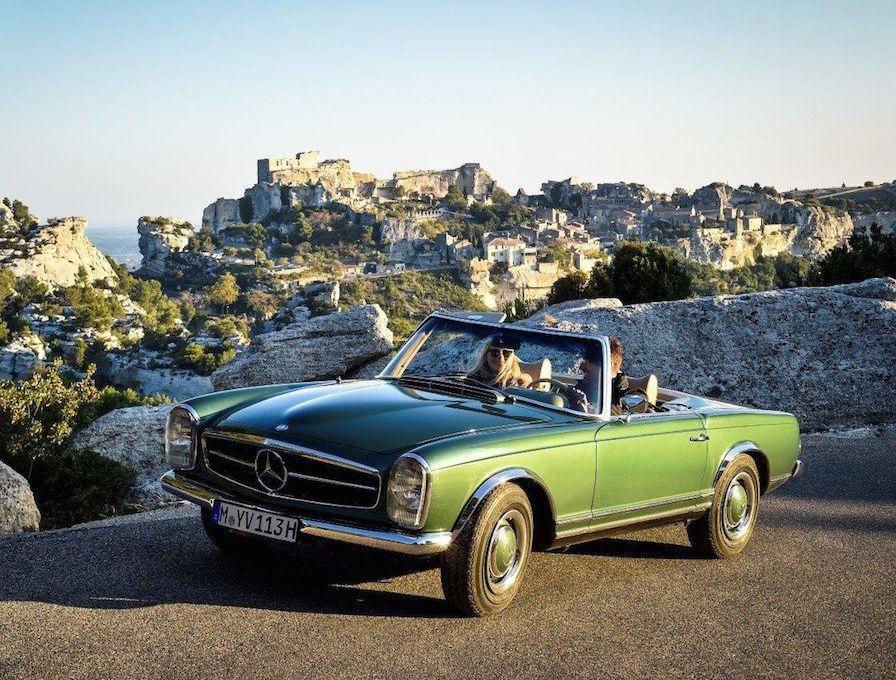
On Tour With Mercedes-Benz Classic

A new partnership between Mercedes-Benz and a German classic car hire firm launches SL tours of the South of France and Tuscany.

Also, a Throw Back Thursday look at a Norwegian fjord road. Today’s headlines: raising speed limits in the Netherlands, and Switzerland; France fatigue test under development; scary new statistics on distraction accidents and applications open for €7.6bn of EU transport funds.

.

ON TOUR WITH MERCEDES-BENZ CLASSICS

New driving trips through the South of France or Tuscany in a classic Mercedes-Benz SL.

mc merc

Mercedes-Benz SL W113 Pagoda.

Business Innovation – Daimler’s in-house laboratory for new business ideas – reckons customers are more interested in using and enjoying luxury goods than they are in actually owning them.

To this end it has teamed up with Nostalgic Classic Car Travel in Munich to offer tours through France and Italy in two SL models, the original 1960s W113 ‘Pagoda’, above, and the more modern R107 ‘Bobby Ewing’ car.

The routes, through Provence and the Cote d’Azur and Tuscany – with another in South Tyrol in the works – give customers, it says, ‘the chance to experience the unique character, charm and power of a Mercedes-Benz old-timer without the high cost of acquisition or maintenance, combined with a chance to experience the most beautiful routes in Europe.’

The Provence tour, over four days next April, September or October takes in perfume capital Grasse, the Gorges du Verdon, the Lac de Sainte Croix, Van Gogh’s Saint-Remy and Avignon with one night at the Hotel InterContinental Carlton in Cannes and the other two at Relais & Chateaux properties.

The Tuscany tour, also four days, in May or September, includes Florence, Siena, Chianti, the ‘Crete Senesi’ cratered clay hills, Montepulciano and San Gimignano, all from a base at the Hotel Borgo Scopeto outside Siena.

Each tour costs €1975 per person based on two sharing and includes B&B hotel accommodation, fuel, one lunch, one dinner and airport transfers but not flights.

Aside from the SL trips, Nostalgic hosts tours in Germany, Italy and France with a range of classic convertibles from Alfa Romeo, and VW Beetles.

Click for more information on Mercedes Classics, or Nostalgic.

.

Throw Back Thursday: R45 Eidsborgvegen at Dalen, on the west end of Lake Bandak in south central Norway in the late 1930s. Photo @Elusive_Moose

Throw Back Thursday: R45 Eidsborgvegen at Dalen, on the west end of Lake Bandak in south central Norway in the late 1930s. Photo via @Elusive_Moose

.

Today’s headlines: more sections of motorway in the Netherlands will have speed limits raised to 130kmh reports DutchNews.nl, taking the total to 61% of the network with a target of 71%. Some locals object to the higher speeds on grounds of noise and pollution. Road sections which switch between 120kmh and 130kmh have long been a source of controversy; TranMin Melanie Schultz promises ‘clarity soon on speed limits’. Also, popular initiative group in Switzerland has almost enough support to hold a national referendum on raising the speed limit from 120kmh to 140kmh on motorways reports Le News.ch. Groupe pour une Suisse sans Armee (Group for a Switzerland without an army) has until 20 November to collect the final 9,000 signatures it needs to pass the required 100,000 mark. A similar vote failed in 1989 but GSsA has a powerful supporter in national motoring club TCS. Scientists in France are developing a saliva test for fatigue, the leading cause of death on autoroutes. Drivers would test themselves before getting in the car. Sponsored by operator Vinci, the first definitive results are expected by the end of the year. Meanwhile, distraction and inattention contributes to between 10-30% of road user accidents in the EU says a new report published by the European Commission. It says voice recognition, biometry, head up displays, artificial intelligence, and vehicle automation will all help according to ITS group Ertico, as will standardised HMI (Human Machine Interface) design. Meanwhile, a call for proposals under the European Commission’s Connecting Europe Facility was announced today. The fund amounts to €30bn in total with €24bn earmarked for transport. This second round disperses €7.56bn, the lion’s share of which (€6.47bn) is directed to countries already receiving Cohesion funds – in Eastern Europe, the Balkans plus Portugal – where the priorities will be projects along the EU’s core network corridors. The remaining €1.09bn is open to all countries and will focus on hi-tec schemes like Intelligent Transport Services. The deadline for applications is 19 January with awards scheduled for next September.

.

Austria Denounces Secret EU Road Toll Report

A ‘secret’ report says the European Commission will abolish windscreen sticker road tolls in favour of pay-as-you-go charges, much to the annoyance of Austrian motoring club OAMTC. 

Also, Timmelsjoch and Grossglockner to stay open a bit longer this year. And, today’s headlines: major Brussels tunnel reopens after overnight emergency repairs. UK government still looking at long-term Operation Stack solution. New temporary bypass at Lake Chambon on Grenoble-Briancon road but detour still best for visitors.

.

AUSTRIA DENOUNCES ‘SECRET’ EU ROAD TOLL REPORT

EU wants to abolish vignette tolls in favour of pay-as-you-go charges.

Austria vignettes. Photo @DriveEurope

Austria vignettes. Photo @DriveEurope

Austrian motoring club OAMTC has denounced an apparently ‘secret’ EU report on abolishing vignette road tolls in favour of a pay-as-you-go charging scheme.

For many years Austria has charged drivers to use the country’s fast roads via a windscreen sticker ‘vignette’ system.

A recent survey showed 61% were satisfied with the system and only 12% opposed.

Bernhard Wiesinger, Director of ÖAMTC advocacy says, ‘Firstly, the EU has no competence at all to regulate the charging of cars and secondly, the discussion around the topic of road pricing on the part of the Commission is being pursued with specious arguments that do not stand up to scrutiny.’

The OAMTC says pay-as-you-go tolls consume up to 20% of total revenue compared to just 7% for vignettes.

And, that per kilometre charges priced in cents mean increases are easier for politicians to sneak through compared to ‘transparent’ vignette charges.

Pay-as-you-go charges also unfairly impact drivers in rural areas, and those who depend on cars for work it says.

The EU’s Transport Commissioner Violeta Bulc said in January the Commission was examining the idea of a pan-Europe road charging scheme, likely distance-based, and expected to make an announcement in eighteen months.

We have attempted to contact the Commission for a comment today, so far without success.

.

Timmelsjoch. More later.

It normally closes in mid-October but thanks to the ‘incredibly resistant November weather’, the cross-border Austria-Italy mountain road Timmelsjoch, above, stays open this year until Monday 9 November. Similarly, ‘consistently good autumn weather’ means Austria’s Grossglockner is open until Monday too, though that is just one week later than normal. However, Sölkpass closed on schedule on 14 October, followed by Maltatal and Nockalmstrasse on 27 October. Stallersattel closed yesterday. Click the blue links for more information, or see PassFinder. Photo Crosspoint Tirol.

.

Today’s headlines: Brussels’ Rogier Tunnel, on the R20 Little Ring around the city centre, in the north, has reopened after a large block of concrete fell on a car last night. ‘Drivers can rest assured: the Rogier Tunnel is safe!’ says FlandersNews.be. ‘The Government is considering cost of Operation Stack solution after talking to Kent MPs’ reports Kent Online after the matter came up in today’s Prime Minister’s Questions. The BBC’s Louise Stewart reckons something might come up in the Chancellor’s Autumn Statement, due on Wednesday 25 November. ‘Tunnel Chambon: where are we six months after it closed?’ asks 20 Minutes France about the still closed D1091 Grenoble-Briancon road. The answer is not much further. A narrow bypass road has been built from scratch but is not recommended for visitors. The laborious bypass is still the best bet though discount tickets for the Frejus Tunnel are available from local tourist offices for holidaymakers forced to go out of their way.

.

Predicting Pollution Proves Problematic in Paris

The Paris Mayor wins the battle over ‘Alternate Traffic’ during pollution peaks. This most restrictive traffic measure will now be introduced if the city and the region agree. But forecasting pollution is proving to be a problem.

Also, strict new traffic restrictions during Madrid pollution spikes and, a quick look at Killary Harbour on Ireland’s Wild Atlantic Way.

.

ALTERNATE TRAFFIC NOW ON DEMAND IN PARIS

Process simplified but pollution forecasts demonstrably inaccurate.

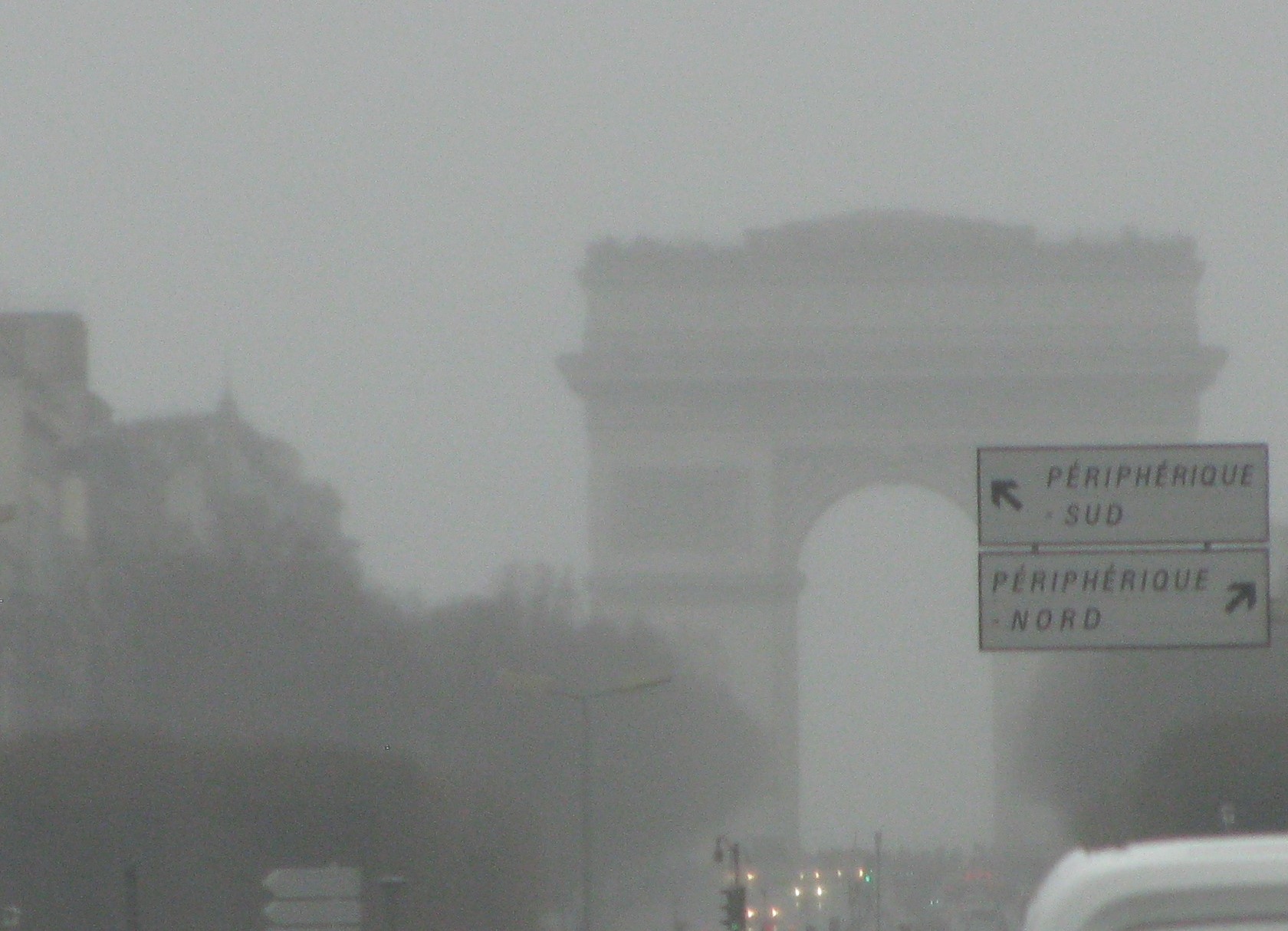
Paris fog, not smog. Photo @DriveEurope

Paris fog, not smog. Photo @DriveEurope

The pollution peak in Paris over the weekend reignited the row over when to introduce the most restrictive traffic measures.

It seems Paris Mayor Anne Hidalgo has prevailed. Ecology minister Segolene Royal finally agreed yesterday (Monday) to simplify the introduction of so-called ‘alternate traffic’ whereby only vehicles with odd then even number plates are allowed in the city on successive days.

‘If city hall and the region together ask for alternate traffic, it will be granted as I promised,’ said Royal on twitter.

Hidalgo actually wanted alternate traffic to be triggered automatically when pollution is forecast to rise above a certain level but she did acknowledge the minister was ‘going in the right direction’.

Be that as it may, forecasting pollution levels accurately is not an exact science as this latest episode demonstrates.

When monitoring organisation Airparif first raised the alarm late on Saturday morning (31 October) it said pollution stood at 79/100 having forecast 67/100 the day before.

Levels were expected to rise to 87/100 on Sunday but ultimately came in at 82/100.

On Monday, Airparif had anticipated 79/100 but it turned out to be 67/100. Only today (Tuesday) did the prediction turn out to be on the mark: 39/100 v 40/100.

It is also worth emphasising that this latest pollution episode occurred at the weekend when traffic is a third of typical weekday levels.

Alternate traffic has been used twice so far during Hidalgo’s time as mayor, in March 2014 and March 2015 (out of a total of three times in the past seventeen years). Both times it was called off after a day when pollution dipped unexpectedly. The measure has not previously applied to foreign registered vehicles.

Also, Madrid: with parking charges depending on CO2 emissions, and new no-car zones, we had thought of the Spanish capital as a poster boy for environmental measures but, according to Feargus O’Sullivan from CityLab today, Madrid is still regularly capped with ‘a dingy dome of dirty air’ in winter called La Boina (the beret) by locals. Strict new rules will attempt to tackle the problem, including an automatic speed limit cut if pollution exceeds a certain level for two hours. If the problem persists this would be followed by non-resident drivers being banned from parking in the city centre, then alternate traffic and finally, in the worst cases, the restrictions will be extended to the entire city.

.

Ireland’s Wild Atlantic Way: the glacial fjord at Killary Harbour is located at the heart of Connemara's famous rugged and dramatic landscape. More at WildAtlanticWay.com

A scene from Ireland’s north-south, tip to toe Wild Atlantic Way: ‘The glacial fjord at Killary Harbour is located at the heart of Connemara’s famous rugged and dramatic landscape.’

.

Financial Fog Clearing on Spanish Motorways

Still huge debts for taxpayers on failing toll motorways but, with traffic now increasing, the worst has passed.

Also, winter tyre rules kick in in Austria, and Italy.

.

The M-12 autopista, Madrid-Barajas airport. Photo OHL

The M-12 autopista, Madrid-Barajas airport. Photo OHL

Better news finally on Spanish toll roads which should go some way to overcoming the country’s reputation as the European poster boy of expensive and underused white elephant infrastructure.

Operator Albertis last week reported an overall 5.9% increase in traffic between January and September this year. After six successive quarters of growth, traffic has reached its highest level for fifteen years.

However some problems do remain, mostly around Madrid, where – ironically – the roads have suffered gridlock twice so far this month.

The M-12 between the city centre and Barajas airport is now in liquidation reports El Pais. It joins AP-36 between La Roda and Ocana south west of Madrid in formal proceedings.

Meanwhile, the capital’s R-3 and R-5 ring roads are both renegotiating with creditors and R-2 and R-4 are reportedly at risk of bankruptcy, as is the Madrid-Toledo AP-41.

The only struggling road not in or around the capital is the section of AP-7 ‘Autopista del Mediterráneo’ between Cartagena and Vera near Murcia in the south west.

The problem has been that many of Spain’s new motorways run parallel to existing roads. It means drivers have easy, free alternatives, much like the struggling M6 Toll Road in the UK.

Attempts have been made to stimulate traffic this year, principally by offering hauliers a fifty percent discount on highway tolls.

The roads were all built using loans guaranteed by the government which could put taxpayers on the hook for €4.5bn.

While still a large amount of money at least there is clarity now about the scale of potential losses. Three years ago it seemed the entire tolled network was in danger of collapse.

Need to know: Spain has two types of motorway, Autovias and Autopistas. Only Autopistas – roads with AP in the name, like AP-2 Zaragoza-Barcelona – are charged, but even then not always. Autovias – using just A in the name, like A66 Seville-Salamanca – are always free. See more on Spanish toll roads.

.

As of yesterday (1 November), until 15 April, cars in Austria must be fitted with ‘winter tyres’ – marked at least M+S – during wintry conditions, i.e. with snow or slush on the road. Vehicles heavier than 3.5t must have winter tyres fitted to at least one drive axle whatever the conditions – with a minimum of 5mm tread depth - and carry snow chains for at least two driving wheels. A spot check by police on the A4 Vienna autobahn today found 80% compliance. More roads in Italy also require winter tyres or chains from 1 November. See more on Winter Tyre Rules. Photo: testing the original Audi Quattro on Turracherhohe, Austria, 1978, Audi AG.

As of yesterday (1 November), until 15 April, cars in Austria must be fitted with ‘winter tyres’ – marked at least M+S – during wintry conditions, i.e. with snow or slush on the road. Vehicles heavier than 3.5t must have winter tyres fitted to at least one drive axle whatever the conditions – with a minimum of 5mm tread depth – and carry snow chains for at least two driving wheels. A spot check by police on the A4 Vienna autobahn today found 80% compliance. More roads in Italy also require winter tyres or chains from 1 November. See more on Winter Tyre Rules. Photo: testing the original Audi Quattro on Turracherhohe, Austria, 1978, Audi AG.

.

Spectre: Moves Game On, Not Up

Spectre is a good film, if not great. But, despite some interesting plot developments, is director Sam Mendes really the right man for the job?

.

1

Industrial moaning about the latest James Bond film is almost as big a business as the franchise itself.

There is plenty in Spectre for the hard core fan to take umbrage at but the overriding feeling at the end is relief.

Some of his spark may be missing but James Bond will live to fight another day.

The big question is does director Sam Mendes, he of the Oscar-winning American Beauty, really have a taste for the audacious Britishness, epic cinematography, and futuristic, far-flung glamour of a James Bond film?

On this second showing, the answer is undoubtedly no.

The opening-sequence helicopter acrobatics above Mexico City, and even a train streaking across the Tunisian desert at sunset, both fall flat for lack of contrast.

And you have to wonder at the wisdom of filming the Rome car chase at night.

Meanwhile, in what should be the prime Bond territory of the Austrian Alps, there is zero sense that the dizzying Otztal Glacier Road is among Europe’s highest mountain passes.

All that said, Soelden’s Ice Q restaurant, perched on a mountain top, looks even better than it does in the brochure.

As in Skyfall, the biggest victim in Spectre is M. Much reduced, thanks to a plan to subsume the British Secret Service into an ‘unelected’ international organisation of ‘member states’ – EU anybody?? – the film comes dangerously close to Keystone Cops territory as he, Q and Moneypenny bumble around towards the end.

At least, under Mendes’ direction, the clunky references to previous Bond films are now gone. Even the reappearance of that bloody Aston Martin DB5 is kept to the absolute minimum.

In general it is much more subtle now. The scriptwriters have obviously read all the books though the prime inspiration is clearly John Pearson’s 1973 ‘Authorised Biography of 007’.

It helps Spectre tie a lot of loose ends together, including a particular end even avid fans will have been unaware needed tying.

Ultimately Spectre is eminently watchable though it merely moves the game on, rather than up.

.

Runaway Transporter Devastates A8 Nice Peage

Suspected brake failure sees car transporter crash head on into autoroute peage in France. Questions arise about the wisdom of toll booths at the bottom of steep descents.

Also, a National Lorry Week look at the racy MAN TGX.

.

MAJOR PEAGE ACCIDENT A8 NICE

Brake failure sees car transporter plough into toll booths.

Less than a week after the tragic coach crash in Bordeaux in which 43 people died, France has been hit by another major accident.

Fortunately on this occasion the consequences were less severe.

One person, a motorbike rider, died and eight were wounded, three seriously, after a car transporter ploughed into the Saint Isidore peage on the A8 westbound near Nice late yesterday afternoon.

Twitter user @HabsyP witnessed the aftermath while driving in the opposite direction.

The truck, Romanian registered says Nice Matin, suffered brake failure on the downhill approach to the toll booths according to Alpes-Maritimes police.

Local councillor Patrick Allemand said on twitter, referring to the crash, ’The choice to build a motorway peage at the bottom of a steep descent is crass stupidity.’

Truck driver @Taffilainen notes a similar set up on the A10 at Irun on the Spanish border near Bordeaux.

However, a truck driver familiar with the road – where there is a 50kmh limit for heavy vehicles – doubts the brake failure theory. @PatSmithF1 tells us, ‘There are at least three escape ramps coming down the hill, my guess is too fast for too long and he got brake fade at the bottom.’

Fifteen vehicles were involved, all of which remain on site for the initial investigation.

The peage itself is closed until further notice says Vinci Autoroutes, including the J52 slip road at Saint Isidore in the direction of Aix-en-Provence.

After long delays this morning traffic now back to free-flowing.

.

A quick National Lorry Week look at the MAN TGX. More later.

Wot no Scania on this National Lorry Week run through the major brands of current long haul trucks? No, because the current offering from the cult Swedish maker is now a bit long in the tooth (despite having the latest generation of clean engines). Instead, a look at the long-haul TGX from Scania’s sister brand MAN – both now owned by Volkswagen – specifically the 560bhp D38 ‘100 Years’ special edition which made a star turn at this year’s Worthersee tuner festival in Austria. Such an appearance is entirely appropriate since MAN dominates the FIA European Truck Racing Championship. Three of the five teams, and seven of the twelve drivers, run the Munich-built trucks. Photo MAN Trucks.

.

France Cancels Truck Vignette Now Too

France is having no luck with truck tolls. The latest plan for a €500 annual charge goes the same way as its unfortunate Ecotaxe predecessor.

Also, a quick National Lorry Week look at the most powerful truck on the market, the 750bhp Volvo FH16 750. And, a second licence issued for a 60 tonne ‘Ecocombi’  in Belgium.

.

FRANCE CANCELS TRUCK VIGNETTE NOW TOO

€500 annual truck toll goes same way as Ecotaxe; diesel tax likely instead.

France has been desperately trying to replace to revenue from the failed Ecotaxe truck toll system.

France has been desperately trying to replace to expected revenue from the failed Ecotaxe truck toll system. The search goes on.

France has cancelled plans for a truck vignette it was announced today.

The toll sticker was expected to cost €500 each year and apply to all roads in the country as the government looked to replace the revenue lost from the failed Ecotaxe truck toll system.

The new charge was expected to raise €95m each year from foreign hauliers.

However, the government was persuaded the vignette would increase traffic as operators made the most of their investment Transport minister Alain Vidalies told the congress of the Organisation des Transporteurs Routiers Européens (ORTE) in Bordeaux today reports FranceRoutes.fr.

ORTE, which had backed the vignette idea as ‘simple and equitable’, and sat on the government Committee where the idea was developed, described Vidalie’s announcement, via video, as ‘inglorious’.

Neither will France join the Eurovignette system for trucks as the directive prevents double tolling. Most motorways are already charged on a pay-as-you-go basis.

It seems a 4c tax surcharge will be added to the price of diesel instead. However, this would raise only around €25m.

Rumours of the vignette first surfaced in August in a report in Le Figaro. An announcement was expected within days, shortly after a government reshuffle, but neither materialised.

.

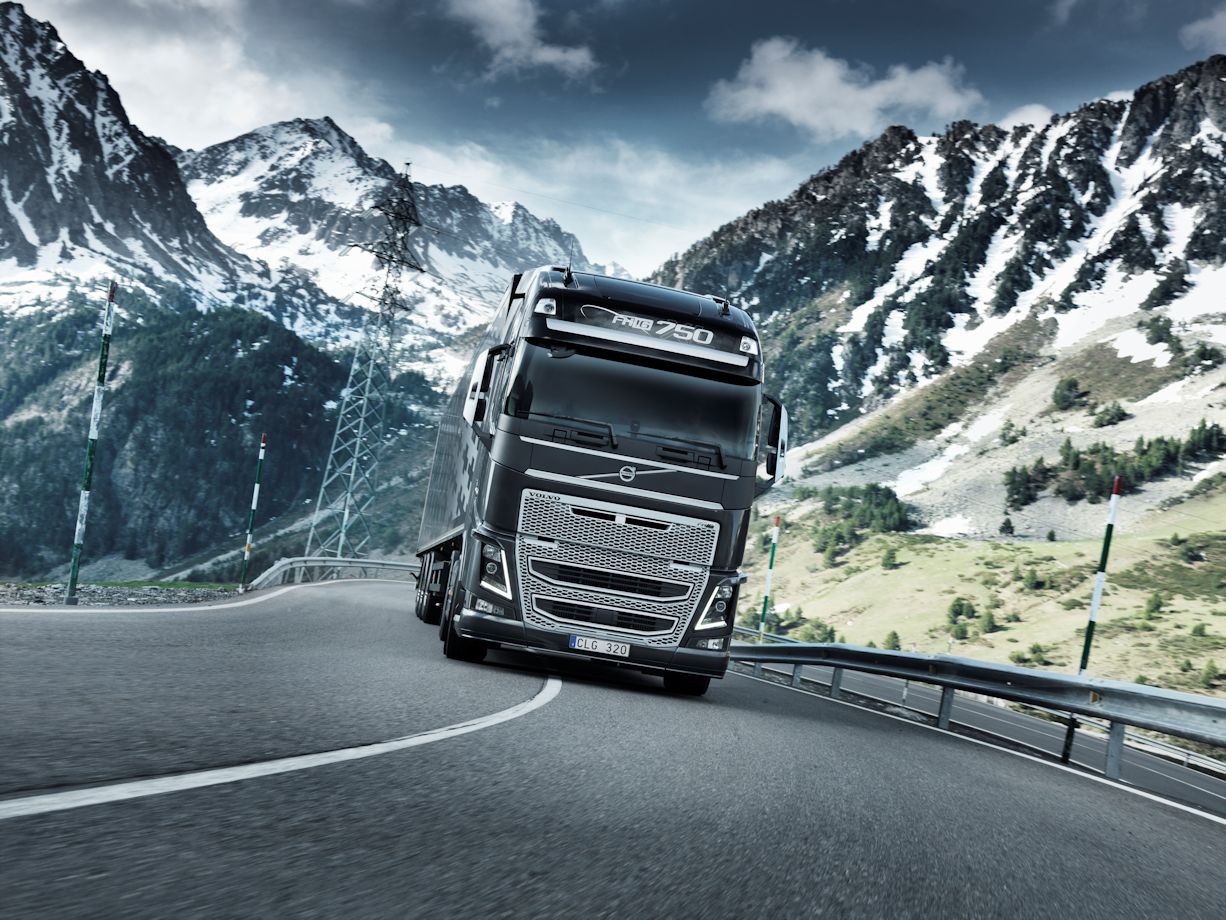
The most powerful truck currently on sale, Volvo's FH16 750. More later

Volvo Trucks might be the master of viral internet marketing – it’s Epic Spilt video with Jean Claude Van Damme has been watched an epic 85 million times – but arguably more impressive is the sheer grunt of its FH16 750: not just the headline 750bhp – which makes it the most powerful truck on the market – but also an eye watering 3550Nm (2618lb ft) of torque from its 16 litre straight six engine. But why have that much power when trucks are limited to 100kmh? The answer is the same as for high powered cars: the quicker the vehicle achieves its legal terminal speed the faster it gets to its ultimate destination. On the super long distance transcontinental trips these beasts are used for – up to one million kilometers in five years – that adds up to a considerable advantage. Photo Volvo Trucks.

.

roundup: BELGIUM. A second Belgian haulier has been licenced to operate a so-called Ecocombi says roads authority Agentschap Wegen & Verkeer (AWV). Gilbert De Clercq International Transport and Logistics will run the 25.25m, 60t trailer combination on a defined route around the Port of Antwerp until June 2016 on a trial to assess, primarily, road safety. If all goes well the trial could be extended for a further two years. Two Ecocombis, also called Longer and Heavier Vehicles (LHV), can carry the same load as three standard articulated trucks, saving kilometres travelled and emissions though their use is controversial. Ninatrans of Leuven was awarded the first LHV licence earlier this year.

.

Swiss Govt Pushing For Second Gotthard Tunnel

As expected, the Swiss government will press ahead with plans to build a second Gotthard Tunnel. Established anti campaigners have been quick off the mark but the general public seems, so far, to be in favour.

Also, a quick National Lorry Week look at the DAF XF, the UK’s favourite.

.

SWISS GOVT PUSHES SECOND GOTTHARD TUNNEL

Highly controversial move subject to referendum next year but two tunnels will not mean twice the traffic.

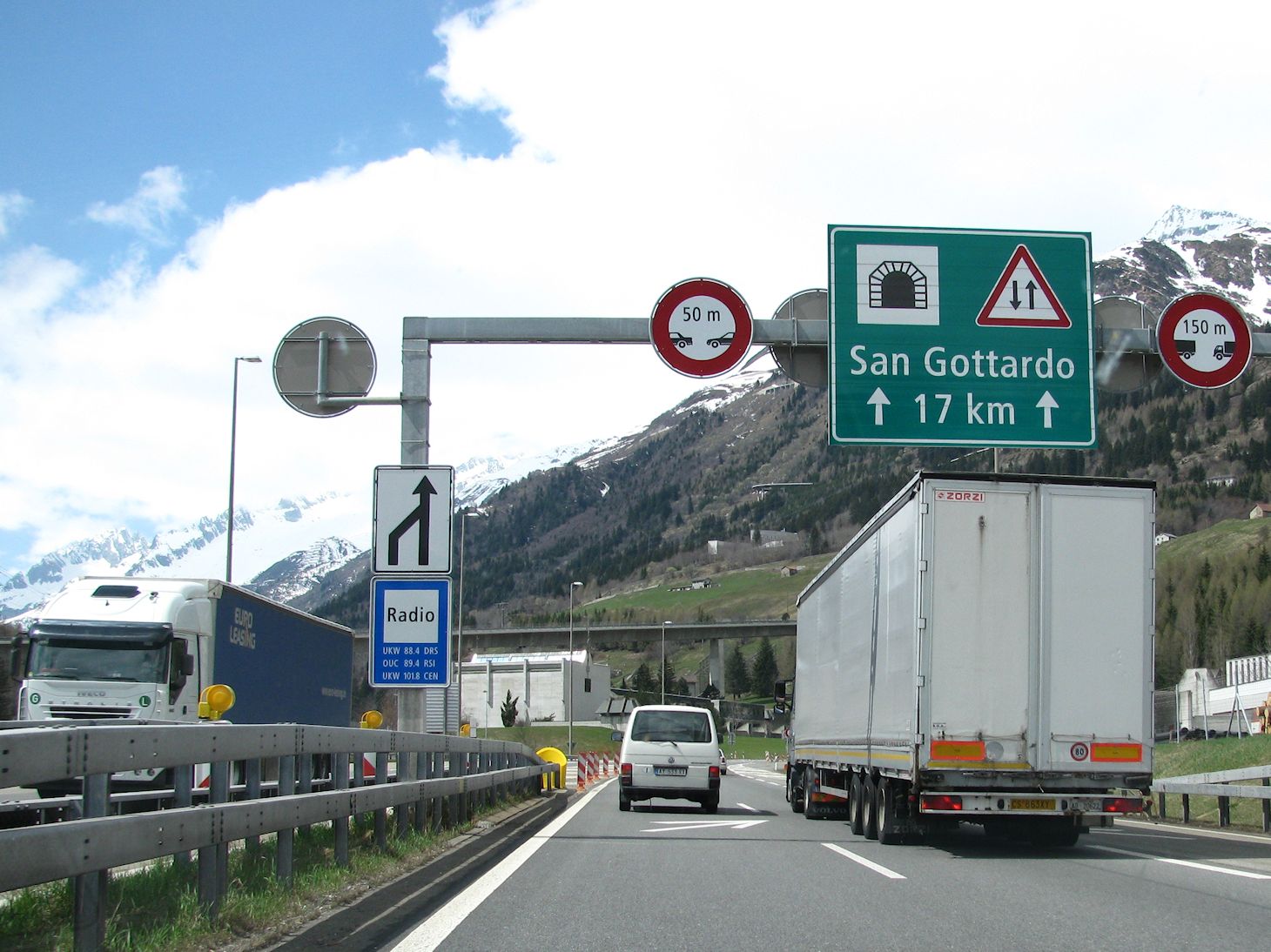
Northbound into the Gotthard Tunnel. Photo @DriveEurope.

Northbound into the Gotthard Tunnel. Photo @DriveEurope.

The Swiss government has launched the campaign to build a highly controversial second tube for the Gotthard Tunnel.

A likely hotly-contested referendum on the issue will be held on Sunday 28 February 2016.

Built in 1980, the 10.8 mile Gotthard Tunnel, the world’s third longest road tunnel on one of the main trans-Alp routes to Italy, is in need of a complete overhaul.

Transport minister Doris Leuthard told a press conference in Bern yesterday (Tuesday), ‘Building a second tunnel guarantees a lasting solution for the population and the economy.’

Almost three billion Swiss francs has been budgeted for the work. If passed, it will begin in 2020 and last up to ten years.

The second tunnel will initially be used to relieve the first during refurbishment.

Subsequently, each tube will carry traffic in one direction on one lane only with a permanent hard shoulder for emergencies.

That only one lane is open in each direction is enshrined in the Swiss Constitution following a previous referendum in 2004. The number of trucks is also limited.

The government also examined a temporary vehicle shuttle train to be used during renovation of the existing tunnel. It would cost around €1.5bn but would have to be dismantled and reassembled during every subsequent renovation whereas the second tube is a permanent solution says Leuthard.

She also said the government remained committed to moving freight from road to rail. Capacity steps up next year when the Gotthard Base Tunnel opens and, again, further south in 2020 with the Ceneri Base Tunnel between Bellinzona and Lugano.

The government originally decided to pursue the second tunnel option last September after which the necessary 100,000 signatures were collected to force a national referendum.

One of many opposition groups, Alpine Initiative, says a second tube would be ‘devastating’ for the Alps and would lead to a doubling of transalpine lorries to two million each year.

A poll for Swiss paper 20 Minutes currently has readers 75:25 in favour of the second tube.

.

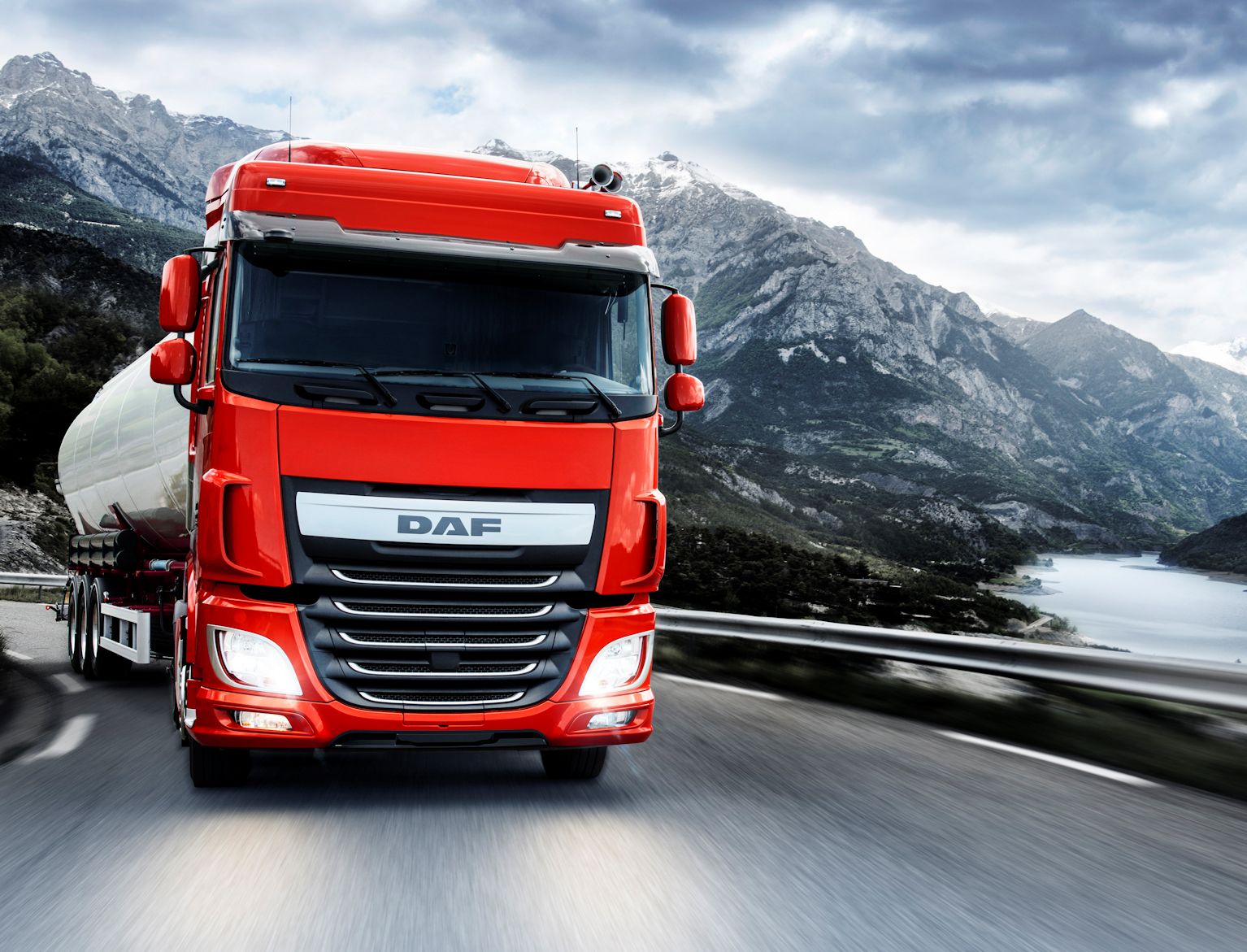
Daily DAF. More later.

No-one drives quite like the Dutch. Logistics is almost the national industry. Despite the lack of an indigenous car maker, it’s appropriate then that there is a domestic truck manufacturer, DAF (albeit owned by American PACCAR). Headquartered in Eindhoven it also has factories in Westerlo, Belgium, and Leyland, Lancashire. The latter builds all the right hand drive versions of its heavy hitting XF long haul truck which is powered by an inline six cylinder turbo diesel with up to 510bhp, mated to a 12 speed AS Tronic automatic gearbox. Last year, DAF took a 13.8% share of the market for heavy trucks, (16 tonnes and over), in Europe. Unsurprisingly it was the market leader in the Netherlands but also Hungary, and the UK too. Photo DAF Trucks.

.

New Calais-Spain ‘Lorry Train’

A new rail terminal for unaccompanied trailers has been inaugurated at Calais Port. It is expected to take 40,000 trucks off the road each year between northern France and Spain, though a huge upswing in business across the Channel means there should still be plenty of work to go round.

Also, a National Lorry Week look at the Mercedes-Benz Actros. Still some ifs and buts over the abolition of mobile phone roaming charges.

.

NEW CALAIS-SPAIN ‘LORRY TRAIN’

Six days per week, 22 hour crossing from next January.

New 'lorry rail' terminal at Calais with side-load bays. Photo VIIA

New ‘lorry rail’ terminal at Calais with side-load bays. Photo VIIA

A new ‘Lorry Rail’ service at Calais Port will take 40,000 trucks of the road each year from when it opens next January.

The journey to Le Boulou on the Spanish Mediterranean frontier will take 22 hours. Two round trips will run each day, six days per week.

Speaking at the inauguration of the new terminal last Friday, Jean-Marc Puissesseau, the CEO of the Port of Boulogne Calais, said, ‘We are proud to be the first European port to possess a terminal of this type. This investment brings the port new prospects for development, and anticipates the growth expected for the port thanks to Calais Port 2015.’

Operated by VIIA, a subsidiary of SNCF Logistics, the new terminal uses new side-loading wagons which allows trailers to be towed directly onto the train as opposed to lifted on by crane as currently.

The new facility cost €7m, funded by the Port of Calais-Boulogne and the EU through the ‘BRIDGE’ project (Building the Resilience of International and Dependent Gateways in Europe).

Freight traffic is expected to grow by 40% by 2030 on the Dover-Calais sea route.

The Calais-Le Boulou route joins the existing Luxembourg-Le Boulou and Chambery-Turin lines.

Operations start on 12 January 2016 with bookings allowed up to one hour before departure. No prices have been announced but VIIA says pre-sales tickets are now available.

For more information see Calais Port and VIIA.com.

Update 28 October: despite having cancelled the similar Calais-Bordeaux rail motorway project in April over costs, French transport minister Alain Vidalies said today he was working with his Spanish counterpart on a rolling motorway along the ‘Atlantic Corridor’ according to a statement. This diagonal road, rail and waterway route links the Iberian Peninsula with France and Germany and is one of the EU’s TEN-T (Trans-European Network) priorities. They will invite expressions of interest next year. The French terminus is likely to be Le Havre.

.

Mercedes-Benz Actros, Belgian Grand Prix 2013. More later.

F1 boss Bernie Ecclestone loves the Mercedes-Benz Actros. He must do, he has at least twenty of them to ship the Formula One circus around the Continent, all painted a bespoke FOM (Formula One Management) grey, and all with sequential personal number plates. Interestingly, for such a top of the range kind of guy, the F1 Actros are all the third tier StreamSpace version (though since this picture was taken at the 2013 Belgian Grand Prix it’s entirely possible he has upgraded twice since then). Aside from the ultra-heavy haulage SLT, the daddy Actros has the GigaSpace cab with a ‘three room apartment’ inside, with room to work, relax and sleep. Thanks to modular construction there are a bewildering number of Actros available – check out the configurator – all available with the top 15.6 litre, straight six diesel engine which pumps out a healthy 625bhp. Photo @DriveEurope.

.

roundup: MOBILE PHONES. Roaming charges will be abolished by June 2017 following a vote in the European Parliament today. However, there will still be a ‘fair use’ limit after which a ‘small basic fee’ can be charged. The European Commission will define the limit. Also, if abolishing roaming undermines an operator’s national business they may still be able to apply a roaming surcharge with the agreement of regulators. Meanwhile, from April next year roaming charges will be cut to around 25% of the current cap according to a statement. Operators will only be able to charge an extra €0.05/min for calls, €0.02 per text and €0.05/MB of data.

.